
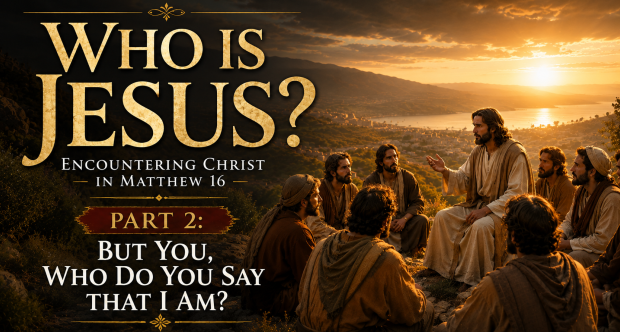
Who Is Jesus – Who Do You Say That I Am?
Please click the PLAY button below to listen to audio
When Inherited Faith Becomes Encounter
“But you, who do you say that I am?” — Matthew 16:15
There comes a moment when the crowd can no longer answer for us.
Jesus had asked His disciples:
“Who do people say that the Son of Man is?”
And they had answers.
John the Baptist.
Elijah.
Jeremiah.
One of the prophets.
They could report what they had heard.
They could repeat what other people believed.
They could discuss public opinion.
They could talk about Jesus without revealing anything about themselves.
And then Jesus changed the question.
“But you, who do you say that I am?”
Suddenly there was nowhere to hide.
Jesus had moved from information to encounter.
From them to you.
From what have you heard? to what do you believe?
From public opinion to personal conviction.
And perhaps every Christian eventually has to stand at that same Caesarea Philippi.
Because sooner or later, the faith we have inherited must become the faith we ourselves embrace.
There Comes a Time When “They Say” Is Not Enough
Many of us first heard about Jesus from somebody else.
For some, it was our parents.
For others, grandparents.
A catechist.
A priest.
A religious sister.
A teacher.
A friend.
Perhaps we were baptized as babies.
Perhaps our parents brought us to Mass.
We learned the Sign of the Cross before we fully understood what the Cross meant.
We learned:
“Our Father, who art in heaven…”
We learned:
“Hail Mary, full of grace…”
We learned to genuflect.
We learned when to stand, when to sit and when to kneel.
We made First Holy Communion.
We were confirmed.
We learned the Creed.
We were taught that Jesus Christ is the Son of God.
And all of this is precious.
This is one of the great gifts of Catholicism: faith is handed on.
Generation tells generation.
Parents teach children.
The Church guards what she has received from the Apostles and hands it faithfully to those who come after.
We do not have to reinvent Christianity in every generation.
But there is a danger.
We can inherit the language of faith without ever personally surrendering to the One about whom that language speaks.
We can know the prayers without knowing the One to whom we pray.
We can know the Mass responses without encountering the One made present upon the altar.
We can know the commandments without knowing the Lawgiver.
We can know Catholic teaching without knowing Christ.
We can know about Jesus without knowing Jesus.
And so eventually Jesus asks:
“But you…”
Not your mother.
Not your father.
Not your grandmother.
Not your priest.
Not your catechist.
Not your parish.
Not even simply, “What does the Catholic Church teach about Me?”
He asks:
“Who do YOU say that I am?”
When Catholicism Becomes Something We “Do”
This question may be particularly important for those of us who have been Catholic for a long time.
Because familiarity can be both gift and danger.
There is something extraordinarily beautiful about a faith that becomes woven into the rhythm of life.
Sunday Mass.
Ash Wednesday.
Stations of the Cross.
Holy Week.
Good Friday.
Easter.
Corpus Christi.
The Rosary.
May devotions.
Adoration.
Christmas Mass.
Funerals.
Baptisms.
Weddings.
Feast days.
In Trinidad and Tobago, Catholicism has also become woven into parts of our national history and culture. Many of us grew up around Catholic schools, parishes, feast-day traditions, religious processions and familiar Catholic expressions.
But anything familiar can eventually become automatic.
We can go to Mass because:
“That is what I do on Sunday.”
We can receive Communion because everyone else in the pew is moving forward.
We can say the Creed because we have memorized it.
We can say “Thanks be to God” without thinking about what we have just heard.
We can make the Sign of the Cross almost mechanically.
We can kneel before the Blessed Sacrament while our hearts remain somewhere else.
We can even serve in ministry—
sing,
read,
teach,
play music,
serve at the altar,
lead prayer,
preach,
organize parish activities—
and still avoid the question:
Who is Jesus Christ to me?
That is a frightening possibility.
Because religious activity and relationship with Jesus are not automatically the same thing.
Peter Had History With Jesus
Peter’s answer does not emerge in a vacuum.
By Matthew 16, Peter has travelled with Jesus.
He has heard Him teach.
He has watched Him heal.
He has seen demons submit to Him.
He has seen crowds gather around Him.
He has watched impossible things happen.
And Peter has had one particularly unforgettable encounter.
A storm.
A boat.
A dark sea.
And a figure walking across the water.
The disciples are terrified.
Jesus tells them:
“Take courage, it is I; do not be afraid.”
Peter responds:
“Lord, if it is you, command me to come to you on the water.”
Jesus says one word:
“Come.”
Peter gets out.
And for a moment, Peter does the impossible.
He walks upon the water toward Jesus.
Then he notices the wind.
Fear takes over.
He begins to sink.
And Peter cries:
“Lord, save me!”
Immediately, Jesus reaches out His hand and catches him.
Think about that.
When Peter later says,
“You are the Christ, the Son of the living God,”
this is the man speaking.
The man who knows what it feels like to sink.
The man who knows what it feels like to cry for Jesus.
The man who knows what it feels like when the hand of Christ reaches down and catches him.
Peter is not merely reciting something from a catechism.
Peter has history with Jesus.
And So Do Many of Us
Perhaps that is where this Gospel becomes intensely personal.
If you have walked with Christ for any length of time, perhaps you have history with Him too.
There may have been moments when you did not know how you were going to get through something.
But somehow you did.
There may have been a death you thought would destroy you.
A diagnosis.
A financial crisis.
A broken relationship.
A child in trouble.
A betrayal.
A period of loneliness.
A terrible mistake.
A season when prayer seemed empty.
A moment when everything you thought was secure suddenly disappeared beneath your feet.
And perhaps, like Peter, all you could say was:
“Lord, save me.”
And somehow—
perhaps dramatically,
perhaps quietly,
perhaps through another person,
perhaps through the Church,
perhaps through Scripture,
perhaps in Confession,
perhaps before the Blessed Sacrament,
perhaps through receiving the Eucharist,
perhaps simply through strength that you knew was not your own—
a hand held you.
Maybe you cannot explain it.
But you know.
You were sinking.
And you were not abandoned.
That becomes part of your answer to Jesus’ question.
Encounter Does Not Always Look Dramatic
Sometimes when Catholics hear the phrase “personal encounter with Jesus,” we imagine that something spectacular has to happen.
A vision.
A voice.
A miraculous healing.
An overwhelming emotional experience.
A dramatic conversion.
Those things can happen.
But encounter is not measured by emotional intensity.
Some of the deepest encounters with Christ happen very quietly.
Sitting alone before the tabernacle.
Hearing one line of Scripture that suddenly seems to have been written directly for you.
Entering Confession burdened with shame and hearing:
“I absolve you from your sins.”
Receiving Holy Communion at a moment when you desperately need strength.
Discovering Christ beside you in suffering.
Recognizing Him in someone poor or forgotten.
Experiencing the inexplicable grace to forgive somebody you thought you could never forgive.
Finding yourself able to pray after months of spiritual dryness.
Sometimes encounter is not:
“I felt something extraordinary.”
Sometimes encounter is simply:
“I know He was there.”
The Eucharist Makes This Question Almost Overwhelming
For the Catholic, there is an extraordinary dimension to Jesus’ question.
“Who do you say that I am?”
Because every time we approach Holy Communion, we are answering it.
The minister raises the consecrated Host and says:
“The Body of Christ.”
And we answer:
“Amen.”
That Amen is enormous.
It means:
Yes.
I believe.
This is truly You.
Not a symbol merely pointing toward You.
Not simply bread reminding me of You.
You.
The One born of Mary.
The One who healed the sick.
The One who walked upon the sea.
The One who asked Peter this question.
The One who hung upon the Cross.
The One who rose from the dead.
The One seated at the right hand of the Father.
You are here.
And I am about to receive You.
What would happen if we truly understood the answer we give every time we say:
“Amen”?
Perhaps we would never approach Holy Communion casually again.
But Encounter Cannot Remain an Experience
There is another danger.
We can become fascinated with spiritual experiences.
We can continually seek another retreat.
Another conference.
Another powerful prayer meeting.
Another emotional worship experience.
Another moment that gives us spiritual goosebumps.
But Jesus did not call Peter merely to experience Him.
He called Peter to follow Him.
Encounter must eventually become discipleship.
If I encounter Jesus but refuse to change, what exactly have I encountered?
Zacchaeus encounters Jesus and his relationship with money changes.
Matthew encounters Jesus and leaves the tax booth.
The Samaritan woman encounters Jesus and runs back to her town.
Bartimaeus receives his sight and follows Jesus.
Mary Magdalene encounters the risen Christ and becomes a messenger of the Resurrection.
Peter encounters Christ and eventually gives his life for Him.
Authentic encounter produces movement.
Not necessarily overnight perfection.
Peter certainly was not perfect.
But encounter changes the direction of a life.
“Who Do You Say That I Am?” Is Not Asking How You Feel About Jesus
This distinction matters enormously in our present world.
Jesus does not ask:
“How do you feel about Me?”
Feelings change.
Some mornings we may feel extraordinarily close to God.
Other mornings we may feel nothing.
Sometimes prayer is beautiful.
Sometimes prayer is difficult.
Sometimes Mass moves us profoundly.
Sometimes we leave Mass wondering why we were distracted through almost the entire celebration.
Faith cannot depend entirely upon emotion.
Peter does not answer:
“Jesus, I feel that You might be…”
He confesses a truth:
“You are the Christ, the Son of the living God.”
Personal faith does not mean inventing a personal version of Jesus.
This is crucial.
When we speak about moving from inherited faith to personal faith, we do not mean:
“The Church says one thing, but this is who Jesus is to me.”
That would simply return us to the problem of the first question—creating Jesus according to our own preferences.
Authentic encounter does something very different.
It moves us from:
“The Church teaches that Jesus is Lord”
to:
“Jesus, I believe that You are Lord.”
From:
“The Church teaches that Jesus is truly present in the Eucharist”
to:
“Jesus, I believe that it is truly You whom I receive.”
From:
“The Church teaches that Christ forgives sins”
to:
“Jesus, I bring You my sin because I believe Your mercy is for me.”
The truth has not changed.
I have.
What was inherited has become embraced.
What was taught has become lived.
What was information has become relationship.
Trinidad and Tobago Needs More Than Cultural Christianity
And perhaps this question has particular urgency for us here in Trinidad and Tobago.
We are not a society unfamiliar with God.
God is spoken about frequently.
Prayer is familiar.
Churches are numerous.
Christian language remains part of public life.
Many people identify themselves as believers.
But the question Jesus asks is not:
“Does your society believe in God?”
It is:
“Who do you say that I am?”
Because if Jesus is truly Lord, His Lordship cannot remain inside the church building.
It must follow us onto the highway.
Into the workplace.
Into Parliament.
Into the classroom.
Into the business place.
Into our homes.
Into our relationships.
Into how we speak about people.
Into how employers treat employees.
Into how employees treat employers.
Into how we use money.
Into how we respond to corruption.
Into how we treat women.
Into how we form our young men.
Into how we respond to crime.
Into how we treat the poor.
Into how we forgive.
Into how we speak on social media.
Into what we do when nobody is watching.
A nation can have many churches and still desperately need conversion.
A country can speak frequently about God while increasingly living as though God does not exist.
And the answer is not simply more religious language.
It is encounter.
Men and women who have met Christ.
Families centred upon Christ.
Young people who know Christ rather than merely knowing Christian vocabulary.
Catholics who do not simply attend Mass but understand whom they encounter at Mass.
Because people who truly encounter Jesus begin to see other people differently.
The Most Dangerous Answer May Be the Correct One
There is something else we should consider.
It is possible to give Jesus the correct theological answer and still refuse Him our lives.
We can say:
“You are the Christ.”
“You are the Son of God.”
“You are Lord.”
“You are truly present in the Blessed Sacrament.”
“You died for my sins.”
Every statement may be perfectly orthodox.
But Jesus’ question eventually penetrates deeper than vocabulary.
Because if I say:
“You are Lord,”
then another question immediately follows:
Lord of what?
Lord of Sunday morning?
Or Lord of my life?
Lord of my prayer?
Or Lord of my money too?
Lord of my church life?
Or Lord of my sexuality?
Lord of my public image?
Or Lord of what I do privately?
Lord of the parts of my life I willingly surrender?
Or Lord also of the room whose door I keep locked?
That may be where Matthew 16 becomes uncomfortable even for the practicing Catholic.
Because perhaps the question is not simply:
“Do I believe Jesus is Lord?”
Perhaps it is:
“Where in my life have I still refused to let Him be Lord?”
What If Jesus Asked You Today?
Imagine for a moment that there is no crowd.
No disciples.
No Peter.
No parish.
No priest.
No article.
No theological discussion.
Just you and Jesus.
And He asks:
“Who do you say that I am?”
What would you say?
Perhaps:
“You are my Lord.”
Then He may ask:
“Then why do you not trust Me?”
“You are my Saviour.”
“Then why are you still trying to save yourself?”
“You are my Shepherd.”
“Then why will you not let Me lead you?”
“You are my Teacher.”
“Then why do you reject the teachings that challenge you?”
“You are my Friend.”
“Then why do you spend so little time with Me?”
“You are the Bread of Life.”
“Then why do you approach the Eucharist as though nothing extraordinary is happening?”
“You are everything to me.”
And perhaps Jesus simply asks:
“Am I?”
That question is not condemnation.
It is invitation.
Because Jesus does not expose the distance between our confession and our lives in order to humiliate us.
He exposes it because He wants the whole heart.
Peter Gives His Answer
And finally Peter speaks:
“You are the Christ, the Son of the living God.”
There it is.
Not:
“People say…”
Not:
“I was taught…”
Not:
“My parents believe…”
Not:
“The synagogue says…”
Peter answers.
You are.
And perhaps those are the two most important words.
Not:
“You were.”
Not:
“You will be.”
You are.
You are Christ when the sea is calm.
You are Christ when the storm comes.
You are Christ when I am walking upon the water.
You are Christ when I am sinking beneath it.
You are Christ when my prayers are answered.
You are Christ when heaven seems silent.
You are Christ when life makes sense.
You are Christ when absolutely nothing makes sense.
You are Christ when I feel Your presence.
You are Christ when I feel nothing at all.
You are.
My circumstances do not determine who You are.
My emotions do not determine who You are.
My suffering does not determine who You are.
My success does not determine who You are.
The opinion of the world does not determine who You are.
You are the Christ, the Son of the living God.
And Now the Question Comes to Us
Perhaps some of us have spent our whole lives answering Jesus’ first question.
We know what they say.
We know what our parents said.
We know what our catechism teacher said.
We know what Father said in the homily.
We know what the Catechism says.
We know what Catholic tradition says.
And thank God for all of it.
Those voices have carried the faith to us.
But now Jesus stands before us.
And there comes a point where nobody else can answer.
Our parents can bring us to the baptismal font.
They cannot believe for us forever.
Our catechists can teach us.
They cannot encounter Christ for us.
Our priests can preach to us.
They cannot surrender our lives for us.
The Church can place Christ Himself before us in the Eucharist.
But she cannot make our “Amen” sincere.
That belongs to us.
And so perhaps today Jesus is asking again:
“But you…”
After everything you have heard.
After everything you have been taught.
After every Mass you have attended.
After every Communion you have received.
After every storm you have survived.
After every time you have fallen.
After every time you have been forgiven.
After every moment when an unseen hand somehow held you together.
After all these years—
Who do you say that I am?
Do not rush the answer.
Sit with Him.
Look back over your life.
Remember the storms.
Remember the rescues.
Remember the Cross.
Look toward the tabernacle.
And then answer Him.
Not because somebody told you what to say.
Not because you memorized the correct response.
But because somewhere along the journey, the Jesus you first heard about became the Jesus you encountered.
And perhaps, with Peter, you will finally be able to say—not merely with your lips, but with your life:
“You are the Christ, the Son of the living God.”
And once we truly say that, another question inevitably follows.
If Jesus really is the Christ—
who does that make me?
Because Peter is about to discover that when we truly recognize the identity of Jesus, Jesus begins revealing our identity and our mission.
And that is where the Gospel takes us next.