
St. Thérèse of the Child Jesus: The Little Way That Leads to Great Holiness
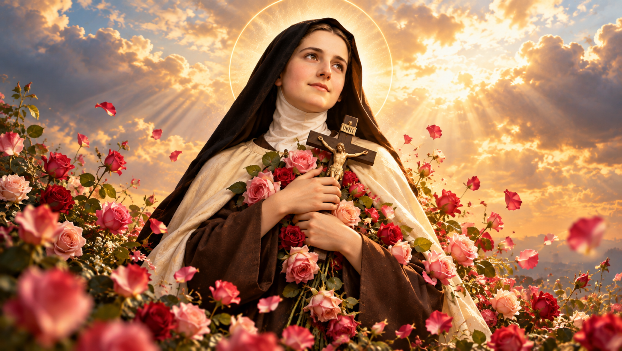
Feast Day: October 1
Today the Church celebrates one of her most beloved saints: St. Thérèse of the Child Jesus and the Holy Face, Virgin and Doctor of the Church.
She lived for only twenty-four years.
She never founded a religious order. She never travelled to the missions. She never preached to great crowds. She never wrote a great theological treatise. Most of her adult life was spent hidden behind the walls of a Carmelite monastery in the small French town of Lisieux.
And yet this young woman became one of the great spiritual teachers in the history of the Catholic Church.
She is the patroness of the missions, despite never having gone on mission.
She is a Doctor of the Church, despite having no formal theological education.
Her autobiography, Story of a Soul, became one of the most influential spiritual works of modern Christianity.
And at the heart of everything she taught was an astonishingly simple conviction:
“It is confidence and nothing but confidence that must lead us to Love.”
Pope Francis began his 2023 Apostolic Exhortation C’est la confiance, devoted entirely to Thérèse, with these words of hers. He wrote that they summarize the genius of her spirituality.
But what exactly did Thérèse discover?
And what can this young Carmelite nun teach those of us struggling to follow Jesus today?
A Child Who Knew Both Love and Loss
Marie-Françoise-Thérèse Martin was born in Alençon, France, on January 2, 1873, to Louis and Zélie Martin.
Her parents were deeply Catholic, and the Martin home was filled with prayer, affection and faith. Louis and Zélie would themselves eventually be canonized together by Pope Francis in 2015.
But Thérèse’s childhood was not untouched by suffering.
Her mother died of cancer on August 28, 1877, when Thérèse was only four years old.
The loss affected her profoundly.
The family moved to Lisieux, where Thérèse was surrounded by the love of her father and sisters. Nevertheless, the sensitive little girl carried deep emotional wounds. When her older sister Pauline, who had become something of a second mother to her, entered the Carmelite monastery, Thérèse again experienced a painful sense of loss.
In 1883, while seriously ill, Thérèse experienced what she understood as a remarkable grace of healing through the intercession of the Blessed Virgin Mary. She later described seeing the statue of Our Lady near her bed appear to smile upon her.
The following year, on May 8, 1884, she received her First Holy Communion.
For Thérèse, this was not simply a childhood milestone. She experienced Communion as a profound encounter with Jesus.
The Eucharistic spirituality that would mark the rest of her life was already taking root.
The Christmas Grace That Changed Her Life
One of the great turning points in Thérèse’s life came at Christmas 1886.
She was nearly fourteen.
Until then, she remained extremely emotionally sensitive. Small disappointments could reduce her to tears.
But on Christmas night something changed.
Thérèse later called it her “complete conversion.”
She believed Jesus had given her the grace to move beyond the emotional fragility that had dominated much of her childhood.
St. John Paul II later described the effect beautifully: after this experience, Thérèse began to “run as a giant” along the road to perfection.
This is important.
Thérèse’s “Little Way” did not come from someone who never struggled.
It came from someone who knew weakness intimately.
She did not discover holiness by pretending she was strong.
She discovered holiness when she learned what God could do through her weakness.
“I Want to Enter Carmel”
Thérèse developed an extraordinary desire to give herself completely to Jesus.
She wanted to enter the Carmelite monastery at Lisieux, where her sisters Pauline and Marie had already entered.
There was one problem.
She was only fifteen.
Her age stood in the way.
But Thérèse was determined.
During a pilgrimage to Rome in 1887, she attended an audience with Pope Leo XIII. Despite instructions that pilgrims should not speak at length with the Pope, Thérèse knelt before him and personally pleaded for permission to enter Carmel at fifteen.
Her persistence became legendary.
Eventually permission was granted.
On April 9, 1888, fifteen-year-old Thérèse Martin entered the Carmel of Lisieux.
She would never leave it.
The Hidden Life of Carmel
It would be easy to romanticize what happened next.
Thérèse did not spend her Carmelite years floating effortlessly through mystical experiences.
Religious community life brought its own difficulties.
There were personalities that irritated her.
There were misunderstandings.
There were ordinary duties.
There were disappointments.
There were moments when prayer felt dry.
There were people whom she naturally liked and others whom she found difficult.
And precisely there, Thérèse discovered her road to holiness.
She began to understand that holiness did not necessarily consist in performing extraordinary deeds.
Holiness could be found in doing very ordinary things with extraordinary love.
A smile.
A kind word.
Remaining silent instead of answering harshly.
Helping someone when you would rather be left alone.
Being patient with someone who irritates you.
Accepting an inconvenience without complaining.
Doing an unnoticed duty faithfully.
Praying when prayer feels empty.
Loving someone precisely when you do not feel like loving them.
These became the arena in which Thérèse pursued holiness.
The Discovery of the “Little Way”
Thérèse wanted desperately to become a saint.
But when she compared herself with the great saints, she saw herself as very small.
That realization could have discouraged her.
Instead, it became the beginning of one of her greatest spiritual discoveries.
She wrote:
“I can, then, in spite of my littleness, aspire to holiness.”
She recognized that she could not make herself spiritually “big.”
So she began searching for what she called a “little way”—a straight and short road to heaven.
She used a wonderfully modern image.
In her time, elevators were beginning to appear. Instead of climbing a staircase step by exhausting step, a person could simply allow the elevator to lift them.
Thérèse asked herself:
What could be my spiritual elevator?
Her answer was Jesus.
“The elevator which must raise me to heaven is your arms, O Jesus!”
Rather than making herself great enough to reach God, she would become small enough to allow God to lift her.
Pope Francis explained that this is the heart of her Little Way: not confidence in ourselves, but confidence in the loving arms of the Lord.
This changes everything.
Christian holiness is not primarily:
“Look what I have accomplished for God.”
It becomes:
“Look what God can accomplish in me when I surrender myself to Him.”
Spiritual Childhood Is Not Spiritual Immaturity
This distinction is extremely important.
Thérèse’s spirituality is sometimes misunderstood as childishness.
It is nothing of the sort.
Jesus Himself said:
“Unless you turn and become like children, you will never enter the kingdom of heaven.”
— Matthew 18:3
A child knows dependence.
A child knows how to receive.
A child trusts the arms of a loving parent.
Thérèse realized that before God we are all children.
The Little Way therefore means approaching God without pretending that we are self-sufficient.
It means saying:
Father, I cannot make myself holy without You.
Jesus, I cannot save myself.
Holy Spirit, I cannot transform my own heart.
But I trust You.
That word—trust—may be the key to understanding Thérèse.
Her Vocation Was Love
Perhaps the most famous passage in Thérèse’s writings came from her struggle to understand her vocation.
Her desires seemed enormous.
She wanted to be a missionary.
A priest.
An apostle.
A martyr.
A teacher.
She wanted somehow to serve Christ everywhere.
How could a cloistered Carmelite nun accomplish all of this?
Reading St. Paul’s teaching about the Church as the Body of Christ, particularly 1 Corinthians 12 and 13, Thérèse suddenly understood.
The Church had many members and many vocations.
But the Church must also have a heart.
And the heart must burn with love.
Her discovery burst from her:
“In the heart of the Church, my Mother, I shall be Love.”
She had found her vocation.
Love.
That realization explains almost everything about Thérèse.
She did not need to travel across continents to become a missionary.
She could love.
She did not need a public platform.
She could love.
She did not need thousands of people to know her name.
She could love.
And through the Communion of Saints, her hidden prayer and sacrifice could strengthen missionaries preaching the Gospel thousands of miles away.
That is why the Church eventually declared this cloistered nun, together with St. Francis Xavier, Patroness of the Missions in 1927.
Holiness in the Ordinary
There is something particularly powerful here for us.
Many people imagine holiness as something reserved for priests, religious, mystics or missionaries.
Thérèse destroys that illusion.
Your home can become a school of holiness.
Your marriage can become a school of holiness.
Caring for an elderly parent can become a school of holiness.
Going to work can become a school of holiness.
Preparing a meal can become an act of love.
Listening patiently to someone can become an offering to God.
Forgiving someone can become an act of worship.
Bearing patiently with another person’s weakness can become a hidden sacrifice.
The Little Way asks a simple question:
How much love can I put into what God has placed before me today?
Not tomorrow.
Not when circumstances improve.
Not when people finally appreciate us.
Today.
When Thérèse Could No Longer Feel God
There is another side of Thérèse that is sometimes lost beneath the roses and sentimental images.
Near the end of her life, Thérèse entered an intense trial of faith.
In April 1896 she began coughing blood, an early sign of the tuberculosis that would eventually kill her.
At almost the same time, she entered a period of profound spiritual darkness.
The young woman who had spoken so beautifully about heaven found herself assailed by doubts concerning eternal life.
The Vatican’s biography of Thérèse describes this as a “trial of faith” that lasted until her death.
This makes her teaching about trust far more powerful.
Thérèse did not trust God merely because she constantly felt God’s presence.
She trusted when she could not feel Him.
She believed when belief became painful.
She loved when consolation disappeared.
Her Little Way therefore cannot be reduced to religious sweetness.
It was tested in darkness.
She continued choosing Jesus when emotionally and spiritually she could no longer see clearly.
That speaks powerfully to anyone who has ever prayed:
“God, where are You?”
Thérèse teaches us that faith is sometimes not a feeling at all.
Sometimes faith is simply continuing to say:
Jesus, I trust You.
“I Am Not Dying; I Am Entering Life”
Tuberculosis gradually destroyed Thérèse’s body.
Her suffering became intense.
She was moved to the monastery infirmary in July 1897.
She was only twenty-four years old.
Yet death did not have the final word.
To one of the missionary priests with whom she corresponded, she wrote:
“I am not dying; I am entering life.”
On September 30, 1897, Thérèse died.
Her final words were extraordinarily simple:
“My God, I love you.”
A fitting conclusion to the life of someone who had discovered that her entire vocation was love.
Story of a Soul
Before her death, at the request of her religious superiors, Thérèse wrote the story of her spiritual journey.
The writings were eventually assembled and published in 1898 under the title Histoire d’une âme—Story of a Soul.
The work consists principally of three autobiographical manuscripts.
But Thérèse left much more.
The Church possesses hundreds of her letters, dozens of poems, prayers, religious plays and the recollections of statements she made during the final months of her life.
Her writings spread extraordinarily quickly throughout the world.
And people began discovering something remarkable.
This young nun had articulated a spirituality that ordinary Christians could actually live.
The Little Flower and the Shower of Roses
Thérèse became affectionately known as “the Little Flower.”
Roses became particularly associated with her because of her desire to continue doing good after death.
The popular devotion surrounding her “shower of roses” should not distract us from what the roses ultimately symbolize.
They point to grace.
Thérèse believed heaven would not mean withdrawing from those still struggling on earth.
She desired to continue helping souls love Jesus.
Her extraordinary worldwide popularity after her death seemed to fulfil that desire.
Within a few decades, this unknown Carmelite nun from Lisieux had become known throughout the Catholic world.
She was canonized by Pope Pius XI on May 17, 1925.
Two years later, he proclaimed her Patroness of the Missions alongside St. Francis Xavier.
And then came another extraordinary recognition.
Doctor of the Church
On October 19, 1997, Pope St. John Paul II proclaimed St. Thérèse of the Child Jesus and the Holy Face a Doctor of the Universal Church.
At the time, she was only the third woman to receive the title.
Why?
Not because she had written volumes of academic theology.
John Paul II described in her writings what he called a “science of love.”
Thérèse understood something profoundly theological:
God is Love.
Holiness therefore consists fundamentally in allowing ourselves to be loved by God and allowing His love to transform the way we love others.
John Paul II explained that Thérèse’s teaching flows from the Gospel and presents the Little Way as a path of holiness available to everyone.
That is extraordinary.
A young woman who died at twenty-four, who never attended a university and who spent fewer than ten years in a cloister became an officially recognized teacher of the Universal Church.
God once again chose what appeared little in the eyes of the world to reveal something immense.
Some Words of St. Thérèse to Carry With Us
Among the thoughts that capture her spirituality are these:
“It is confidence and nothing but confidence that must lead us to Love.”
Trust God.
“The elevator which must raise me to heaven is your arms, O Jesus!”
Let Jesus carry what you cannot carry alone.
“In the heart of the Church, my Mother, I shall be Love.”
Whatever our particular vocation, every Christian vocation must ultimately become love.
“I am not dying; I am entering life.”
For the Christian, death is not annihilation. Christ has transformed death into the doorway to eternal life.
And her final earthly profession of faith:
“My God, I love you.”
Perhaps nothing more needed to be said.
What Can St. Thérèse Teach Us Today?
Perhaps her first lesson is this:
1. Stop waiting to become important before serving God.
You do not need a platform.
You do not need recognition.
You do not need thousands of followers.
You do not need extraordinary talents.
Love the person God has placed before you.
That is already holy ground.
2. Small acts matter.
The world celebrates spectacular achievements.
The Kingdom of God often grows invisibly.
A prayer nobody hears.
A sacrifice nobody notices.
A kindness nobody remembers.
A temptation resisted.
An insult left unanswered.
A difficult person treated with dignity.
A task performed faithfully.
Nothing offered to God in love is insignificant.
3. Weakness does not disqualify us from holiness.
This may be one of Thérèse’s greatest lessons.
She did not say:
“When I finally become strong enough, God will love me.”
She discovered almost the opposite.
Her littleness became the very place where she encountered God’s mercy.
We sometimes bring God our achievements.
Thérèse teaches us to bring Him our poverty too.
4. Trust is greater than fear.
Some Christians live as though God were constantly waiting for them to fail.
Thérèse saw the Father differently.
She saw the God revealed by Jesus—the Father who runs toward the prodigal son.
Christian holiness therefore grows not primarily from terror of punishment but from confidence in Divine Mercy.
We repent because we have discovered how deeply we are loved.
5. Love the Church from within the Church.
Thérèse did not ask:
“What position can I occupy?”
She asked:
“Where can I love?”
And she found her answer:
In the heart of the Church.
That is a beautiful examination of conscience for every Catholic.
Do I merely criticize the Church?
Do I merely consume what the Church gives me?
Or am I helping the Church love?
6. Prayer can reach places our feet never will.
Thérèse never went to Africa.
She never went to Asia.
She never crossed oceans preaching the Gospel.
Yet the Church calls her Patroness of the Missions.
Why?
Because mission is not merely geography.
The missionary life begins in the heart that desires that Jesus be known and loved.
Our prayers can accompany missionaries.
Our sacrifices can strengthen priests.
Our suffering can be offered for conversions.
Our hidden fidelity can participate in the evangelizing mission of the Church.
7. Faithfulness matters more than feelings.
Perhaps this is especially important.
Thérèse experienced spiritual darkness.
Yet she continued believing.
There may be days when prayer feels empty.
Days when Mass feels dry.
Days when God seems distant.
Days when suffering makes no sense.
Thérèse reminds us:
The absence of consolation is not the absence of God.
Sometimes the purest faith is the faith that continues walking through darkness.
The Greatness of Being Little
The world tells us:
Become powerful.
Become noticed.
Become influential.
Become successful.
Build your name.
Thérèse whispers something radically different:
Become little.
Not insignificant.
Not passive.
Not weak in character.
Little enough to depend upon God.
Little enough to receive grace.
Little enough to admit that we cannot save ourselves.
Little enough to allow Jesus to lift us.
That is the paradox of the Little Way.
The smaller Thérèse became before God, the larger her influence became throughout the world.
The woman who wanted to remain hidden became one of Christianity’s best-known saints.
The nun who never entered the missions became their patroness.
The young woman without a theology degree became a Doctor of the Church.
The Carmelite who died at twenty-four continues teaching millions more than a century after her death.
Such is the strange arithmetic of the Kingdom of God.
A Little Way for Today
Perhaps we can honour St. Thérèse today not merely by admiring her, but by trying her Little Way.
Choose one person who is difficult to love.
Love them anyway.
Choose one ordinary task you dislike.
Do it with love.
Choose one worry you keep carrying.
Place it deliberately into the arms of Jesus.
Choose one hidden sacrifice.
Offer it for someone who needs grace.
Choose one moment today when you would normally complain.
Instead say:
Jesus, I offer this to You.
That is the Little Way.
And perhaps holiness is much closer than we imagined.
Not somewhere far away.
Not reserved for extraordinary people.
Not waiting for some dramatic moment in our lives.
Perhaps holiness is hidden inside the next ordinary thing God asks us to do—
if we do it with extraordinary love.
Prayer through the Intercession of St. Thérèse
St. Thérèse of the Child Jesus and the Holy Face,
you desired nothing more than to love Jesus
and to make Him loved.
Teach us your Little Way.
When we feel weak,
teach us to trust.
When we feel insignificant,
remind us that nothing done with love is small in the eyes of God.
When prayer becomes difficult,
teach us to remain faithful.
When God seems distant,
help us to believe even in the darkness.
When pride makes us depend upon ourselves,
teach us to become little enough
to rest in the arms of Jesus.
Help us to recognize the opportunities for holiness
hidden within the ordinary moments of each day.
May our homes become places of love.
May our work become an offering.
May our suffering become prayer.
May our words bring mercy.
May our lives lead others to Jesus.
And with you, may we discover our deepest vocation:
In the heart of the Church, may we be Love.
St. Thérèse of the Child Jesus and the Holy Face,
pray for us.
Amen.