
Who Do People Say That I Am? – In 2026 The Question Remains The Same
Please click the PLAY button below to listen to audio
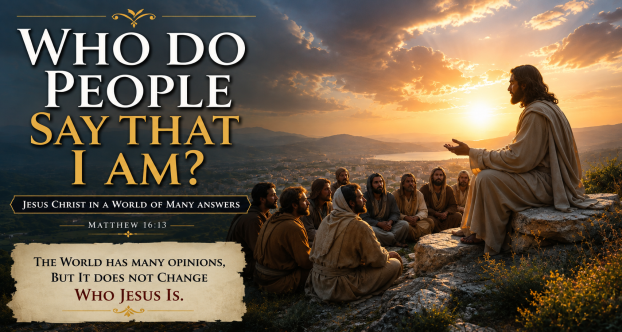
Jesus Christ in a World of Many Answers
“Who do people say that the Son of Man is?” — Matthew 16:13
There are questions we answer and move on from.
And then there are questions that follow humanity through history.
Nearly two thousand years ago, somewhere in the region of Caesarea Philippi, Jesus turned to His disciples and asked one of those questions:
“Who do people say that the Son of Man is?”
It sounds almost casual.
What are people saying about Me?
What have you heard?
What is the word on the street?
The disciples had answers ready.
“Some say John the Baptist, others Elijah, still others Jeremiah or one of the prophets.”
What is striking is that none of these answers was particularly insulting.
The people were not saying that Jesus was insignificant. They were comparing Him with some of the greatest figures in Israel’s history.
John the Baptist.
Elijah.
Jeremiah.
A prophet.
They recognized that there was something extraordinary about Him.
But they were wrong.
And therein lies one of the great dangers of every generation:
It is possible to say wonderful things about Jesus and still not know who Jesus is.
The Question Has Never Gone Away
If Jesus walked through our world today and asked us,
“Who do people say that I am?”
we would probably have far more answers than the disciples did.
Some would say:
A great teacher.
A prophet.
A religious leader.
A revolutionary.
A social activist.
A champion of the poor.
A healer.
A spiritual master.
A symbol of love.
A historical figure.
A myth.
A good man.
Some would say He is God.
Others would say they are not sure He ever existed.
Some would wear His Cross around their neck without giving Him much thought.
Some would invoke His name in prayer.
Some would use His name casually or profanely.
Some would build their entire lives around Him.
Others would simply shrug.
Yet Jesus continues to stand before humanity and ask:
“Who do people say that I am?”
The question is as alive in 2026 as it was at Caesarea Philippi.
The Jesus We Have Created
Perhaps one of the greatest spiritual dangers of our age is not simply rejecting Jesus.
It is recreating Him.
We can construct a Jesus who conveniently agrees with us.
A Jesus who shares all our opinions.
A Jesus who approves our politics.
A Jesus who confirms our lifestyle.
A Jesus who never challenges our desires.
A Jesus who never speaks about sin.
A Jesus who never asks us to repent.
A Jesus who never speaks about judgement.
A Jesus who demands no sacrifice.
A Jesus who never says, “Take up your cross.”
A Jesus whose principal function is to make us feel comfortable.
We take the Jesus of the Gospel, remove everything that unsettles us, preserve the parts we like, and then call what remains “Jesus.”
But the Jesus we manufacture in our own image cannot save us.
The question is not whether I like the Jesus I have constructed.
The question is whether the Jesus I believe in is the Jesus who actually is.
“Jesus Was About Love”
Perhaps one of the most common descriptions of Jesus today is:
“Jesus was about love.”
And that statement is absolutely true.
God is love.
Jesus reveals the Father’s love.
He touches lepers.
He welcomes sinners.
He feeds the hungry.
He forgives.
He heals.
He seeks the lost.
He eats with those whom respectable society rejects.
He allows the broken to approach Him.
He gives His life for sinners.
But we misunderstand Jesus when we redefine His love as simple approval.
The Jesus who says,
“Neither do I condemn you,”
also says,
“Go, and do not sin again.”
The Jesus who welcomes sinners also calls sinners to conversion.
The Jesus who forgives also says:
“Repent, for the kingdom of heaven is at hand.”
The Jesus who loves us completely loves us too much to leave us unchanged.
Christian love therefore cannot simply mean:
“Whatever you choose is fine.”
Sometimes love comforts.
Sometimes love forgives.
Sometimes love embraces.
And sometimes love says:
This road is destroying you. Come back.
The world often wants the compassion of Jesus without the conversion demanded by Jesus.
But we cannot separate the two.
The Jesus of Social Media
There is another phenomenon particular to our age.
Jesus has entered the world of algorithms.
A verse appears on Facebook.
A Scripture quotation appears on Instagram.
A thirty-second sermon appears on TikTok.
A preacher’s statement goes viral.
A quotation attributed to Jesus is shared thousands of times—even though Jesus never said it.
And increasingly, people encounter Christianity not through Scripture, prayer, family, parish or serious formation, but through fragments selected for them by an algorithm.
That creates a peculiar danger.
We can begin building our understanding of Christ from clips.
A verse here.
A meme there.
A motivational quotation somewhere else.
We hear the Jesus whom the algorithm knows we are likely to engage with.
But Jesus cannot be reduced to content.
He cannot be understood through slogans alone.
The Gospel must be encountered whole.
Because the same Jesus who says,
“Come to me, all you who labour and are burdened,”
also says,
“Whoever wishes to come after me must deny himself, take up his cross, and follow me.”
The same Jesus who searches for the lost sheep overturns the tables of the money changers.
The same Jesus who says, “Blessed are the merciful,” warns repeatedly about judgement.
The same Jesus who forgives from the Cross also commands us to forgive those who hurt us.
Jesus continually refuses to fit comfortably into the boxes we create for Him.
And What About Trinidad and Tobago?
Now the question becomes much closer to home.
Who do people in Trinidad and Tobago say that Jesus is?
We are a deeply religious society.
Churches are everywhere.
Christian language is everywhere.
Prayer appears at public events.
Christian celebrations remain woven into our national culture.
Christmas and Easter remain prominent parts of our national calendar.
Our religious landscape is wonderfully diverse, with Christians living alongside Hindus, Muslims and people of other faiths or none.
And historically, Roman Catholicism has had a particularly significant presence in Trinidad and Tobago. The 2011 national census—the latest detailed official religious composition readily available—recorded Roman Catholicism as the country’s largest single religious denomination, with 285,671 people identifying as Catholic. Yet that same census showed changes already occurring within our religious landscape, including substantial growth among Pentecostal/Evangelical/Full Gospel communities and growth in the number reporting no religious affiliation.
But statistics cannot answer Jesus’ question.
Because identifying ourselves as Christian is not the same as knowing Christ.
Writing “Roman Catholic” on a census form is not the same as discipleship.
Being baptized is not the same as living one’s Baptism.
Going to Mass occasionally is not the same as surrendering one’s life to Jesus.
Having a crucifix in the house is not necessarily the same as allowing the Crucified One to govern the house.
And perhaps this is where Jesus’ question becomes particularly uncomfortable for us.
Who does Trinidad and Tobago say that Jesus is—not merely with our mouths, but with the way we live?
What Does Our Society Say About Him?
This is not a question intended to condemn Trinidad and Tobago.
It is an invitation to examination.
We are a country capable of tremendous generosity.
When tragedy strikes, strangers help strangers.
Communities rally around families in need.
Food is shared.
Money is collected.
People pray for people they have never met.
Our culture retains a deep instinct for hospitality, family, celebration and community.
There is much that is beautiful among us.
But there are also painful contradictions.
We can speak frequently about God while becoming increasingly comfortable with behaviours utterly contrary to God.
We can pray publicly and hate privately.
We can worship on Sunday and exploit people on Monday.
We can sing about Jesus and refuse to forgive our brother.
We can receive the Body of Christ and then destroy another person’s reputation before the day is over.
We can ask God to bless Trinidad and Tobago while participating in corruption, dishonesty, violence, greed, prejudice and injustice.
We can demand morality from politicians while excusing immorality in ourselves.
We can condemn crime while nurturing the anger, materialism, family breakdown, dishonesty and disregard for human dignity from which a culture of violence can grow.
Our society has wrestled painfully with crime, violence, pressures affecting young people, educational challenges and wider questions about social cohesion and national values. These are not merely political problems. They also force a religious society to ask what values are actually forming its people.
If Christ truly occupies the place our religious language suggests He occupies, then His presence should become visible somewhere in the character of our society.
That is not a demand for a perfect nation.
There has never been one.
It is simply to ask:
What does the fruit tell us about the tree?
The Cultural Jesus
Perhaps for many of us in Trinidad and Tobago, Jesus can become part of the culture without necessarily remaining Lord of our lives.
We know Christmas.
We know Good Friday.
We know Easter.
We know hymns.
We know prayers.
Catholics know when to stand.
When to sit.
When to kneel.
We know the Sign of the Cross.
We know when to answer, “And with your spirit.”
Some of us have known these things since childhood.
And all of that can be beautiful.
Tradition can carry faith from one generation to another.
But there is a danger when familiarity replaces encounter.
Jesus can become someone we know about rather than Someone we know.
He becomes part of the furniture of our lives.
Present.
Familiar.
Respected.
But not necessarily followed.
We call Him “Lord,” yet major decisions are made without consulting Him.
Relationships are conducted without reference to Him.
Money is pursued without reference to Him.
Sexual morality is determined without reference to Him.
Business is conducted without reference to Him.
Political loyalties sometimes influence us more deeply than the Gospel.
Popular culture forms our values more powerfully than Scripture.
Social media shapes our identity more aggressively than Baptism.
And still we say:
“Lord, Lord.”
Perhaps the question is not whether Jesus exists in our culture.
Perhaps the question is:
What authority does He actually have?
The Convenient Jesus
Every generation is tempted to keep the parts of Jesus it likes.
Those concerned about social justice may emphasize His concern for the poor while ignoring His teaching on personal holiness.
Those concerned about personal morality may emphasize sin while ignoring His demands concerning mercy, poverty, justice and care for the vulnerable.
Those who emphasize prosperity may speak endlessly about blessing while saying very little about the Cross.
Those who emphasize tolerance may celebrate His welcome while ignoring His call to repentance.
Those who emphasize doctrine may defend every teaching correctly while failing to love the person standing in front of them.
We can all create a convenient Christ.
Left.
Right.
Conservative.
Progressive.
Rich.
Poor.
Clergy.
Laity.
All of us can be tempted to make Jesus a spokesman for our camp.
But Jesus Christ belongs to no political party.
No ideology owns Him.
No nation owns Him.
No social class owns Him.
No race owns Him.
No generation gets to redefine Him.
Rather, He lays claim to all of us.
When Jesus Becomes Useful Rather Than Lord
There is another Jesus our world frequently creates:
the emergency Jesus.
When the diagnosis comes, we pray.
When the child is in trouble, we pray.
When the relationship collapses, we pray.
When the examination approaches, we pray.
When the hurricane threatens, we pray.
When violence comes close to our home, we pray.
When the plane begins experiencing turbulence, suddenly even people who rarely think about God remember how to pray.
And God hears desperate prayers.
The Gospel is filled with people crying out to Jesus from their desperation.
There is nothing wrong with running to Him when we are frightened.
But Christianity cannot reduce Jesus to an emergency service.
Jesus did not come merely to rescue us from difficult situations.
He came to save us from sin and reconcile us to the Father.
He did not come merely to improve our existing lives.
He came to give us new life.
The Prosperity Jesus
Another version of Jesus increasingly encountered in modern Christianity is a Christ whose principal purpose seems to be making us successful.
Follow Jesus and you will prosper.
Follow Jesus and the doors will open.
Follow Jesus and the promotion will come.
Follow Jesus and the money will arrive.
Certainly, God provides.
Certainly, we should bring our material needs before Him.
Certainly, Scripture contains abundant testimony to God’s providence.
But the centre of Christianity is not prosperity.
It is a Cross.
Jesus never promised His disciples uninterrupted comfort.
He told them:
“Take up your cross and follow me.”
Any Christianity that has no place for Calvary has eventually created another Christ.
The Harmless Jesus
Perhaps this is the Jesus modern society finds easiest to tolerate.
A Jesus who is inspirational but not authoritative.
Beautiful but not demanding.
Spiritual but not sovereign.
A Jesus whose words can decorate a greeting card but cannot interfere with our decisions.
Such a Jesus threatens nobody.
And perhaps that is precisely how we know that he is not the Jesus of the Gospel.
Because the real Jesus disturbed people.
Herod feared Him.
Religious leaders plotted against Him.
Demons cried out before Him.
Sinners were drawn to Him.
The self-righteous were exposed by Him.
The suffering reached for Him.
Crowds followed Him.
Others abandoned Him.
And eventually humanity crucified Him.
Nobody crucifies a harmless motivational speaker.
Perhaps We Have Been Asking the Wrong Question
Our culture often approaches Christianity by asking:
“What does Jesus have to offer me?”
Can He make me happy?
Can He fix my marriage?
Can He heal me?
Can He help my children?
Can He give me peace?
Can He make me successful?
Can He solve my problems?
These are understandable questions.
But Christianity eventually turns the question around.
Instead of asking,
“How can Jesus fit into my life?”
we begin asking,
“How must my life change because Jesus is Lord?”
That is an entirely different Christianity.
The Catechism teaches that Christian faith is first of all a personal adherence to God, inseparably joined to accepting the truth He has revealed. Believing in Jesus therefore cannot simply mean admiring Him; it means entrusting ourselves to Him.
Jesus Does Not Conduct an Opinion Poll
There is something else remarkable about the scene at Caesarea Philippi.
Jesus already knows who He is.
He does not ask the disciples this question because He is insecure.
He is not checking His approval rating.
He does not need the crowd to validate His identity.
The answers of the people do not change the truth.
If everyone calls Him merely a prophet, He remains the Son of God.
If everyone rejects Him, He remains Lord.
If an entire generation forgets Him, He remains Lord.
If Christianity becomes culturally unpopular, He remains Lord.
If His teachings trend on social media, He is Lord.
If His teachings are ridiculed on social media, He is Lord.
Truth is not determined by polling.
That is profoundly countercultural in a world where popularity can easily be mistaken for truth.
The Gospel confronts us with Someone whose identity does not depend upon our opinion of Him.
So, Who Do People Say That He Is?
There are billions of answers.
And Jesus allows the question to hang in the air.
Who does the university say He is?
Who does popular culture say He is?
Who does social media say He is?
Who does Hollywood say He is?
Who do politicians say He is?
Who do influencers say He is?
Who does Trinidad and Tobago say He is?
Who does your family say He is?
Who do your friends say He is?
Who does your parish say He is?
Who does the person who has stopped going to church say He is?
Who does the young person struggling to find meaning say He is?
Who does the grieving mother say He is?
Who does the prisoner say He is?
Who does the successful businessman say He is?
Who does the person who has everything yet still feels empty say He is?
The answers matter.
But Jesus does not stop there.
After listening to everything the crowds have said, He turns to the Twelve.
And suddenly the safe distance disappears.
The crowd can no longer answer for them.
Culture cannot answer.
Tradition cannot answer.
Parents cannot answer.
The parish cannot answer.
The priest cannot answer.
The Catechism cannot answer in their place.
Jesus looks at them.
And the question changes.
“But you—who do you say that I am?”
That is where our next deep dive must begin.
Because eventually every second-hand answer about Jesus must give way to an encounter in which Christ stands before me.
Not “Who do they say?”
Not “What does the Church say?”
Not “What did my parents teach me?”
Not even merely “What does the Bible say?”
But having heard all of that—
having encountered Him,
having heard His Word,
having seen what He has done,
having fallen,
having cried out,
having been forgiven,
having been carried,
having received Him in the Eucharist—
Jesus looks directly at me.
And asks:
“But you—who do you say that I am?”
That question cannot ultimately be answered by the crowd.
I have to answer it myself.