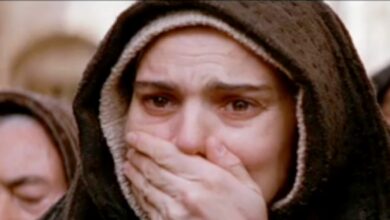

Our Lady of Sorrows — A Mother Who Understands Our Pain
You can click the PLAY button below to listen to this post
September 15 — Memorial of Our Lady of Sorrows
“And you yourself a sword will pierce.” — Luke 2:35
There are moments in life when words simply cannot explain our pain.
The death of someone we love. A child who has gone astray. A marriage under strain. Illness. War. Violence. Betrayal. Loneliness. A prayer that seems to go unanswered. The suffering of someone we love when there is absolutely nothing we can do to take that suffering away.
On September 15, the Church gives us a Mother who understands.
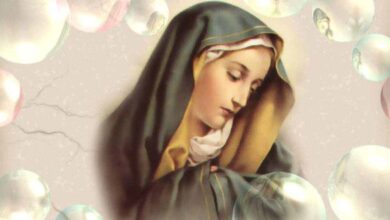
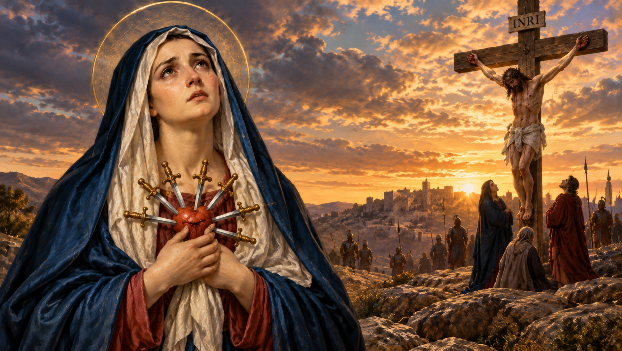
We honour Our Lady of Sorrows — Mary, the Mother who stood at the foot of the Cross.
A Sword Will Pierce Your Soul
Mary’s sorrow did not begin on Calvary.
When Mary and Joseph presented the infant Jesus in the Temple, the elderly Simeon took the Child into his arms and prophesied that Jesus would be a sign of contradiction. Then, turning to Mary, he gave her words that must have remained with her throughout her life:
“And you yourself a sword will pierce.”
— Luke 2:35
Mary had said her great “Yes” to God at the Annunciation. But that yes did not guarantee her a life without suffering.
Quite the opposite.
Her faithfulness would eventually bring her to the foot of a Cross.
And she remained there.
The Seven Sorrows of Mary
Catholic tradition invites us to meditate particularly upon Seven Sorrows experienced by the Blessed Virgin Mary:
- The Prophecy of Simeon — Luke 2:34–35
- The Flight into Egypt — Matthew 2:13–15
- The Loss of the Child Jesus in the Temple — Luke 2:41–50
- Mary Meets Jesus on the Way to Calvary
- The Crucifixion and Death of Jesus — John 19:25–30
- Jesus Is Taken Down from the Cross
- Jesus Is Laid in the Tomb — John 19:38–42
These sorrows take us through very different kinds of human suffering: fear, displacement, uncertainty, separation, helplessness, bereavement and grief.
That is one reason devotion to Our Lady of Sorrows remains so relevant.
Mary knows what it means to hurt.
Where Did the Feast Come From?
Devotion to the sorrows of Mary developed over many centuries and became especially widespread during the Middle Ages. The Cistercians and particularly the Servites — the Order of the Servants of Mary — played an important role in spreading devotion to the suffering Mother of Christ.
The Servite Order, founded in the 13th century, made meditation upon Mary’s sorrows a central part of its spirituality.
Over time, liturgical celebrations honouring Mary’s sorrows appeared in different places and on different dates. Pope Benedict XIII placed a feast of Mary’s Sorrows on the Roman Calendar in 1727.
A particularly significant development came after the upheavals of the French Revolution and the Napoleonic period. Pope Pius VII extended the observance of Our Lady of Sorrows to the whole Church in 1814, recalling the suffering endured by the Church during those turbulent years.
In the early 20th century, Pope St. Pius X established September 15 as the date of the celebration.
Today it is observed as the Memorial of Our Lady of Sorrows.
And its position in the calendar is profoundly meaningful.
September 14 — The Exaltation of the Holy Cross.
September 15 — Our Lady of Sorrows.
First we contemplate Christ upon the Cross.
Then we look beside the Cross and see His Mother standing there.
Mary Stood
Perhaps one of the most powerful descriptions of Mary in the entire Gospel is contained in a single verse:
“Standing by the cross of Jesus were his mother…”
— John 19:25
Standing.
Mary could not remove the nails.
She could not stop the soldiers.
She could not take away her Son’s physical agony.
She could not make the crowd understand who He really was.
But she could remain.
And she did.
There is an extraordinary lesson here for us.
Sometimes Christian love cannot fix the situation.
Sometimes we cannot cure the cancer.
We cannot repair another person’s broken marriage.
We cannot force an addicted person to change.
We cannot bring a dead loved one back.
We cannot make a wandering child return to God.
We cannot instantly end the wars, violence, poverty and injustice that wound our world.
But like Mary, we can remain.
We can accompany.
We can pray.
We can love.
We can refuse to abandon those who suffer.
Our Lady of Sorrows and Our World Today
Our world has no shortage of sorrow.
There are mothers grieving children killed by violence. Families fleeing war and persecution. Parents watching children struggle with addiction. People caring for ageing parents. Families struggling financially. Men and women carrying depression, loneliness and anxiety that nobody else sees.
There are people mourning relationships that have collapsed and others mourning loved ones whose chairs at the family table will always remain empty.
Our Lady of Sorrows does not give us a Christianity that pretends suffering does not exist.
She shows us something much deeper:
Suffering does not mean that God has abandoned us.
Mary was extraordinarily close to God, yet she suffered profoundly.
Jesus Himself was the beloved Son of the Father, yet He went to Calvary.
Christian faith therefore does not promise us an escape from every Cross. It promises us that the Cross does not have the final word.
Mary Teaches Us How to Suffer Without Losing Faith
At Calvary, Mary could not yet see Easter Sunday.
She saw blood.
She saw nails.
She saw a spear.
She saw her Son die.
Yet she remained faithful.
That makes Our Lady of Sorrows particularly important when we find ourselves in our own Holy Saturday — that uncomfortable place between suffering and the answer we are still waiting for.
Mary teaches us to trust God even when we cannot understand what God is doing.
She teaches us that faith is not merely praising God when everything is going well.
Sometimes faith simply means remaining at the foot of the Cross and refusing to walk away from God.
A Mother Given to Us
Something extraordinary happened while Mary stood beneath the Cross.
Jesus looked at Mary and at the beloved disciple and said:
“Woman, behold, your son.”
Then He said to the disciple:
“Behold, your mother.”
— John 19:26–27
Catholic tradition has always seen something profound here.
At the very moment when Mary’s heart was being pierced with unimaginable sorrow, Christ entrusted His disciple to her — and entrusted her to His disciple.
At Calvary, the sorrowful Mother becomes a mother to Christ’s disciples.
That means that when we suffer, we do not merely look at Mary.
We can turn to Mary.
We can say:
Mother, you stood beside Jesus when everything seemed lost. Stand beside me now.
Sorrow Is Not the End of Mary’s Story
Our Lady of Sorrows is not Our Lady of Despair.
That distinction matters.
Mary’s sorrow is filled with faith.
Calvary leads to the empty tomb.
Good Friday leads to Easter Sunday.
The Mother who watched her Son die would rejoice in His victory over death.
And therefore Our Lady of Sorrows whispers something desperately needed by anyone presently carrying a Cross:
Do not confuse the chapter you are living with the end of the story.
God may still be working where you cannot see Him.
What Can We Do Today?
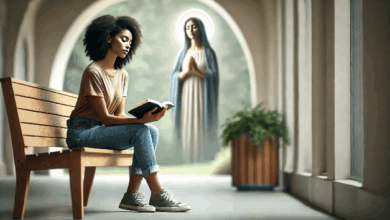
On this Memorial of Our Lady of Sorrows, perhaps we can take a few moments to sit quietly with Mary at the foot of the Cross.
Bring to her your own sorrow.
Bring the person in your family who is hurting.
Bring the situation you cannot fix.
Bring the prayer that has not yet been answered.
Bring the suffering of our communities and our world.
And then ask for the grace Mary possessed in abundance:
The grace to remain faithful when we do not understand.
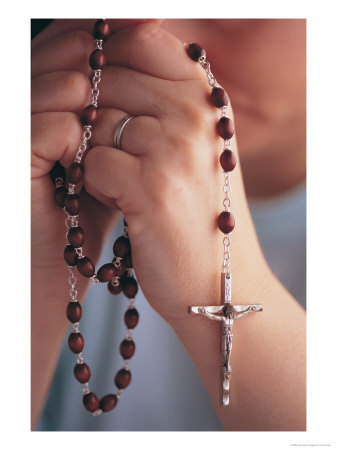
We can also pray the Chaplet of the Seven Sorrows of Mary, meditate upon the Seven Sorrows, pray the Rosary, or spend time contemplating John 19:25–27.
And perhaps most importantly, we can ask ourselves:
Who is standing at a cross today who needs me to stand beside them?
For devotion to Our Lady of Sorrows should not only make us contemplate Mary’s compassion.
It should make us more compassionate.
Prayer to Our Lady of Sorrows
Our Lady of Sorrows,
Mother who stood faithfully beneath the Cross,
stand beside us in the crosses of our lives.
When we cannot understand, teach us to trust.
When we cannot change the situation, teach us to remain.
When grief overwhelms us, lead us to your Son.
When others suffer, give us the courage not to abandon them.
Mother of Sorrows,
remember the mothers who weep for their children,
the families torn apart by violence and war,
the sick and the dying,
the lonely and forgotten,
those grieving someone they love,
and all who carry crosses known only to God.
Teach us to stand with you at Calvary,
believing that beyond every Good Friday
God still promises resurrection.
Our Lady of Sorrows, pray for us.
Mary, Mother of the Crucified, pray for us.
Mary, Mother of Hope, pray for us.
Amen.
🙏 Today, let us remember someone who is carrying a heavy cross. Say a prayer for them. Better yet, reach out to them. Sometimes the greatest gift we can give a suffering person is simply to let them know: “You do not have to carry this alone.”