
Our Lady of Guadalupe: When a Mother Came to a Wounded People
When Mary Came — Her Apparitions, Her Messages, and Their Meaning for Our World
Mexico, December 1531.
Imagine living in a world where almost everything familiar has suddenly changed. Your homeland has been conquered, your traditions have been shaken, your people have suffered, and the future is uncertain. You are trying to understand a new political order, a new culture, and a new religion.
This was the world of many Indigenous people in Mexico in 1531, just ten years after the Spanish conquest of the Aztec capital, Tenochtitlan, in 1521. The conquest had brought warfare, devastation, disease, and enormous social upheaval. Christianity was spreading, but it was doing so in a society deeply marked by the inequalities and wounds of colonial rule.
It was against this troubled background that, according to a cherished and officially recognised Catholic tradition, the Blessed Virgin Mary appeared to a humble Indigenous Christian named Juan Diego on Tepeyac Hill, near present-day Mexico City.
Her message would become one of the most beloved expressions of Mary’s maternal care in the history of the Church.
A World Marked by Fear, Sacrifice, and Upheaval
To appreciate the significance of Guadalupe, we must understand something of the religious world that existed before the Spanish conquest.
The Aztec civilisation possessed remarkable achievements in agriculture, architecture, astronomy, art, and social organisation. Yet certain aspects of its religious practices also involved ritual human sacrifice, including the sacrifice of children.
Among the deities worshipped by the Aztecs were Huitzilopochtli, associated with the sun and warfare, and Tlaloc, the god of rain and agricultural fertility. Archaeological discoveries at the Templo Mayor in Mexico City have provided evidence of human sacrifices associated with these religious practices, including the remains of children offered to Tlaloc.
These sacrifices were connected with beliefs about maintaining cosmic order, securing rainfall, and sustaining life. They reflected a religious worldview very different from the Christian understanding of God and the dignity of the human person.
The contrast with the Christian Gospel is profound.
The God revealed by Jesus Christ does not demand that human beings sacrifice their children to earn His favour. Instead, God the Father gives His own beloved Son for the salvation of the world.
“For God so loved the world that he gave his only Son…” (John 3:16).
This is one of the most extraordinary truths of Christianity: salvation is not something humanity purchases through human sacrifice. It is God’s gift of love, revealed through the self-offering of Jesus Christ.
It is important, however, to recognise that the great state-sponsored sacrificial ceremonies of the Aztec Empire had already been disrupted by the Spanish conquest in 1521, ten years before the reported Guadalupe apparitions. We therefore cannot accurately say that Mary’s appearance directly ended those practices.
Nevertheless, Guadalupe emerged during a period of profound religious transformation, when Indigenous communities were struggling with the consequences of conquest and the encounter with Christianity.
And into this wounded world came a message associated not with fear or destruction, but with tenderness, compassion, and maternal love.
A Humble Man Receives an Extraordinary Message
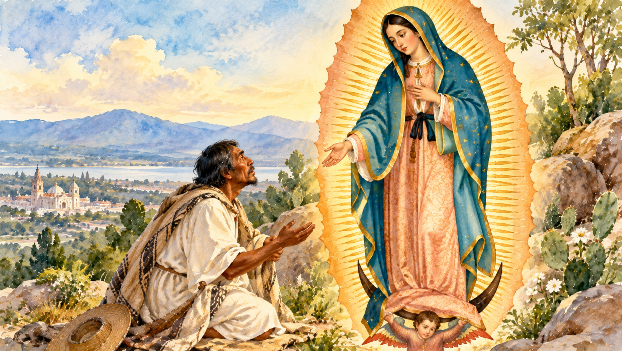
On the morning of December 9, 1531, Juan Diego was making his way towards religious instruction and worship when he heard beautiful birdsong coming from Tepeyac Hill. According to the traditional account, he then heard someone calling him affectionately by name.
When he climbed the hill, he encountered a beautiful woman who identified herself as the ever-Virgin Mary, Mother of the true God.
She spoke to him in Nahuatl, the language of his people. She did not approach him as someone insignificant or unworthy. She addressed him with tenderness and entrusted him with a mission.
Mary asked that a small church be built at that place, where she could make known her love and compassion, hear the cries of those who suffered, and lead people towards God.
Think about the significance of that encounter. In a society where Indigenous people had experienced humiliation and displacement, Mary chose one of them to carry her message to the bishop.
Juan Diego was not selected because of his wealth, education, or social standing. He was entrusted with the mission because, in God’s eyes, human dignity is not measured by worldly importance.
What a powerful reminder for us today! How often do we underestimate ourselves because we are poor, uneducated, unnoticed, or seemingly unimportant? Yet throughout Scripture, God repeatedly chooses ordinary people to accomplish extraordinary things.
The Bishop Asks for a Sign
Juan Diego obediently went to Bishop Juan de Zumárraga and delivered Mary’s request. The bishop listened but was not immediately convinced. He asked for a sign.
Juan Diego returned to Mary, who reassured him and instructed him to come back.
But then an unexpected difficulty arose. Juan Diego’s uncle, Juan Bernardino, became seriously ill. Concerned for his uncle’s life, Juan Diego went in search of a priest. According to the account, he even tried to avoid the place where he had previously encountered Mary, fearing that his mission would delay him.
How human that reaction was! He was worried about someone he loved, and the responsibility entrusted to him seemed overwhelming.
Yet Mary met him again.
Her words, preserved in the traditional account known as the Nican Mopohua, are among the most tender associated with any Marian apparition:
“Am I not here, I who am your Mother?”
She reassured Juan Diego that he was under her maternal protection and that his uncle would recover.
Those words were spoken to one man in a particular historical moment, but their spiritual meaning continues to comfort countless people today.
Mary does not promise us a life without suffering. Rather, as our spiritual Mother, she accompanies us in our difficulties and intercedes for us before her Son.
The Roses and the Miraculous Image
Mary instructed Juan Diego to climb the hill and gather flowers. According to the traditional narrative, he found beautiful roses blooming in the cold of December, an unexpected sight on that rocky hillside.
He gathered them in his tilma, a simple cloak made from plant fibre, and carried them to the bishop.
When Juan Diego opened his tilma, the roses fell to the ground. The account tells us that an image of the Blessed Virgin Mary appeared upon the fabric.
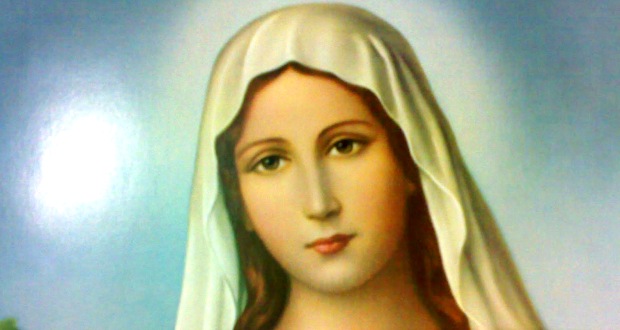
The image showed a young woman with her head bowed, her hands joined in prayer, a blue-green mantle decorated with stars, and a dark sash around her waist. Her appearance and the imagery of her clothing carried meanings that resonated with the Indigenous people of Mexico.
She was not presented as a distant European queen. Her image spoke to the people among whom the reported apparition had taken place.
And, importantly, her bowed head and prayerful hands directed attention beyond herself, towards the God she served.
The image associated with these events is still venerated at the Basilica of Our Lady of Guadalupe in Mexico City.
What Happened After Guadalupe?
The devotion to Our Lady of Guadalupe became deeply rooted in Mexican Catholic life and developed into one of the most influential Marian devotions in the world.
A shrine arose at Tepeyac, and over the centuries Guadalupe became a place of pilgrimage, prayer, conversion, and renewed faith. The image became an important symbol of Mexican religious and cultural identity, especially for Indigenous and mixed-heritage communities.
The devotion is also closely associated with the growth of Christianity in Mexico. Although popular accounts sometimes attribute millions of conversions directly to the apparitions, such numerical claims should be treated carefully. The wider history of evangelisation involved many people and complex social circumstances.
Nevertheless, the enduring spiritual importance of Guadalupe is unmistakable.
In 2002, Pope Saint John Paul II canonised Juan Diego, recognising his holiness and his place in the life of the Church. Today, millions of pilgrims visit the Basilica of Our Lady of Guadalupe, and her feast is celebrated on December 12.
The woman who, according to tradition, appeared to one humble man has become a beloved Mother to generations of believers.
What Is Our Lady of Guadalupe Saying to Us Today?
Although the events are associated with sixteenth-century Mexico, their lessons are remarkably relevant to our own world.
First, every human life is sacred. The contrast between ancient practices of human sacrifice and the Christian proclamation of God’s love reminds us that human beings are not objects to be used or discarded. Every person, from the unborn child to the elderly, from the wealthy to the poor, possesses an inherent dignity that must be respected and protected.
Second, no human being is insignificant to God. Mary entrusted her message to Juan Diego, a man with little social influence. We live in societies where wealth, education, appearance, nationality, and social status often determine how people are treated. Guadalupe challenges us to recognise the dignity of every person, especially those who are overlooked or marginalised.
Third, God does not abandon people in their suffering. Mary came, according to the tradition, to a people experiencing tremendous uncertainty. Today, families struggle with poverty, violence, displacement, illness, and fear about the future. Guadalupe reminds us that God’s love reaches into the very places where people are hurting.
Fourth, faith must be expressed through compassion. Mary asked for a place where suffering people could find comfort and spiritual help. Our churches, families, and communities should reflect that same welcoming love. Do people who are grieving, struggling financially, or burdened by past mistakes find compassion when they encounter us?
Fifth, God can work through our willingness, even when we feel inadequate. Juan Diego was hesitant, and his circumstances were difficult, yet he continued responding to the mission entrusted to him. We too may feel unqualified to serve God. But holiness begins not with extraordinary ability, but with a willing heart.
And finally, Mary always leads us to Jesus Christ. Her message at Guadalupe was not an invitation to worship her. It was an invitation to encounter the true God, to trust His love, and to discover His mercy.
That remains the purpose of authentic Marian devotion.
A Mother’s Message That Still Speaks
There is something deeply moving about the fact that Mary’s message at Guadalupe was delivered in the language of the people who needed to hear it.
She did not demand that Juan Diego first become powerful or important. She met him in the circumstances of his ordinary life, listened to his concerns, reassured him, and sent him forward with a mission.
Perhaps that is one of the greatest lessons of Guadalupe.
God knows where we are. He knows the burdens we carry, the fears we struggle with, and the responsibilities that sometimes overwhelm us. Through Mary’s maternal example, we are reminded that faith is not an escape from these realities. It is a way of facing them with greater trust, courage, and love.
And just as Mary encouraged Juan Diego to carry her message to others, she invites us to become messengers of God’s compassion in our own homes, workplaces, parishes, and communities.
The question for us is not simply whether we admire the story of Guadalupe.
The question is whether we are willing to become instruments of the same love, dignity, and compassion that her message proclaimed.
Let Us Pray
Our Lady of Guadalupe, loving Mother of Jesus and our Mother, you came to a people wounded by suffering and uncertainty, bringing a message of tenderness, hope, and trust in God.
Pray for our world today, especially for those affected by war, poverty, injustice, displacement, and discrimination. Help us to recognise the dignity of every person, regardless of their background, circumstances, or position in society.
Mother Mary, intercede for families burdened by illness, for parents anxious about their children, and for those who feel forgotten or unworthy of God’s love.
Teach us the humility and courage of Saint Juan Diego. Help us to listen when God calls, to trust Him when the road is difficult, and to carry His compassion to those who need it most.
Above all, lead us ever closer to your Son, Jesus Christ, who alone is our Saviour and the source of our hope.
Our Lady of Guadalupe, pray for us. Amen.
Fully Catholic — Sharing the Joy of the Faith