The Assumption of Mary: A Promise of What God Intends for Us
Please click on the “Play” button to lieten to the audio of this post.
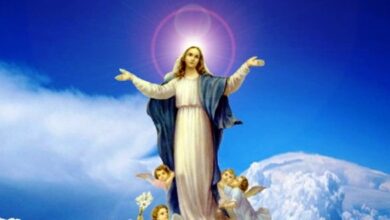
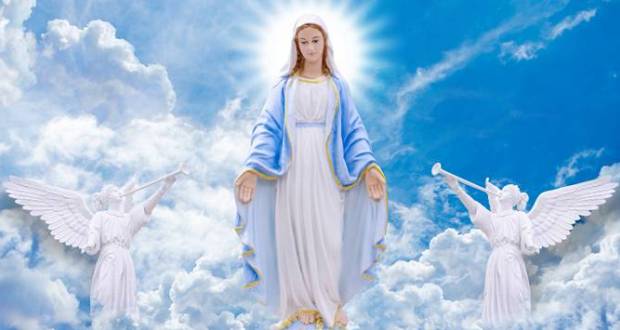
Today the Church celebrates one of the most beautiful and hope-filled feasts of the Blessed Virgin Mary: the Solemnity of the Assumption of the Blessed Virgin Mary.
It is a feast about Mary, certainly. But if we understand it properly, we discover that the Assumption is also a feast about Jesus Christ, the Resurrection, the destiny of the human body, and the glorious future God desires for His people.
The Church teaches that:
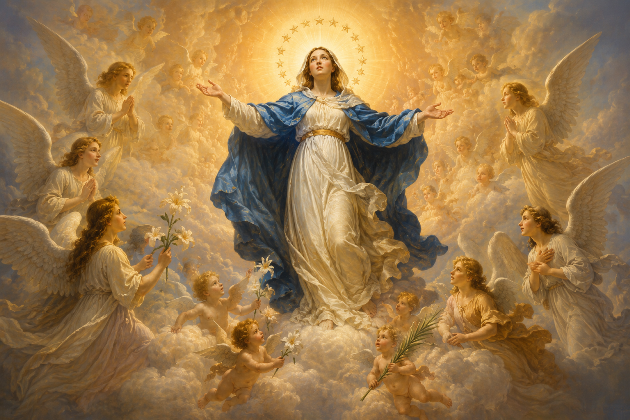
At the end of her earthly life, the Blessed Virgin Mary was taken body and soul into the glory of heaven.
This is not to say that Mary ascended into heaven by her own power. Christ ascended; Mary was assumed. Jesus, the divine Son, returns to the Father by His own divine power. Mary, a creature redeemed by Christ, is taken into heavenly glory entirely by the grace and power of God.
And this distinction is important.
The Assumption does not make Mary divine. It reveals instead what the grace of God can accomplish in a human person who belongs completely to Christ.
Where Does the Church Get This Teaching?
Some may object that nowhere in Scripture do we read the sentence, “Mary was assumed body and soul into heaven.”
That is true. But Catholic doctrine is not based upon isolated sentences of Scripture. The Church reads Scripture as a whole, within the Apostolic Tradition handed down through the centuries.
And today’s readings allow us to see the Assumption within the great story of salvation.
The first reading takes us into the mysterious imagery of Revelation:
“God’s temple in heaven was opened, and the ark of his covenant could be seen in the temple.”
Immediately afterward, St. John sees:
“A great sign appeared in the sky, a woman clothed with the sun, with the moon under her feet, and on her head a crown of twelve stars.”
The woman in Revelation 12 has several dimensions of meaning. She represents the people of God, Israel and the Church, but Catholic tradition has also seen in her an image of Mary, the Mother of the Messiah.
And notice what appears immediately before the woman: the Ark of the Covenant.
That connection is extraordinarily significant.
Mary, the New Ark of the Covenant
The ancient Ark carried the signs of God’s covenant and His presence among His people.
But Mary carried within her womb Jesus Christ Himself.
The old Ark carried the word of God written upon stone.
Mary carried the Word made flesh.
The old Ark was overshadowed by the glory of God.
At the Annunciation, the Holy Spirit overshadowed Mary.
The Ark therefore finds a profound fulfillment in Mary—not because of anything Mary possesses independently of God, but because of the One whom she carried.
She is the living Ark of the New Covenant.
How fitting, then, that the woman associated with the heavenly Ark should be presented in glory: clothed with the sun and crowned with twelve stars.
“Christ Has Been Raised From the Dead”
But perhaps the theological heart of today’s celebration is found in the second reading from 1 Corinthians 15.
St. Paul declares:
“Christ has been raised from the dead, the firstfruits of those who have fallen asleep.”
This is essential to understanding the Assumption.
Christianity does not teach merely that the soul survives death. We profess every Sunday in the Creed:
“I look forward to the resurrection of the dead and the life of the world to come.”
God intends to redeem the whole human person—body and soul.
Death separates body and soul. The resurrection reunites them in glory.
What the Church believes will happen to the faithful at the resurrection of the dead has, through a singular grace of God, already been accomplished in Mary.
Her Assumption is therefore not an alternative to the Resurrection of Christ.
It is a consequence of it.
Christ is the firstfruits.
Mary is the first and most perfect participation in the victory of her Son.
Why Mary?
Why should this privilege be given to her?
The answer begins not with Mary, but with Jesus.
Everything the Church teaches authentically about Mary ultimately protects or illuminates some truth about Christ.
Mary’s Immaculate Conception points to the saving grace of Christ.
Her divine motherhood proclaims that Jesus Christ is truly God and truly man.
Her perpetual virginity points toward her complete consecration to God.
And her Assumption proclaims the victory of Christ over sin and death.
Mary was uniquely united to Jesus from the beginning of His earthly life.
She gave Him His human flesh.
She carried Him in her womb.
She gave birth to Him.
She nurtured Him.
She followed Him.
She stood beneath His Cross.
She remained with the disciples.
And therefore the Church sees a profound fittingness in the fact that the body from which the Son of God received His humanity would not ultimately remain subject to the corruption of the grave.
In 1950, Pope Pius XII solemnly defined the doctrine of the Assumption, declaring that Mary, having completed the course of her earthly life, “was assumed body and soul into heavenly glory.”
Notice the careful language: having completed the course of her earthly life.
The dogma does not settle the ancient question of precisely how Mary’s earthly life ended. Eastern Christianity has long spoken beautifully of the Dormition, or “falling asleep,” of the Mother of God. What the Church definitively teaches is what followed: Mary was taken body and soul into heavenly glory.
“My Soul Proclaims the Greatness of the Lord”
Then we come to today’s Gospel.
Mary visits Elizabeth, and from this encounter bursts forth one of the greatest prayers in all of Scripture—the Magnificat:
“My soul proclaims the greatness of the Lord; my spirit rejoices in God my Savior.”
These words are particularly beautiful on the Feast of the Assumption because Mary herself tells us where our attention should be directed.
To God.
Mary does not say, “Look what I have accomplished.”
She says:
“The Almighty has done great things for me.”
That sentence is almost a key to understanding the whole of Marian theology.
The Immaculate Conception?
The Almighty has done great things for me.
The Annunciation?
The Almighty has done great things for me.
The Incarnation?
The Almighty has done great things for me.
The Assumption?
The Almighty has done great things for me.
Authentic devotion to Mary never ends with Mary.
Mary continually points beyond herself and says:
Look what God has done.
A Woman Who Believed
Before Mary sings the Magnificat, Elizabeth says something profoundly important:
“Blessed are you who believed that what was spoken to you by the Lord would be fulfilled.”
Mary’s greatness is not merely biological. She did not simply give birth to Jesus.
She believed.
She trusted.
She surrendered.
She said:
“Let it be done to me according to your word.”
And then she lived that yes.
Her fiat was not one moment of obedience. It became the orientation of her entire life.
At Nazareth: yes.
At Bethlehem: yes.
During the hidden years: yes.
When she did not understand: yes.
At Cana: yes.
On Calvary: yes.
At Pentecost: yes.
Her life became one long surrender to God.
And the Assumption shows us where that surrender ultimately leads:
into the fullness of life with God.
Mary’s Assumption Is Also About Us
This may be the most important point for us today.
We can admire Mary from such a distance that we miss what God is saying to us through her.
Mary is unique, certainly. She is the Mother of God and was given privileges that belong uniquely to her vocation.
But Mary is also the first and most perfect disciple and an image of what the Church herself is called to become.
What God has already accomplished in Mary anticipates what He intends ultimately to accomplish in His faithful people.
Her Assumption therefore says to every Christian:
Death does not have the final word.
The grave does not have the final word.
Suffering does not have the final word.
Sin does not have the final word.
Christ does.
St. Paul tells us today that Christ must reign until He has placed all His enemies beneath His feet:
“The last enemy to be destroyed is death.”
And in Mary’s Assumption we glimpse, ahead of time, what that victory looks like.
A human person.
Body and soul.
Completely redeemed.
Completely alive.
Completely united with God.
Our Bodies Matter to God
The Assumption also challenges one of the great misunderstandings of Christianity.
Our bodies are not disposable containers from which our souls eventually escape.
The body matters to God.
The Son of God took a human body.
He suffered in a human body.
He died in a human body.
He rose with a glorified human body.
And Mary is assumed body and soul into heaven.
Christian salvation is therefore not an escape from creation. It is the redemption and transformation of creation.
That means what we do with our bodies matters.
How we treat ourselves matters.
How we treat other people matters.
Human dignity matters.
The poor matter.
The elderly matter.
The unborn matter.
The sick matter.
The disabled matter.
Every human person possesses a dignity that cannot be measured by usefulness, productivity, wealth, beauty, strength, age or social status.
The Assumption reminds us of the extraordinary destiny for which the human person was created.
The Queen Stands at Your Right Hand
Today’s responsorial psalm gives us another beautiful image:
“The queen stands at your right hand, arrayed in gold.”
The Church has long seen in this an image that finds a beautiful fulfillment in Mary, the Queen Mother of the messianic King.
But Mary’s queenship must always be understood through Christ.
She is Queen because He is King.
Her glory comes from His glory.
Her holiness comes from His grace.
Her victory comes from His victory.
And her intercession comes from her relationship with Him.
That is why Catholics ask Mary to pray for us.
We do not worship Mary.
We ask her to do what Christians have always asked one another to do:
Pray for me.
But in Mary’s case, we ask the woman who is already completely united with her Son in heavenly glory.
And what should we ask her to pray for?
Our families.
Our Church.
Our world.
Those who have abandoned their faith.
Those who have never encountered Christ.
Those trapped in sin.
Those who believe themselves beyond God’s mercy.
Those who do not yet know how deeply they are loved by God.
We ask Mary to intercede especially for the conversion of souls, so that others may come to know the Son whom she carried into the world.
Where Mary Is, She Wants Us to Be
The Assumption is not merely Mary’s destination.
It points toward ours.
Mary has reached the destination toward which the Church is travelling.
She stands before us as a sign of hope, showing us what God’s grace intends to accomplish in those who belong to Christ.
And perhaps today, from the glory of heaven, Our Blessed Mother continues to give us the same instruction she gave the servants at Cana:
“Do whatever He tells you.”
Follow Him.
Trust Him.
Listen to Him.
Receive His mercy.
Remain close to Him.
Give Him your yes.
Because Mary’s Assumption tells us something extraordinarily beautiful:
Heaven is not an idea.
Resurrection is not a metaphor.
Eternal life is not wishful thinking.
Jesus Christ has conquered death.
And Mary, assumed body and soul into heavenly glory, stands as a radiant sign that the promises of God are true.
So today we rejoice with her.
We honour her.
We ask for her prayers.
And with Mary, our Mother and Queen, we proclaim:
“My soul proclaims the greatness of the Lord; my spirit rejoices in God my Savior.”
For indeed,
the Almighty has done great things for her.
And through Jesus Christ, He desires to do great things in us as well.
Prayer to Our Lady of the Assumption
Blessed Virgin Mary,
Mother of Jesus and Mother of the Church,
today we rejoice in the glory
to which your Son has raised you.
You who trusted the word of God,
you who gave your wholehearted yes,
you who carried Jesus within you
and brought Him into the world,
pray that we too may surrender our lives completely to Him.
Our Lady assumed into heaven,
pray for the Church.
Pray for our families.
Pray for those who have lost their way.
Pray for those whose hearts have grown cold.
Pray for those who have abandoned the faith
and for those who have never truly encountered your Son.
Mother Mary,
we entrust to your intercession
the conversion of souls throughout the world.
Pray that hardened hearts may be softened,
that blinded eyes may be opened,
that those imprisoned by sin may discover the freedom of Christ,
that those who have lost hope may encounter His mercy,
and that every soul may come to know
the immeasurable love of Jesus.
Mother of God and our Mother,
take our prayers to your Son.
Teach us to say yes as you said yes.
Teach us to trust when we cannot see.
Teach us to remain faithful beneath the Cross.
Teach us to treasure Jesus above everything else.
And when our earthly pilgrimage is complete,
pray that we may share with you and all the saints
in the resurrection of the dead
and the everlasting joy of heaven.
Our Lady of the Assumption, pray for us.
Mary, Queen of Heaven, pray for us.
Mary, Mother of the Church, pray for us.
And through your maternal intercession,
may many souls come home to Jesus Christ,
our Lord and our Savior.
Amen.