Melchizedek, Jesus and the Eucharist: Why Bread and Wine?
Have you ever wondered why Jesus chose bread and wine at the Last Supper?
Why not something else?
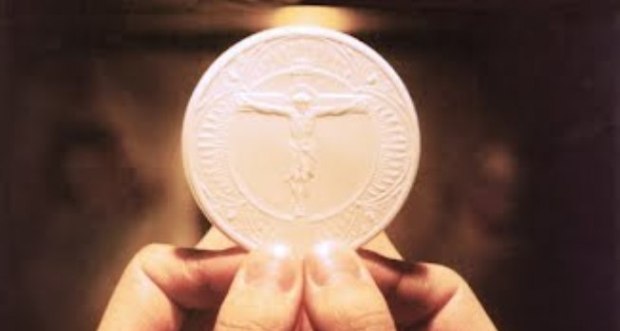
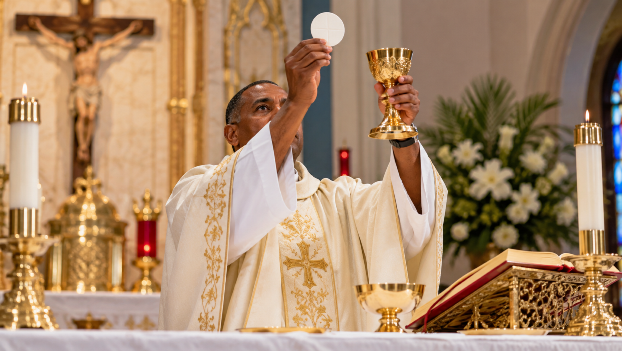
For Catholics, bread and wine are so familiar that we can easily take them for granted. At every celebration of the Holy Eucharist, bread and wine are brought to the altar. Through the words of consecration and the power of the Holy Spirit, they become the Body and Blood of Jesus Christ.
But the story of bread and wine did not begin in the Upper Room.
To understand something of the extraordinary biblical background to the Eucharist, we need to travel far back into the Old Testament—to the time of Abraham—and meet one of the most mysterious figures in all of Sacred Scripture.
His name is Melchizedek.
A Mysterious Priest Appears
Melchizedek appears briefly in Genesis 14.
Abram, who would later be called Abraham, had returned victorious after rescuing his nephew Lot. Then Scripture tells us:
“And King Melchizedek of Salem brought out bread and wine; he was priest of God Most High.”
— Genesis 14:18
Melchizedek blesses Abram, saying:
“Blessed be Abram by God Most High, maker of heaven and earth.”
Abram then gives Melchizedek a tenth of everything.
And almost as suddenly as he appears, Melchizedek disappears from the Genesis narrative.
Only a few verses are devoted to him.
Yet those verses become enormously important for understanding the priesthood of Jesus Christ—and, within Catholic tradition, the Eucharist.
Who Was Melchizedek?
Scripture tells us several remarkable things about him.
Melchizedek is both king and priest.
He is the king of Salem and the priest of God Most High.
His name is understood in the Letter to the Hebrews as meaning “king of righteousness,” while “king of Salem” is associated with “king of peace” (Hebrews 7:2).
And what does this priest bring forth?
Bread and wine.
Already, Christians cannot help noticing something familiar.
A priest.
A king.
Righteousness.
Peace.
Bread.
Wine.
But Genesis is only the beginning.
“You Are a Priest Forever”
Much later, Psalm 110 contains a mysterious prophecy:
“You are a priest forever according to the order of Melchizedek.”
— Psalm 110:4
This is extraordinary because Israel already possessed an established priesthood associated with Aaron and the tribe of Levi.
Yet the promised Messiah would possess another kind of priesthood.
He would be:
“a priest forever according to the order of Melchizedek.”
The Letter to the Hebrews reveals the fulfillment of this prophecy.
It is Jesus Christ.
Jesus, Our Eternal High Priest
Hebrews repeatedly applies Psalm 110 to Jesus.
Christ is not a priest because He belongs to the tribe of Levi. In fact, Jesus comes from the tribe of Judah.
His priesthood is different.
His is the eternal priesthood foretold in the Psalms—the priesthood associated with Melchizedek.
Hebrews tells us:
“You are a priest forever, according to the order of Melchizedek.”
— Hebrews 5:6
The mysterious Old Testament priest therefore becomes what Catholic tradition calls a prefiguration or type of Christ.
This does not mean that Melchizedek was Jesus or that everything about the two is identical.
Rather, God allowed something to appear earlier in salvation history that would point toward a much greater reality to come.
Melchizedek points beyond himself.
He points toward Jesus Christ, our eternal High Priest.
Melchizedek and the Eucharist
And now we return to the bread and wine.
The Catholic Church explicitly recognizes the connection.
The Catechism of the Catholic Church states:
“The Church sees in the gesture of the king-priest Melchizedek, who ‘brought out bread and wine,’ a prefiguring of her own offering.”
— CCC 1333
This is important.
Genesis tells us that Melchizedek “brought out bread and wine” and identifies him as priest of God Most High. The text itself does not explicitly say that he sacrificed the bread and wine.
Nevertheless, the Church has long recognized in his gesture a foreshadowing of the Eucharistic offering.
And suddenly the biblical picture becomes even more beautiful.
From Melchizedek to the Upper Room
Centuries after Melchizedek, Jesus gathers His Apostles in the Upper Room.
The One whom Scripture identifies as the eternal priest according to the order of Melchizedek takes bread.
He gives thanks.
He breaks it.
And He says:
“This is my body.”
Then He takes the cup of wine and declares it to be His Blood of the covenant.
And He commands His Apostles:
“Do this in memory of me.”
The bread and wine associated with the mysterious priest in Genesis now find a far greater fulfillment in the hands of Jesus Christ, the eternal High Priest.
But there is an enormous difference.
Melchizedek brings bread and wine.
Jesus gives Himself.
Jesus Is Both Priest and Victim
This takes us to the heart of the mystery of the Cross.
At Calvary, Jesus is not merely the victim being sacrificed.
He is also the High Priest who offers the sacrifice.
The priest is Jesus.
The victim is Jesus.
The offering is Jesus Himself.
He does not offer an animal or some possession separate from Himself.
He offers His own life to the Father for the salvation of the world.
This sacrifice is offered once for all.
The Mass therefore does not mean that Catholics believe Jesus is being sacrificed over and over again.
There is only one sacrifice of Christ.
Calvary happened once.
Rather, in the Holy Eucharist, that one sacrifice of Christ is made sacramentally present to us.
The altar therefore leads us directly to the Cross.
An Extraordinary Biblical Pattern
Place these passages beside one another and a remarkable pattern emerges.
Genesis 14:
Melchizedek appears as king and priest and brings forth bread and wine.
Psalm 110:
The promised Messiah is declared to be “a priest forever according to the order of Melchizedek.”
Hebrews 5–7:
Jesus is identified as that eternal High Priest.
The Last Supper:
Jesus takes bread and wine and gives us His Body and Blood.
Calvary:
The eternal High Priest offers Himself for the salvation of the world.
The Holy Eucharist:
The Church continues to obey Christ’s command, “Do this in memory of me,” as His one sacrifice is sacramentally made present.
What begins as a mysterious encounter with Abraham in Genesis eventually points us toward the altar.
Melchizedek Is Even Remembered at Mass
There is another beautiful detail that many Catholics may never have noticed.
Melchizedek is actually mentioned in the Church’s Eucharistic liturgy.
In Eucharistic Prayer I, the Roman Canon, the Church recalls the offerings of Abel, Abraham and Melchizedek:
“…the offering of your high priest Melchizedek, a holy sacrifice, a spotless victim.”
So this mysterious priest from Genesis has not disappeared from Christian worship.
Thousands of years after the encounter between Abraham and Melchizedek, his name continues to be heard at Catholic altars throughout the world.
But Melchizedek Is Only Part of the Story
The connection with Melchizedek does not mean that he alone explains why Christ chose bread and wine.
The Eucharist stands at the convergence of many biblical themes.
There is Melchizedek and his bread and wine.
There is the Passover, when God’s people were delivered from slavery through the sacrifice of the lamb.
There is the manna in the wilderness, the bread God gave Israel from heaven.
There is the Bread of the Presence associated with Israel’s worship.
There is Jesus multiplying the loaves to feed the multitude.
There is Christ’s extraordinary teaching in John 6:
“I am the bread of life.”
And:
“The bread that I will give for the life of the world is my flesh.”
Then comes the Last Supper.
Then Calvary.
Then the Resurrection.
Then the disciples recognizing the risen Jesus at Emmaus “in the breaking of the bread.”
And then the early Church continuing faithfully in the teaching of the Apostles, fellowship, prayer and the breaking of bread.
These are not isolated episodes.
Together they form an extraordinary biblical tapestry.
The Old Testament Points Forward
This is one of the great beauties of reading Scripture through the lens of salvation history.
The Old and New Testaments belong together.
Events, people and signs in the Old Testament can prepare God’s people for realities that are revealed more fully in Christ.
Melchizedek is one such figure.
The mysterious king-priest appears for only a moment in Genesis.
Yet centuries later the Psalmist speaks of his priesthood.
Then Hebrews takes us deeper into its meaning.
And ultimately our attention is directed not toward Melchizedek himself, but toward Jesus Christ.
Melchizedek was the sign.
Christ is the fulfillment.
Melchizedek was the priest who brought forth bread and wine.
Jesus is the eternal High Priest who gives us Himself under the appearances of bread and wine.
The Next Time You Are at Mass…
Perhaps the next time we see the bread and wine being carried toward the altar, we might look at them differently.
We are witnessing something whose biblical roots stretch back thousands of years.
Think of Abraham.
Think of Melchizedek.
Think of the Passover.
Think of manna falling in the wilderness.
Think of Jesus feeding the multitude.
Think of His words: “I am the bread of life.”
Think of the Upper Room.
Think of Calvary.
Think of the empty tomb.
Think of Emmaus and the breaking of bread.
And then look toward the altar.
The mysterious threads running through salvation history have led us there—to Jesus Christ, our eternal High Priest, who continues to nourish His Church with the gift of Himself.
And perhaps Psalm 110 will never sound quite the same again:
“You are a priest forever according to the order of Melchizedek.”
Scripture for Further Reading
Genesis 14:17–20; Psalm 110:1–4; Hebrews 5:1–10; Hebrews 6:19–20; Hebrews 7; John 6:22–59; Matthew 26:26–29; Luke 22:14–20; Luke 24:13–35; Acts 2:42.
Catholic References
Catechism of the Catholic Church, especially CCC 1333 and the sections concerning the Eucharist as sacrifice and Christ’s priesthood.