
The Communion of Saints: We Are Never Alone
An All Saints’ Day Reflection on One of the Most Beautiful Truths of Our Catholic Faith
Have you ever stopped to think about what you are actually saying when you recite the Creed?
We say it so often that sometimes the words just roll off our tongues without our giving them much thought.
“I believe in God, the Father Almighty…”
And a little further on:
“I believe in the Holy Spirit, the holy Catholic Church, the communion of saints…”
The Communion of Saints.
What a beautiful expression! But what does it actually mean?
Does it simply mean that we believe there are saints in heaven? Does it mean that we can ask St. Anthony to help us find something we’ve lost, or St. Jude to intercede for us when things seem hopeless?
Well, yes, asking the saints for their prayers is part of it. But the Communion of Saints is something much bigger, much deeper, and far more beautiful than many of us realise.
It means that, in Jesus Christ, we belong to a family that even death cannot destroy.
And on this Solemnity of All Saints, that is something worth celebrating!
One Family, Three States of Life
One of the first things we need to understand is that the Church is much bigger than the people we see sitting in the pews on Sunday morning.
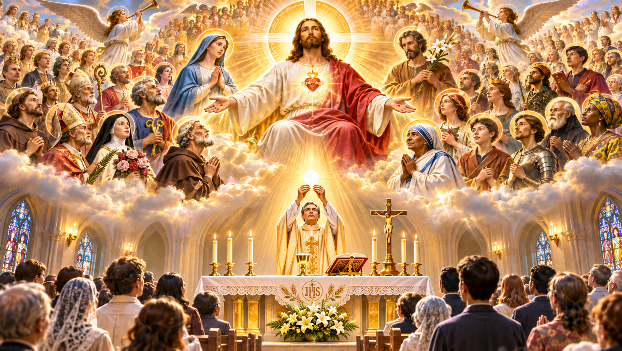
The Church includes those who are living here on earth, those who have died and are being purified in preparation for heaven, and those who are already enjoying the glory of God.
Traditionally, the Church speaks of these as three states of the one Church.
The Church Militant — Those of Us Still on Earth
That’s you and me!
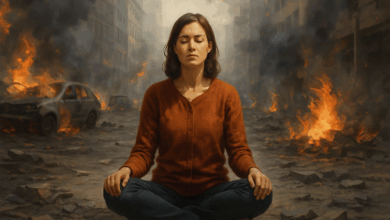
We are called the Church Militant, not because we are supposed to be fighting other people, but because we are engaged in a spiritual struggle.
We struggle against sin. We wrestle with temptation. We try to grow in holiness. We fall, we repent, we get up, and with God’s grace, we keep going.
Some days we do well. Other days, not so well.
But we are all on the journey, and we are not travelling alone.
The Church Suffering — Those Being Purified
These are our brothers and sisters who have died in God’s friendship but are still undergoing the purification necessary to enter fully into the joy of heaven.
We commonly refer to them as the souls in Purgatory.
They are not lost. They belong to Christ. Their salvation is assured, but their purification is not yet complete.
And here is something wonderful: we can pray for them.
Our prayers, especially the offering of the Holy Sacrifice of the Mass, can assist them.
Isn’t that a beautiful expression of love? That even after someone has died, our love for that person can still be expressed through prayer?
The Church Triumphant — Those Already in Heaven
And then there are those who have completed the journey.
They have fought the good fight. They have finished the race. They now behold God face to face.
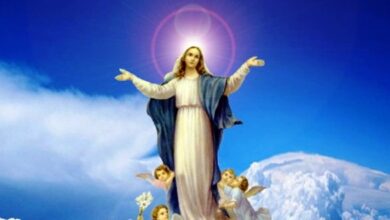
These are the saints in heaven.
Some are well known to us: St. Peter, St. Paul, St. Francis of Assisi, St. Catherine of Siena, St. Thérèse of Lisieux, and countless others.
But many more are people whose names we have never heard.
They may have been ordinary mothers and fathers, teachers, farmers, nurses, labourers, grandparents, or children who lived lives of extraordinary love and faithfulness to God.
They may even include members of our own families!
And today, on All Saints’ Day, we celebrate all of them — the canonised and the uncanonised, the famous and the unknown.
But Are We Really Connected to Them?
This is where the Communion of Saints becomes especially beautiful.
St. Paul tells us:
“Now you are the body of Christ and individually members of it.” — 1 Corinthians 12:27
Think about that for a moment.
We are not simply individuals who happen to believe in the same God. Through Baptism, we are united to Jesus Christ and, through Him, to one another.
We are members of His Body.
And because Christ has conquered death, death does not sever that union.
Jesus Himself tells us:
“He is God not of the dead, but of the living.” — Mark 12:27
Those who have died in Christ have not ceased to exist. They are alive in Him.
So the Church in heaven and the Church on earth are not two completely separate families.
We are one family in Christ.
The saints in heaven are not strangers who have gone away and forgotten about us. They remain united with us in Christ, and they intercede for us before God.
And that brings us to a question that is sometimes raised, especially by our non-Catholic brothers and sisters.
Why Ask the Saints to Pray for Us When We Can Go Directly to Jesus?
It’s a fair question, and it deserves a thoughtful answer.
First of all, let us be absolutely clear.
Jesus Christ is our one Mediator between God and humanity.
St. Paul tells us precisely that in 1 Timothy 2:5.
Nothing in Catholic teaching changes or diminishes that truth.
We do not need a saint to give us access to Jesus. We can and should speak directly to Him every day.
But consider this.
Have you ever asked a friend to pray for you?
Perhaps you were ill, worried about your children, preparing for an examination, or going through a difficult time.
You might have said, “Please keep me in your prayers.”
Why did you do that?
Was it because you couldn’t pray to God yourself?
Of course not!
You asked because you believed that the prayers of others matter.
And Scripture encourages precisely this.
St. James tells us:
“Pray for one another, so that you may be healed. The prayer of the righteous is powerful and effective.” — James 5:16
Now, if we can ask our brothers and sisters here on earth to pray for us, why would we imagine that those who are perfectly united to Christ in heaven can no longer pray for us?
The Book of Revelation gives us a beautiful glimpse of heavenly worship, where the prayers of God’s holy people are presented before Him (Revelation 5:8; 8:3–4).
So when we ask Our Lady, St. Joseph, St. Francis, or any of the saints to pray for us, we are not replacing Jesus.
We are asking members of His Body to join us in prayer to Him.
All Christian prayer, whether offered on earth or in heaven, draws its power from Jesus Christ.
And let us remember something else: Catholics do not worship the saints.
Worship belongs to God alone.
We honour the saints because of what God’s grace accomplished in their lives, and we ask them to intercede for us.
That is a very important distinction.
The Communion of Saints Is Also About Sharing
There is another dimension to the Communion of Saints that we sometimes overlook.
It is not only about the people who belong to Christ. It is also about the spiritual blessings we share in Christ.
The Catechism of the Catholic Church explains this beautifully in paragraphs 946–953.
We share in one faith, one Baptism, the sacraments, spiritual gifts, and the fruits of charity.
Above all, we share in the Eucharist.
In fact, the expression Communion of Saints has two closely connected meanings: communion among holy persons and communion in holy things.
And this has very practical consequences.
When one member of Christ’s Body suffers, the others are called to care.
When someone is struggling, we pray for them.
When someone is hungry, we feed them.
When someone is lonely, we visit them.
When someone has fallen into sin, we encourage them toward repentance and reconciliation.
And when someone is grieving, we stand beside them.
The Communion of Saints is not simply a beautiful idea about heaven.
It is a call to live differently here on earth.
Our lives are connected. Our prayers matter. Our acts of charity matter. Our faithfulness matters.
And, sadly, our sins also wound the communion we share.
That is why the Sacrament of Reconciliation is so important. Through God’s mercy, it restores not only our relationship with Him but also heals the communion that sin has wounded.
Every Mass Is a Meeting of Heaven and Earth
Now here is something that I find particularly moving.
Have you ever considered that when you attend Holy Mass, you are participating in something far greater than what your eyes can see?
We see the priest, the altar, the congregation, the candles, and the sacred vessels.
But the Eucharistic celebration is not merely an earthly gathering.
It is a participation in the heavenly worship of God.
The Letter to the Hebrews speaks of our approaching the heavenly Jerusalem, the angels in festal gathering, and the assembly of those made perfect (Hebrews 12:22–24).
And during the Mass, just before the Sanctus, the Church invites us to join the angels and saints in praising God.
Then together we proclaim:
“Holy, Holy, Holy Lord God of hosts. Heaven and earth are full of your glory.”
Heaven and earth!
Not heaven alone. Not earth alone.
There is something profoundly beautiful about that.
The next time you attend Mass, particularly when you are feeling lonely or grieving the loss of someone you love, remember that you are not simply standing among the people physically present in your parish church.
You are participating in the worship of the whole Church, united in Christ.
And while we must not presume to know the eternal state of any particular person who has died, we can entrust our departed loved ones to God’s mercy and remain united with them through prayer.
The Eucharist reminds us that the love of Christ is stronger than death.
The Saints Are Not Just People to Admire
Sometimes we can make the saints seem so extraordinary that we forget they were human beings just like us.
They had weaknesses. They faced temptation. They experienced suffering, disappointment, and fear.
Some made serious mistakes before surrendering their lives to God.
Think of St. Peter, who denied Jesus three times.
Think of St. Paul, who once persecuted the Church.
Think of St. Augustine, who spent years searching for happiness in all the wrong places.
Their holiness did not come from being naturally perfect.
It came from allowing God’s grace to transform them.
And this is important because holiness is not reserved for a select few.
Every baptised Christian is called to become a saint.
That includes you.
That includes me.
And perhaps this is one of the most important messages of All Saints’ Day.
We are not celebrating people who achieved something completely beyond our reach.
We are celebrating what God can accomplish in ordinary human lives when people cooperate with His grace.
The same Holy Spirit who strengthened the martyrs, inspired the great missionaries, and sustained the saints in their struggles is the Holy Spirit given to us.
The question is whether we are willing to let Him transform us.
The Great Multitude That No One Could Count
The first reading for the Solemnity of All Saints, from Revelation 7, gives us a magnificent picture of heaven.
St. John sees a great multitude that no one can count, from every nation, race, people, and tongue, standing before the throne and before the Lamb.
What an extraordinary vision!
People from every corner of the world.
Different languages. Different cultures. Different histories.
But all united in worship before God.
And the Gospel for today’s solemnity gives us the Beatitudes (Matthew 5:1–12).
Blessed are the poor in spirit.
Blessed are those who mourn.
Blessed are the meek.
Blessed are the merciful.
Blessed are the pure in heart.
Blessed are the peacemakers.
These are not simply beautiful sayings.
They are a portrait of the life of holiness to which Jesus calls us.
The saints are those who, through God’s grace, allowed these words to shape their lives.
And Jesus invites us to do the same.
So What Does It Mean When We Say, “I Believe in the Communion of Saints”?
It means that I believe I belong to something far greater than myself.
It means I believe that my brothers and sisters in Christ are not strangers, but members of the same spiritual family.
It means I believe that those who have gone before us in faith are not forgotten by God.
It means I believe that the saints in heaven pray for us, that we can pray for the faithful departed, and that we are called to support one another here on earth.
It means that when I suffer, I do not suffer alone.
When I pray, I do not pray alone.
When I worship, I do not worship alone.
And when I struggle to become holy, I am surrounded by the witness, encouragement, and prayers of a great family of faith.
Above all, it means that Jesus Christ is the source and centre of our communion, and nothing — not even death — can defeat His victory.
Perhaps the next time we recite the Creed, we might slow down just a little when we reach those words:
“I believe… in the communion of saints.”
And allow ourselves to appreciate the extraordinary reality we are professing.
We belong to Christ.
We belong to one another.
And we are called to spend eternity together in the presence of God.
What a beautiful faith we have!
A Question for Reflection
As we celebrate All Saints’ Day, perhaps we could ask ourselves:
Am I living as someone who truly believes in the Communion of Saints?
Do I pray for others?
Do I remember the faithful departed in my prayers?
Do I seek the intercession of the saints and learn from their example?
Do I recognise my responsibility to care for the other members of Christ’s Body?
And most importantly, am I allowing God’s grace to make me holy?
Because one day, by His mercy, we too hope to be numbered among that great multitude standing before the throne of the Lamb.
Not because we were perfect, but because we allowed the love and mercy of Jesus Christ to transform us.
Closing Prayer
Heavenly Father,
On this beautiful Solemnity of All Saints, we thank You for the great family of faith into which You have called us.
Thank You for the saints who have gone before us, for their example of holiness, their faithfulness in suffering, and their prayers on our behalf.
Thank You for the brothers and sisters who walk beside us on our earthly journey.
We entrust to Your infinite mercy all our loved ones who have died, especially those who are still being purified in preparation for the fullness of Your presence.
Lord Jesus, help us never to forget that we are members of Your Body.
Teach us to love one another, to pray for one another, to forgive one another, and to encourage one another along the road to holiness.
Holy Spirit, transform our hearts so that we, too, may live the Beatitudes and become the saints You have called us to be.
And when our earthly journey is complete, may we be welcomed, through Your mercy, into the eternal joy of heaven, where, together with Mary, our Blessed Mother, and all the angels and saints, we shall praise You forever.
Amen.
All you holy men and women, pray for us!
Fully Catholic — Sharing the Joy of the Faith.