
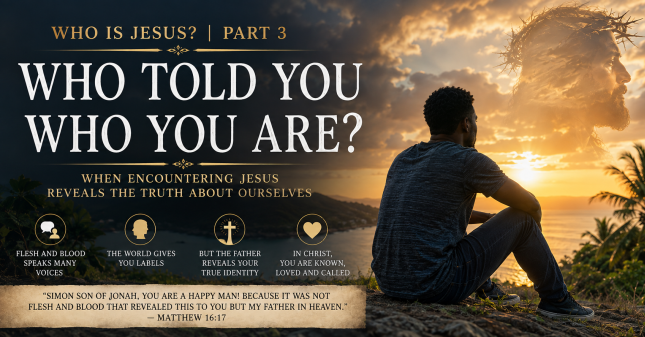
Who Told You Who You Are? Discovering Your True Identity Through Jesus Christ | Matthew 16
Please click the PLAY button below to listen to audio
Encountering Jesus Reveals the Truth About Ourselves
“Simon son of Jonah, you are a happy man! Because it was not flesh and blood that revealed this to you but my Father in heaven.” — Matthew 16:17
There is something extraordinary happening at Caesarea Philippi.
And if we move too quickly through the Gospel, we may miss it.
Jesus has asked His disciples:
“Who do people say that the Son of Man is?”
They tell Him what everyone else is saying.
John the Baptist.
Elijah.
Jeremiah.
One of the prophets.
Then Jesus makes the question personal:
“But you, who do you say that I am?”
And Peter answers:
“You are the Christ, the Son of the living God.”
That is the great confession.
Peter recognizes something about the identity of Jesus.
But then something remarkable happens.
Jesus begins speaking about the identity of Peter.
Peter says:
“You are the Christ.”
And shortly afterwards Jesus says:
“You are Peter.”
Peter tells Jesus who He is.
Then Jesus tells Peter who he is.
And perhaps hidden within this exchange is one of the most important truths about the Christian life:
When we truly encounter Jesus Christ, we begin to discover the truth about ourselves.
We Have Been Asking: Who Is Jesus?
That has been the question running through this entire series.
In Part One we stood with the crowd:
“Who do people say that I am?”
We looked at the many Jesuses our world creates.
The teacher.
The revolutionary.
The social activist.
The healer.
The spiritual guru.
The tolerant Jesus.
The political Jesus.
The Jesus of social media.
The Jesus carefully edited so that He never contradicts us.
And we confronted an uncomfortable possibility:
It is possible to say wonderful things about Jesus and still be wrong about who Jesus is.
Then in Part Two the crowd disappeared.
Jesus looked directly at the disciples and asked:
“But you, who do you say that I am?”
Now inherited answers were no longer enough.
Peter had to answer.
And so do we.
But now Matthew 16 takes us somewhere we might not expect.
Because once Peter begins to understand who Jesus is, Jesus begins revealing Peter to himself.
That means the question “Who is Jesus?” eventually becomes inseparable from another question:
“Who am I in the light of Jesus Christ?”
And that raises an even more uncomfortable question:
Who told you who you are?
Someone Has Been Telling You Who You Are
Long before most of us were old enough to ask “Who am I?”, other people were already answering the question for us.
Sometimes beautifully.
Sometimes destructively.
A parent may have said:
“I’m proud of you.”
A teacher may have said:
“You have tremendous potential.”
A grandparent may have told you:
“God has something special for you.”
Someone may have believed in you before you learned to believe in yourself.
Those voices can become extraordinary gifts.
But there are other voices.
Perhaps somebody told you:
“You’re stupid.”
“You’ll never amount to anything.”
“Why can’t you be like your brother?”
“Why can’t you be like your sister?”
“Nobody will ever want you.”
“You’re ugly.”
“You’re too fat.”
“You’re too thin.”
“You’re a disappointment.”
“You’re useless.”
“You’re just like your father.”
“You’re just like your mother.”
Sometimes these sentences are spoken in anger and forgotten by the person who said them.
But not by the person who heard them.
A child can carry one sentence for forty years.
Flesh and Blood Speaks
Listen again to Jesus:
“It was not flesh and blood that revealed this to you but my Father in heaven.”
Jesus is speaking specifically about Peter’s recognition of Christ.
Peter has not arrived at this truth merely through human reasoning. The Father has revealed something to him.
But those words also invite us to think about the voices that shape our lives.
Because flesh and blood speaks constantly.
Family speaks.
Friends speak.
Teachers speak.
Classmates speak.
Employers speak.
Partners speak.
Society speaks.
Social media speaks.
Culture speaks.
And eventually those voices can become so deeply embedded within us that they begin speaking from inside us.
Nobody has to call us worthless anymore.
We do it ourselves.
Nobody has to tell us we will fail.
We tell ourselves before we even try.
Nobody has to reject us.
We begin expecting rejection before anyone has the opportunity.
The voice that originally came from outside has moved inside.
And eventually we no longer say:
“Someone told me I was worthless.”
We say:
“I am worthless.”
That is the tragedy.
Someone else’s opinion has become our identity.
Social Media Has Industrialized Comparison
Our generation faces something previous generations never experienced at this scale.
We carry millions of other people’s lives in our pockets.
Open a phone.
Someone is more successful.
Someone has a nicer house.
Someone has more followers.
Someone has a better body.
Someone’s children appear more accomplished.
Someone’s marriage looks happier.
Someone travels more.
Someone earns more.
Someone seems more talented.
Someone seems more attractive.
Someone’s ministry appears more successful.
Even religion can become a competition.
Who preaches better?
Who sings better?
Whose church is growing?
Whose video got more views?
Who appears more spiritual?
And slowly, almost invisibly, comparison begins answering the question:
Who are you?
Not enough.
Not successful enough.
Not attractive enough.
Not holy enough.
Not young enough.
Not wealthy enough.
Not talented enough.
Not important enough.
But there is something profoundly deceptive about this.
We are comparing the entirety of our lives with carefully selected fragments of somebody else’s.
And then we allow that comparison to determine our worth.
But Jesus never asked Instagram who you are.
The Father does not determine your value by engagement statistics.
Heaven does not count followers.
And the Cross did not happen because you performed well enough to deserve love.
Sometimes Our Failures Tell Us Who We Are
But it is not always other people.
Sometimes the loudest accusation comes from our own history.
Perhaps you made a terrible mistake.
Perhaps you hurt somebody.
Perhaps a marriage failed.
Perhaps a business collapsed.
Perhaps you lost an opportunity.
Perhaps you betrayed somebody’s trust.
Perhaps you committed a sin you deeply regret.
Perhaps you have fallen into the same sin repeatedly.
Perhaps there is something in your past that you would be horrified for other people to know.
And eventually something subtle happens.
We stop saying:
“I failed.”
And begin saying:
“I am a failure.”
We stop saying:
“I sinned.”
And begin saying:
“I am beyond redemption.”
We stop saying:
“I made a terrible decision.”
And begin saying:
“My life is ruined.”
But Christianity makes an enormously important distinction.
Your sin is real.
God does not pretend otherwise.
The Gospel never asks us to deny responsibility.
Repentance requires truth.
But your sin is not the deepest truth about who you are.
If sin were the final word on human identity, there would be no Peter.
No Paul.
No Mary Magdalene.
No Zacchaeus.
No Augustine.
No saints.
And no Christianity.
Because Christianity is filled with people whose worst moment did not get the final word.
Jesus did.
Peter Himself Is Proof
Consider the man standing before Jesus in Matthew 16.
Peter.
We often hear:
Saint Peter.
Prince of the Apostles.
The Rock.
But Peter’s story contains some deeply uncomfortable moments.
Peter is impulsive.
Peter misunderstands Jesus.
Peter speaks when perhaps he should remain silent.
Peter sinks.
Peter argues.
Peter boasts.
And eventually Peter will do something he probably once thought impossible.
He will deny Jesus.
Not once.
Three times.
Imagine if Peter had allowed that night to become his identity.
I am the man who denied Jesus.
That statement would have been historically true.
But it would not have been the whole truth.
Because after the Resurrection, Jesus comes looking for Peter.
And beside another charcoal fire—the setting itself painfully recalling the night of denial—Jesus asks:
“Simon, son of John, do you love me?”
Three denials.
Three opportunities to profess love.
And then:
“Feed my sheep.”
Do you see what Jesus does?
He does not pretend Peter never failed.
He redeems the failure and restores the mission.
Peter’s worst moment does not cancel what Jesus saw in him.
Who Is Jesus?
And here we must return to the central question.
Because this series is not ultimately about self-esteem.
It is about Jesus Christ.
If Jesus is merely a motivational teacher, then perhaps all He can do is encourage us to think more positively about ourselves.
But if Peter is right—
if Jesus truly is:
“the Christ, the Son of the living God”
—then Jesus possesses an authority no human voice possesses.
He knows you more completely than your parents know you.
More completely than your spouse.
More completely than your friends.
More completely than your enemies.
More completely than your psychologist.
More completely than an algorithm.
More completely even than you know yourself.
And therefore when Jesus speaks about who you are, He is not offering another opinion to place alongside everybody else’s.
The One through whom you were created is speaking.
That changes everything.
Jesus Has a Disturbing Habit of Seeing People Differently
Read the Gospels carefully and you will notice something.
Jesus continually sees people differently from the crowd.
The crowd sees a tax collector.
Jesus sees Matthew.
The crowd sees a sinner up a tree.
Jesus sees Zacchaeus—and invites Himself to his house.
The crowd sees a blind beggar making too much noise.
Jesus hears Bartimaeus calling Him.
The disciples see children who are interrupting something important.
Jesus says:
“Let the children come to me.”
The crowd sees a woman with a reputation.
Jesus sees someone capable of receiving mercy.
People see a Samaritan woman whose personal life is complicated.
Jesus sees an evangelist waiting to be awakened.
The religious establishment sees a dangerous persecutor named Saul.
The risen Christ sees an apostle.
And when everyone else sees an unstable fisherman named Simon—
Jesus sees:
Peter.
Christ does not merely see what we have been.
He sees what grace can make of us.
“You Are Peter”
There is extraordinary power in those words.
Simon did not invent the name.
Jesus gave it to him.
“You are Peter.”
Rock.
Peter receives an identity from Christ.
But notice something very important.
Jesus does not merely tell Peter something flattering about himself.
He gives him an identity that contains a responsibility.
This is where Christian identity differs radically from much of modern self-help.
The Gospel does not say:
“Discover how wonderful you are and spend the rest of your life admiring yourself.”
God reveals who we are so that we can become who He created us to be.
Peter is called Rock because there is something Peter will be asked to do.
Identity becomes vocation.
Identity becomes responsibility.
Identity becomes mission.
What Does God Say About You?
So what does Scripture reveal about the human person?
Before anyone had an opinion about you:
You were created in the image and likeness of God.
Before anyone graded you:
you possessed dignity.
Before anyone chose you:
God desired your existence.
Before anyone rejected you:
you were loved.
Before you accomplished anything:
your life had value.
Before you earned a salary:
your dignity was already established.
Before you accumulated followers:
you mattered.
Before you succeeded:
you were loved.
And yes—
before you sinned,
God knew you would need a Saviour.
And He came.
That may be one of the most astonishing answers to the question “Who am I?”
You are someone for whom Jesus Christ considered the Cross worth enduring.
Not because sin does not matter.
Precisely because it does.
The Cross simultaneously tells us two things we desperately need to hear:
Our sin is more serious than we sometimes imagine.
And:
We are more deeply loved than we sometimes dare believe.
Baptism Says Something About Who You Are
For the Christian, identity goes even deeper.
At Baptism, Christianity does not simply place a religious label beside our name.
Something happens.
We are baptized into Christ.
We become members of His Body.
We become adopted sons and daughters of the Father.
We receive a new life.
That means the deepest Christian answer to:
“Who am I?”
cannot be separated from:
“Whose am I?”
I belong to Christ.
That identity precedes profession.
Precedes status.
Precedes wealth.
Precedes popularity.
Precedes nationality.
Precedes achievement.
And one day, all those other labels will disappear.
Degrees will not matter.
Job titles will disappear.
Bank accounts will be left behind.
Follower counts will become meaningless.
Awards will gather dust.
But the question of whether we belonged to Christ will remain.
But Be Careful: “God Says I Am…” Can Also Become Distorted
There is another danger here.
We can turn Christian identity into another form of self-centered affirmation.
We can quote:
“I am chosen.”
“I am blessed.”
“I am a child of God.”
“I am loved.”
All true.
But if those truths never lead to repentance, holiness, obedience, service and mission, we have again created a Christianity centred upon ourselves.
God does not reveal our identity merely to make us feel better.
He reveals our identity so that we may live differently.
If I am a child of the Father, I should begin to resemble the Father.
If I belong to Christ, my life should begin to resemble Christ.
If the Holy Spirit dwells in me, there should eventually be fruit.
Love.
Joy.
Peace.
Patience.
Kindness.
Goodness.
Faithfulness.
Gentleness.
Self-control.
Identity without transformation is incomplete.
Which brings us back again to Jesus.
Encounter Changes People
Something happens repeatedly in the Gospels.
People encounter Jesus.
And then they move.
The Samaritan woman comes to the well carrying a water jar.
She encounters Jesus.
And something happens.
She leaves the jar behind.
She runs into the town.
And the woman who may have preferred avoiding people becomes the person telling everybody:
“Come and see a man who told me everything I have done.”
Encounter becomes mission.
Mary Magdalene comes to the tomb grieving.
She encounters the risen Christ.
Jesus calls her by name:
“Mary.”
And the grieving woman becomes a messenger:
“I have seen the Lord.”
Encounter becomes mission.
Zacchaeus encounters Jesus.
His relationship with money changes.
Encounter becomes conversion.
Matthew encounters Jesus.
He gets up from the tax booth.
Encounter becomes discipleship.
Saul encounters the risen Christ on the road to Damascus.
The persecutor becomes the preacher.
Encounter becomes mission.
And Peter—
the fisherman,
the impulsive disciple,
the man who sinks,
the man who will deny Jesus—
encounters Christ.
And Jesus says:
“You are Peter.”
Encounter becomes identity.
And identity becomes mission.
This Is Why Knowing Who Jesus Is Matters So Much
Now perhaps we can see why the question at Caesarea Philippi is so enormously important.
“Who do you say that I am?”
This is not a theological examination Jesus gives because He wants to see whether Peter has memorized the correct answer.
Everything changes depending upon the answer.
If Jesus is merely a teacher, we can admire Him.
If Jesus is merely a prophet, we can quote Him.
If Jesus is merely an historical figure, we can study Him.
If Jesus is merely a moral example, we can imitate selected parts of His life.
But if Jesus is:
“the Christ, the Son of the living God,”
then we must confront an entirely different reality.
He has authority to tell us who He is.
He has authority to tell us who we are.
He has authority to tell us what we were created for.
And He has authority to call us.
Perhaps You Have Been Living Under the Wrong Name
Maybe this is where the Gospel becomes personal.
Perhaps somebody named you years ago.
Failure.
Unwanted.
Stupid.
Ugly.
Weak.
Addict.
Divorced.
Rejected.
Poor.
Uneducated.
Damaged.
Hopeless.
Not enough.
Perhaps you have spent years answering to a name God never gave you.
Or perhaps your false name sounds positive.
Successful.
Important.
Powerful.
Popular.
Wealthy.
Influential.
Needed.
Even those identities can imprison us if they become the foundation of our worth.
Because eventually success disappears too.
The Christian cannot build identity entirely upon either our wounds or our trophies.
Both are temporary.
There is only one foundation strong enough to carry the weight of a human life:
Jesus Christ.
Let Jesus Tell You Who You Are
Perhaps some of us need to sit before Jesus and ask a question we have never seriously asked:
“Lord, who do You say that I am?”
Not:
What does social media say?
Not:
What did the person who rejected me say?
Not:
What did my teacher say?
Not:
What does my bank account say?
Not:
What does my past say?
Not even:
What do I say?
But:
Jesus, who do You say that I am?
And perhaps before we hear anything else, we need to look at the Cross.
Because the Cross already says something.
You are loved.
Not cheaply.
Not sentimentally.
Not because everything you do is acceptable.
But with a love willing to bleed for your salvation.
Then look at the empty tomb.
It says something else.
Your story does not have to end where you think it ends.
And then listen again to Jesus.
Because the One who told Simon:
“You are Peter”
still calls people by names the world cannot see yet.
But Your New Name Is Not the End of the Story
And this is where we must be careful not to stop.
Peter recognizes Jesus.
Jesus reveals Peter.
But then Peter is entrusted with something.
The Samaritan woman encounters Jesus.
Then she runs to tell others.
Mary Magdalene hears Jesus call her name.
Then He sends her.
Paul encounters Christ.
Then Christ sends him.
Throughout Scripture there is a pattern:
Encounter.
Identity.
Mission.
Jesus does not reveal us to ourselves so that we can remain sitting at Caesarea Philippi congratulating ourselves on finally knowing who we are.
He sends us.
Because somewhere there is another person still living under a false name.
Someone still believes they are worthless.
Someone still believes their sin is beyond forgiveness.
Someone still believes Christianity is merely a collection of rules.
Someone still believes Jesus wants nothing to do with them.
Someone is living without hope.
Someone has never experienced the mercy of Christ.
Someone does not know who Jesus is.
And perhaps the Christ who has revealed Himself to you now intends to reach that person through you.
Who Told You Who You Are?
So perhaps today we need to hear both sides of the conversation at Caesarea Philippi.
Jesus asks:
“Who do you say that I am?”
Peter answers:
“You are the Christ, the Son of the living God.”
And then Jesus begins answering a question Peter did not even ask:
“And you are Peter…”
There is a profound mystery here.
We spend our lives trying to discover ourselves.
But perhaps we cannot fully know ourselves until we know the One in whose image we were created.
Perhaps the deepest journey into our own identity does not begin by looking inward.
Perhaps it begins by looking at Jesus Christ.
Because when I know who He is,
I begin to understand who I am.
When I know that He is Saviour,
I can admit that I need saving.
When I know that He is Mercy,
I can bring Him my sin.
When I know that He is Truth,
I can stop hiding behind lies.
When I know that He is Lord,
I can surrender control.
When I know that He is the Son,
I begin to understand what it means to become a child of the Father.
When I know that He calls,
I begin to understand that my life has a purpose.
And when I encounter Him—
really encounter Him—
I cannot remain exactly as I was.
And Now Comes the Next Question
Peter has confessed who Jesus is.
Jesus has begun revealing who Peter is.
But Jesus is not finished.
Because Peter’s new identity comes with an extraordinary responsibility.
Jesus continues:
“You are Peter, and on this rock I will build my Church.”
Now we move from identity to mission.
From personal encounter to responsibility.
From:
“Who is Jesus?”
to:
“Who am I because I have encountered Him?”
and finally:
“What is He asking me to do?”
Because an encounter with Jesus Christ that remains entirely private has not yet reached its destination.
Christ calls us by name.
Christ restores us.
Christ tells us who we are.
And then—
Christ sends us.
That is where we go next.