Why Do Catholics Make the Sign of the Cross?
“In the name of the Father, and of the Son, and of the Holy Spirit. Amen.”
For many Catholics, these are among the first words of prayer we learn as children. We make the Sign of the Cross when we enter a church. We make it before and after prayer. We begin the Holy Mass with it. We may make it before meals, before travelling, when passing a church, when facing danger, when receiving difficult news, or when asking God for help.
And sometimes, because we have done it thousands of times, we can do it almost without thinking.
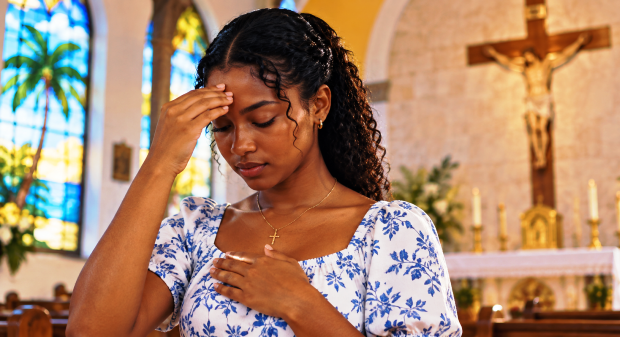
Hand to forehead.
Hand to chest.
Shoulder to shoulder.
Amen.
But have you ever stopped to ask:
Why do Catholics make the Sign of the Cross?
Is it simply a Catholic habit? Is it something the Church invented? Is it merely a way of beginning and ending prayer?
Not at all.
The Sign of the Cross is actually one of the simplest and yet richest prayers in the Christian tradition. In just a few words and one physical gesture, we proclaim some of the deepest truths of the Christian faith.
We proclaim who God is.
We proclaim what Jesus Christ has done for us.
We remember who we became in Baptism.
And we mark ourselves with the sign of the instrument through which Christ conquered sin and death.
It Begins With the Holy Trinity
When Catholics make the Sign of the Cross, we say:
“In the name of the Father, and of the Son, and of the Holy Spirit.”
Notice something important.
We do not say, “In the names of the Father, Son and Holy Spirit.”
We say:
“In the name…”
One name.
Three Divine Persons.
This reflects the great Christian mystery of the Most Holy Trinity: one God in three Persons — Father, Son and Holy Spirit.
These words come directly from Jesus Himself.
Before His Ascension, Jesus commanded His disciples:
“Go therefore and make disciples of all nations, baptizing them in the name of the Father and of the Son and of the Holy Spirit.”
— Matthew 28:19
Every time we make the Sign of the Cross, therefore, we echo the baptismal command given by Jesus.
We are not merely saying, “God, help me.”
We are identifying the God whom we worship.
Father.
Son.
Holy Spirit.
The Sign of the Cross is therefore a short profession of faith in the Trinity.
It Proclaims the Cross of Jesus Christ
But we do not merely speak the name of the Trinity.
We trace a cross upon our bodies.
Why?
Because the Cross stands at the centre of the Christian faith.
St. Paul wrote:
“But we proclaim Christ crucified.”
— 1 Corinthians 1:23
And again:
“May I never boast of anything except the cross of our Lord Jesus Christ.”
— Galatians 6:14
To the ancient world, crucifixion was a sign of shame, suffering and defeat.
But Jesus transformed the Cross.
Through His death and Resurrection, the instrument of execution became the sign of salvation.
The Cross tells us:
God loved us enough to enter our suffering.
Christ gave Himself for us.
Sin does not have the final word.
Death does not have the final word.
Jesus Christ is risen.
So when a Catholic traces the Cross upon his or her body, it is not an empty movement.
We are identifying ourselves with the crucified and risen Christ.
It is almost as though we are saying:
I belong to Jesus Christ.
The Sign of the Cross Is Deeply Biblical
Sometimes Catholics are asked:
“Where is the Sign of the Cross in the Bible?”
The Bible does not contain an instruction saying, “Touch your forehead, chest and shoulders in this exact manner.”
But the biblical foundations of the practice are unmistakable.
The words we say come directly from Christ’s command in Matthew 28:19.
The Cross itself is central to the New Testament.
And Scripture also contains the powerful idea of God’s servants being marked with a sign.
In Ezekiel 9:4, the faithful are marked on their foreheads.
In the Book of Revelation we again encounter the servants of God being marked upon their foreheads:
“Do not damage the earth or the sea or the trees, until we have marked the servants of our God with a seal on their foreheads.”
— Revelation 7:3
The Sign of the Cross developed within the early Christian community as a visible expression of belonging to Christ.
The Earliest Christians Made the Sign of the Cross
The Sign of the Cross is not a medieval Catholic invention.
Christians were using the sign centuries earlier.
Around the beginning of the third century, the Christian writer Tertullian described Christians tracing the sign of the Cross frequently during ordinary daily life — when coming and going, dressing, bathing, eating, lighting lamps, going to bed and carrying out other everyday activities.
That is remarkable.
It tells us that Christians were marking themselves with the Cross very early in the Church’s history.
The precise manner in which Christians made the sign developed over time. Early Christians often traced a smaller cross, especially on the forehead. The larger gesture familiar to Catholics today developed later.
But the fundamental idea is ancient:
Christians marked themselves with the Cross of Christ.
The Sign of the Cross Reminds Us of Our Baptism
There is another beautiful dimension that we can easily overlook.
The Sign of the Cross is deeply connected with Baptism.
Jesus commanded His disciples to baptize:
“In the name of the Father and of the Son and of the Holy Spirit.”
Those are the very words we repeat when making the Sign of the Cross.
Therefore, every time we make it, we can remember:
I have been baptized.
I belong to Christ.
I have been brought into the life of the Trinity.
I am called to live as a child of God.
This is one reason the Sign of the Cross should never become meaningless routine.
It reminds us of our Christian identity.
Before we were workers, teachers, parents, professionals, musicians, students, leaders or anything else, through Baptism we became members of Christ.
The Sign of the Cross calls us back to that identity.
Why Do Catholics Use Holy Water and Make the Sign of the Cross?
When Catholics enter a church, we will often dip our fingers into holy water and make the Sign of the Cross.
That combination is especially meaningful.
Water immediately recalls Baptism.
The Trinitarian words recall the formula of Baptism.
And the Cross recalls the death and Resurrection of Christ into which we have been baptized.
So this little action upon entering a church can become a beautiful prayer:
Lord, remind me who I am.
I have been baptized.
I belong to You.
Help me now to worship You faithfully.
Done consciously, it is anything but meaningless.
We Pray With Our Bodies
Catholic worship is deeply physical.
We stand.
We kneel.
We sit.
We bow.
We strike our breast.
We receive ashes.
We are anointed with oil.
We eat the Eucharistic Bread and drink from the Chalice when the Precious Blood is offered.
Why?
Because human beings are not merely minds.
We are body and soul.
Jesus Himself entered the world bodily.
“And the Word became flesh and lived among us.”
— John 1:14
Christianity is not a religion that treats the body as irrelevant.
Our bodies participate in worship.
The Sign of the Cross is therefore a bodily prayer.
Our lips speak the Trinity while our hand traces the Cross.
Our body participates in what our mind believes and our heart professes.
The Sign of the Cross Can Be a Prayer in Itself
Sometimes we think the Sign of the Cross merely announces that prayer is about to begin.
We say:
“In the name of the Father…”
Then we begin praying.
But the Sign of the Cross is itself a prayer.
There may even be moments when it is the only prayer we can manage.
Imagine receiving frightening news.
Imagine standing outside an operating room.
Imagine being overwhelmed by grief.
Imagine facing temptation.
Imagine waking from a nightmare.
Imagine being unable to find the words to pray.
You slowly make the Sign of the Cross:
In the name of the Father,
and of the Son,
and of the Holy Spirit.
Amen.
That is prayer.
You have invoked the Holy Trinity.
You have remembered the Cross.
You have placed yourself consciously in the presence of God.
Sometimes four short lines and one simple gesture can say what hundreds of words cannot.
The Cross Is Also a Sign of Spiritual Battle
The Christian life includes spiritual struggle.
We struggle against temptation, sin, discouragement, fear and everything that seeks to draw us away from God.
The Cross reminds us that Christ has already won the decisive victory.
St. Paul writes that Christ:
“disarmed the rulers and authorities and made a public example of them, triumphing over them in it.”
— Colossians 2:15
Christians should not treat the Sign of the Cross as magic.
It is not a charm.
It is not superstition.
The power is not in mechanically moving one’s hand in a particular pattern.
Our hope is in Jesus Christ.
The Sign of the Cross expresses faith in Him and in the saving mystery of His death and Resurrection.
When made prayerfully in moments of temptation or fear, it can therefore be a powerful act of faith:
Jesus Christ is Lord.
I belong to Him.
The Cross has conquered.
Why Do Catholics Make the Sign Before the Gospel?
At Mass, before the Gospel is proclaimed, Catholics make three small crosses:
on the forehead,
on the lips,
and over the heart.
This gesture beautifully expresses a prayer traditionally understood as:
May the Gospel of Christ be in my mind, on my lips and in my heart.
In other words:
Lord, help me understand Your Word.
Help me speak Your Word.
Help me love and live Your Word.
The Gospel is not meant merely to pass through our ears.
It is meant to transform our minds, our speech and our hearts.
“Amen” Matters Too
We finish the Sign of the Cross by saying:
Amen.
Amen is not simply a convenient way of saying, “The prayer is finished.”
It expresses assent.
It means, in effect:
Yes.
Truly.
So be it.
I believe.
So think about what we are actually doing when we make the Sign of the Cross:
In the name of the Father…
I believe in the Father.
and of the Son…
I believe in Jesus Christ, the Son of God.
and of the Holy Spirit…
I believe in the Holy Spirit.
And while saying these words, we trace the Cross of Christ over ourselves.
Then:
Amen.
Yes, Lord.
This is the faith I profess.
Perhaps We Need to Slow Down
Because the Sign of the Cross is so familiar, it can easily become automatic.
We can rush through it so quickly that our hand has almost finished before our mind realizes what we are doing.
Perhaps we sometimes need to slow it down.
Not dramatically.
Not for show.
Simply prayerfully.
In the name of the Father…
Remember the Father who created you and loves you.
and of the Son…
Remember Jesus Christ who became man, died for you and rose again.
and of the Holy Spirit…
Remember the Spirit of God who dwells within His people and sanctifies us.
Amen.
I believe.
I belong to You.
A Tiny Prayer Containing an Enormous Faith
The Sign of the Cross takes only a few seconds.
Yet contained within those few seconds are some of the greatest mysteries of Christianity:
The Trinity.
The Incarnation.
The Cross.
The Resurrection.
Baptism.
Salvation.
Our identity in Christ.
That is extraordinary.
What appears to be one of the simplest Catholic gestures is actually a compact proclamation of the Christian faith.
So the next time you make the Sign of the Cross, try not to rush through it.
Remember what you are doing.
You are not simply beginning a prayer.
You are praying.
You are invoking the Holy Trinity.
You are remembering your Baptism.
You are tracing upon your own body the sign of Christ’s victory.
You are declaring who your God is.
And you are reminding yourself whom you belong to.
In the name of the Father,
and of the Son,
and of the Holy Spirit.
Amen.
A Prayer
Most Holy Trinity,
Father, Son and Holy Spirit,
teach me never to take the Sign of the Cross for granted.
Whenever I trace the Cross upon myself,
remind me of the love of the Father,
the saving sacrifice of the Son,
and the presence and power of the Holy Spirit.
Remind me of my Baptism.
Remind me that I belong to Christ.
Help me to carry my own cross faithfully
and to live each day as a witness
to Jesus Christ, crucified and risen.
May everything I think,
everything I say,
and everything I do
be done for Your glory.
In the name of the Father,
and of the Son,
and of the Holy Spirit.
Amen.