
The Good Shepherd: Leadership That Smells Like the Sheep
A Catholic Reflection on John 10:1–10, Psalm 23, 1 Peter 2, and the Call to Shepherd God’s People
There are some images in Scripture that never grow old. No matter how modern the world becomes, no matter how advanced our technology, no matter how complicated our societies, the image of the shepherd still speaks deeply to the human heart.
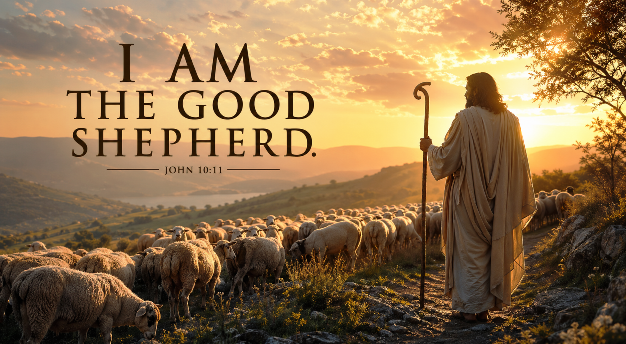
This weekend, as the Church celebrates Good Shepherd Sunday, we are invited to contemplate Jesus Christ as the Shepherd who knows His sheep, calls them by name, leads them to life, protects them from danger, and becomes the very gate through which they enter into safety.
But this Sunday is not only about being comforted by the thought that Jesus is our Shepherd. It is also a Sunday of challenge. It asks us: Whose voice are we listening to? Whose leadership are we following? And what kind of shepherds are we becoming for others?
It is also a special time to pray for vocations: for priests, deacons, religious sisters, religious brothers, consecrated men and women, and all who are answering the call to give their lives in service to God’s people.
At the heart of this reflection is the unforgettable phrase of Pope Francis, who reminded pastors that true shepherds must “smell like the sheep.” That phrase is earthy, uncomfortable, and deeply biblical. It means that true spiritual leadership is not distant, cold, or merely administrative. A true shepherd is close to the flock. He knows their wounds. He walks with them in their struggles. He is not afraid of the messiness of real human lives.
And in this, Pope Francis was pointing us back to Jesus.
Jesus does not shepherd from a distance.
He enters the sheepfold.
He calls His sheep by name.
He walks ahead of them.
He protects them.
He lays down His life for them.
“Anyone Who Does Not Enter Through the Gate…”
Jesus begins this passage with a solemn warning:
“I tell you most solemnly, anyone who does not enter the sheepfold through the gate, but goes in some other way, is a thief and a brigand.”
— John 10:1
This is a strong opening. Jesus is not beginning with a soft pastoral image. He begins with a warning about false shepherds.
The sheepfold represents the people of God. It is the place where the sheep are gathered, protected, and kept safe. But Jesus says that not everyone who enters the sheepfold comes with good intentions.
Some do not enter through the gate. They climb in another way. They bypass the proper entrance. They sneak in. They force their way in. They do not come to serve the sheep, but to use them.
This is a warning against every form of false leadership.
A false shepherd does not come through Christ. He comes through ambition, pride, manipulation, popularity, control, greed, or self-interest. He may speak religious language. He may hold a position. He may appear respectable. But if he does not enter through the way of Christ, he is not a true shepherd.
To enter through the gate means to come through truth, humility, love, obedience, sacrifice, and communion with God.
This applies not only to priests and bishops. It applies to every leader.
A parent who leads without love is not entering through the gate.
A teacher who forms minds without concern for souls is not entering through the gate.
A politician who uses people for power is not entering through the gate.
A church leader who prefers status over service is not entering through the gate.
A business leader who treats workers as tools rather than persons is not entering through the gate.
Jesus is teaching us that leadership must have a rightful entrance. It must come through God.
Leadership that does not pass through Christ eventually becomes dangerous.
“The One Who Enters Through the Gate Is the Shepherd”
Jesus continues:
“The one who enters through the gate is the shepherd of the flock.”
— John 10:2
The true shepherd does not need to sneak in. He does not need to manipulate his way into people’s lives. He comes openly, truthfully, humbly, and lovingly.
There is something deeply peaceful about authentic leadership. It does not need to dominate. It does not need to frighten. It does not need to deceive.
The true shepherd comes with the heart of Christ.
He does not ask, “How can I use these people?”
He asks, “How can I serve them?”
He does not ask, “How can I make them admire me?”
He asks, “How can I help them hear God’s voice?”
That is why spiritual authority is never meant to be about ego. It is always meant to be about service.
In the Church, this is especially important. Priests, bishops, deacons, catechists, ministry leaders, and parents must constantly examine themselves. Are we leading people to Christ, or are we leading people to ourselves?
The true shepherd does not make himself the destination.
He leads the sheep to God.
“The Sheep Hear His Voice”
Jesus says:
“The sheep hear his voice, one by one he calls his own sheep and leads them out.”
— John 10:3
This is one of the most beautiful lines in the Gospel.
The Shepherd does not call the sheep as a nameless crowd. He calls them one by one. He knows them personally. He knows their strengths, their wounds, their fears, their history, their sins, their potential, and their deepest hunger.
This is the heart of the Gospel: God does not love humanity in a vague, distant way. He loves each person personally.
Christ knows your name.
He knows where you have wandered.
He knows what has wounded you.
He knows what you are afraid to say aloud.
He knows the sins you are ashamed of.
He knows the prayers you have stopped praying.
He knows the tears no one saw.
And still, He calls you.
This is important in our world today, where so many people feel invisible. Many feel like numbers in a system, usernames on a screen, workers in a machine, or statistics in a report. But the Good Shepherd does not see us that way.
He calls His own by name.
This is also why true pastoral ministry must be personal. People are not projects. They are not problems to be managed. They are not interruptions. They are souls.
To “smell like the sheep” means that the shepherd knows the flock not abstractly, but personally. He knows their joys and struggles. He knows the grief in the widow’s heart, the confusion of the young person, the burden of the single mother, the loneliness of the elderly, the quiet shame of the sinner, the exhaustion of the father trying to provide, the spiritual dryness of the faithful Catholic who keeps showing up but feels empty inside.
The true shepherd listens before he lectures.
He draws near before he corrects.
He loves before he leads.
Do We Know the Shepherd’s Voice?
Jesus says:
“He walks ahead of them, and the sheep follow because they know his voice.”
— John 10:4
This is both comforting and challenging.
The sheep follow because they recognize the voice of the shepherd. But that raises a serious question for us:
Do we recognize the voice of Christ?
We live in a noisy world. Many voices are calling us.
The voice of fear says, “Protect yourself at all costs.”
The voice of pride says, “You answer to no one.”
The voice of lust says, “Use people for pleasure.”
The voice of greed says, “You are what you own.”
The voice of despair says, “Nothing will ever change.”
The voice of the world says, “Follow the crowd.”
The voice of Christ says, “Follow Me.”
The Christian life requires spiritual listening. We must learn to distinguish the voice of the Shepherd from the voice of the stranger.
Christ’s voice does not always tell us what we want to hear, but it always leads us to life.
His voice may convict us, but it does not crush us.
His voice may correct us, but it does not humiliate us.
His voice may call us to sacrifice, but it does not abandon us.
His voice speaks truth with mercy.
This is why prayer, Scripture, the Eucharist, Confession, silence, and the teaching of the Church are so important. They train the heart to recognize the voice of the Shepherd.
If we never spend time with Him, how will we know His voice?
“They Will Never Follow a Stranger”
Jesus continues:
“They will never follow a stranger, but will run away from him because they do not recognize the voice of strangers.”
— John 10:5
This is where many of us must examine our lives honestly.
Are we running from the voice of the stranger, or have we become familiar with it?
Sometimes the danger is not that we immediately reject Christ. The danger is that we slowly become comfortable with voices that are not His.
We become comfortable with bitterness.
Comfortable with gossip.
Comfortable with impurity.
Comfortable with prayerlessness.
Comfortable with half-truths.
Comfortable with indifference.
Comfortable with anger.
Comfortable with the idea that holiness is unrealistic.
But Jesus says His sheep do not follow the stranger. They flee from him.
This is especially important for families. Parents are shepherds in the home. They must help their children recognize the difference between the voice of Christ and the voices that seek to steal their identity, purity, dignity, faith, and peace.
This is also important for national and global leaders. The people entrusted to them are not objects. They are not voting blocs. They are not economic units. They are human beings made in the image of God.
When leaders speak with the voice of division, hatred, exploitation, corruption, or deception, they are not speaking with the voice of the Shepherd.
The voice of the Good Shepherd gathers.
The voice of the thief scatters.
“I Am the Gate of the Sheepfold”
The people did not understand the parable, so Jesus spoke even more clearly:
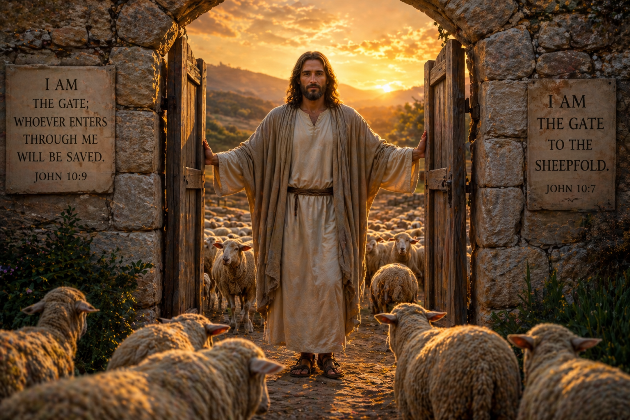
“I tell you most solemnly, I am the gate of the sheepfold.”
— John 10:7
This is a profound statement.
Jesus is not only the Shepherd. He is also the Gate.
The shepherd leads the sheep, but the gate protects the sheep. The gate determines what enters and what does not. The gate is the place of safety.
In ancient shepherding, especially in simple sheepfolds, the shepherd himself might lie across the entrance at night. In that sense, the shepherd became the gate. Nothing could enter without passing him. No sheep could leave without crossing over him.
Jesus is saying: I am the way into safety. I am the way into life. I am the way into the Father’s care.
This connects beautifully with another statement of Jesus:
“I am the Way, the Truth and the Life.”
— John 14:6
Christ is not one option among many. He is the gate.
This is not arrogance. It is mercy.
God has not left us wandering through endless confusion, wondering where safety is. He has given us a gate. He has given us a Shepherd. He has given us His Son.
To pass through Christ means to surrender to Him. It means to allow Him to define life, truth, goodness, freedom, love, and salvation.
Many people today want the blessings of the sheepfold without entering through the gate. They want peace without conversion. They want meaning without surrender. They want spirituality without obedience. They want comfort without the Cross.
But Jesus does not simply point to the gate.
He says, “I am the gate.”
“All Others Are Thieves and Brigands”
Jesus says:
“All others who have come are thieves and brigands; but the sheep took no notice of them.”
— John 10:8
Jesus is not condemning the prophets or faithful leaders sent by God. He is exposing false claimants—those who came pretending to lead but were actually exploiting the flock.
This should make us think seriously about leadership today.
False shepherds are not always obvious. Some are charming. Some are popular. Some use religious language. Some promise freedom. Some promise prosperity. Some promise belonging. Some promise power.
But Jesus gives us a test:
Do they lead to life, or do they steal life?
Do they lead to God, or to themselves?
Do they protect the vulnerable, or use them?
Do they speak truth, or manipulate emotion?
Do they serve, or dominate?
A true shepherd sacrifices for the sheep.
A false shepherd sacrifices the sheep for himself.
This applies in the Church, in families, in politics, in business, in education, and in media.
A culture can have false shepherds too. When society teaches people that their value depends on beauty, money, pleasure, popularity, productivity, or power, it is stealing something from them.
It is stealing their dignity.
It is stealing their peace.
It is stealing their identity.
Christ comes to restore what the thief has stolen.
“Anyone Who Enters Through Me Will Be Safe”
Jesus says:
“Anyone who enters through me will be safe: he will go freely in and out and be sure of finding pasture.”
— John 10:9
This is a beautiful promise.
Christ does not imprison His sheep. He gives them freedom.
But notice: true freedom comes through the gate.
In the modern world, many people define freedom as doing whatever one wants. But Jesus teaches a deeper freedom: the freedom of living in truth, walking in grace, and being protected from what destroys the soul.
The sheep who enter through Christ are safe. They can go in and out. They can find pasture.
This means that life in Christ is not narrow in the sense of being suffocating. It is spacious. It is fruitful. It is secure.
The commandments of God are not a cage. They are the fence around the pasture.
The Church’s moral teaching is not meant to steal joy. It is meant to protect life.
The Shepherd does not lead us away from happiness. He leads us toward the only happiness that lasts.
“I Have Come That They May Have Life”
The passage reaches its climax:
“The thief comes only to steal and kill and destroy. I have come so that they may have life and have it to the full.”
— John 10:10
This is the mission of Jesus.
He comes to give life.
Not shallow life.
Not artificial life.
Not temporary excitement.
Not mere survival.
He comes to give abundant life.
This does not mean a life without suffering. Jesus Himself suffered. The apostles suffered. The saints suffered.
Abundant life means a life rooted in God. A life that death cannot destroy. A life filled with grace, meaning, forgiveness, mercy, courage, and hope.
This is why 1 Peter speaks so powerfully:
“You had gone astray like sheep but now you have come back to the shepherd and guardian of your souls.”
— 1 Peter 2:25
We are not merely people who made mistakes. We are sheep who wandered. And Christ is the Shepherd who brought us back.
That is the mercy of God.
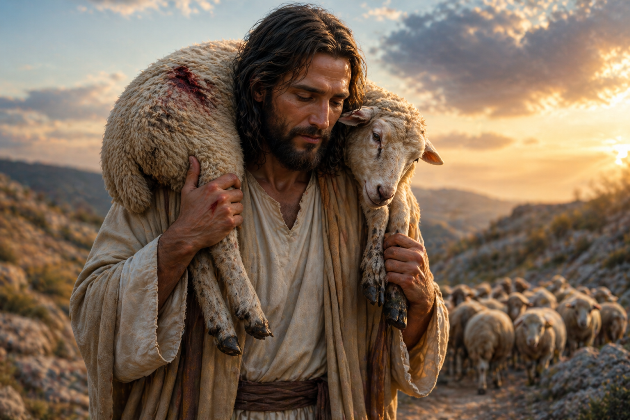
The Good Shepherd does not abandon wandering sheep.
He searches.
He calls.
He carries.
He heals.
He restores.
Psalm 23: The Shepherd Who Restores the Soul
The Responsorial Psalm gives us the inner experience of being shepherded by God:
“The Lord is my shepherd; there is nothing I shall want.”
— Psalm 23:1
This psalm is not sentimental poetry. It is a declaration of trust.
If the Lord is my Shepherd, I am not abandoned.
If the Lord is my Shepherd, I am not without direction.
If the Lord is my Shepherd, I do not have to be ruled by fear.
The psalm continues:
“Near restful waters he leads me, to revive my drooping spirit.”
This speaks directly to our world.
So many people today have drooping spirits. They are tired, anxious, spiritually dry, emotionally burdened, financially pressured, morally confused, and deeply lonely.
The Good Shepherd does not merely give commands. He restores the soul.
He leads us to restful waters.
He knows that we cannot live constantly in noise, pressure, conflict, and exhaustion.
This is a word for families: homes must become places where souls are restored, not constantly wounded.
This is a word for parishes: churches must become places where weary people encounter the mercy of Christ, not merely religious activity.
This is a word for society: leaders must care about the human soul, not only the economy, productivity, or public image.
“Your Rod and Your Staff, They Comfort Me”
Psalm 23 also says:
“Your rod and your staff, they comfort me.”
The rod and staff represent protection and guidance.
The shepherd’s care is not passive. He defends the sheep from danger and redirects them when they wander.
This is important because love without correction is not true shepherding.
A parent who never corrects is not shepherding.
A priest who never preaches difficult truths is not shepherding.
A leader who refuses to confront evil is not shepherding.
But correction must always come from love, not anger or ego.
The rod and staff comfort the sheep because they belong to the Shepherd. Discipline becomes comforting when it comes from someone who loves us and wants our good.
Christ corrects us because He wants us alive.
Shepherds Who Smell Like the Sheep
Now we return to that unforgettable image from Pope Francis.
A shepherd who smells like the sheep is one who is close enough to the flock to carry their burdens.
He does not lead from a balcony.
He does not serve from a safe distance.
He does not reduce people to files, numbers, statistics, or problems.
He enters into their reality.
This is exactly what Jesus did in the Incarnation.
The Son of God did not save us from afar. He became man. He entered our suffering. He touched lepers. He ate with sinners. He wept at Lazarus’ tomb. He allowed the broken, the sick, the rejected, and the sinful to come near.
Jesus smelled like the sheep.
He smelled like the dust of the road.
He smelled like the homes of sinners.
He smelled like the sickbed.
He smelled like the Cross.
That is true shepherding.
And this is the model for every priest, every parent, every bishop, every catechist, every teacher, every leader, every Christian.
The Call to Priests, Religious, and Consecrated Life
Good Shepherd Sunday is also a special time to pray for vocations.
We must pray for young men called to the priesthood, that they may have courage to say yes.
We must pray for women called to religious life, that they may hear the Bridegroom’s voice and follow Him with joy.
We must pray for men called to religious brotherhood, that they may serve Christ with undivided hearts.
We must pray for deacons, seminarians, missionaries, contemplatives, and all who are discerning consecrated life.
But we must also create a culture where vocations can be heard.
A noisy, distracted, cynical culture makes it hard to hear the Shepherd’s voice.
Families must become places where children are free to ask: “Lord, what do You want me to do with my life?”
Parishes must speak positively and joyfully about priesthood and religious life.
Catholics must stop treating vocations as something meant for someone else’s child.
The Church needs shepherds.
The world needs witnesses.
The harvest is great.
Shepherding in the Family
The first place many people encounter shepherding is in the home.
Parents are shepherds.
Fathers and mothers are called to lead their children not merely to success, but to holiness.
A parent shepherds by:
- Teaching the faith
- Praying with the family
- Correcting with love
- Listening with patience
- Protecting children from destructive influences
- Modeling forgiveness
- Bringing the family to Mass
- Showing mercy when a child has gone astray
A home without shepherding becomes spiritually vulnerable.
Children need more than food, clothes, schooling, and devices. They need guidance. They need moral formation. They need the voice of Christ spoken through the lives of their parents.
And parents must also smell like the sheep. That means being present. Not merely providing materially, but emotionally and spiritually. It means knowing what their children are struggling with, what they are watching, what they are afraid of, what pressures they face, and what questions they are carrying.
Shepherding in the Church
The Church must always examine whether her shepherds are close to the flock.
A parish can become busy but not pastoral.
A priest can become active but not close.
A ministry can become organized but not loving.
A true shepherding Church is one where people are known, welcomed, challenged, forgiven, healed, and sent out.
This does not mean watering down the truth. The Good Shepherd does not lie to the sheep. But truth must be spoken with the heart of Christ.
The Church must be a sheepfold, not a museum.
A place of safety, not cold judgment.
A place of conversion, not comfort in sin.
A place where the wounded can return to the Shepherd and Guardian of their souls.
Shepherding in Society
The shepherd image also challenges political, national, and global leadership.
A leader is not truly great because he has power. A leader is great when he uses power to protect the vulnerable and serve the common good.
A shepherd-leader asks:
- Are the poor being protected?
- Are families being strengthened?
- Are the elderly being honored?
- Are children being safeguarded?
- Are workers being treated justly?
- Are the unborn, the sick, the disabled, and the forgotten being defended?
- Are we building peace or deepening division?
The opposite of shepherding is exploitation.
When leaders enrich themselves while the people suffer, they are not shepherds.
When leaders divide people for political gain, they are not shepherds.
When leaders ignore the cries of the vulnerable, they are not shepherds.
When leaders speak lies to maintain power, they are not shepherds.
The world needs leaders who enter through the gate of truth, justice, humility, and service.
The Question for Each of Us
This Gospel is not only about priests, bishops, parents, and presidents.
It is about each of us.
Every Christian has some shepherding responsibility.
Someone is listening to your voice.
Someone is watching your example.
Someone is affected by your choices.
Someone may be closer to Christ because of you—or farther away.
So we must ask:
Do I lead people toward Christ?
Do I speak with the voice of the Shepherd or the voice of the stranger?
Do I protect others or use them?
Do I serve or control?
Do I help others find pasture, or do I make their burdens heavier?
Do I know the voice of Jesus well enough to follow Him?
Conclusion: Come Back to the Shepherd
The beauty of Good Shepherd Sunday is that it is not only a call to leaders. It is first an invitation to every wandering soul.
Maybe you have drifted.
Maybe you have followed strange voices.
Maybe you have been wounded by false shepherds.
Maybe you have grown tired.
Maybe your spirit is drooping.
Maybe you are not sure you still know the Shepherd’s voice.
The message of this Sunday is simple:
Come back.
Come back to the Shepherd and Guardian of your soul.
Come back to the One who calls you by name.
Come back to the One who does not come to steal, kill, or destroy, but to give life.
Come back to the One who is both Shepherd and Gate.
Come back to the One who smells like the sheep because He came all the way into our humanity to save us.
Jesus Christ is the Good Shepherd.
He knows you.
He calls you.
He leads you.
He protects you.
He restores your soul.
And He says even now:
“I have come that you may have life, and have it to the full.”
Closing Prayer
Lord Jesus Christ,
Good Shepherd of our souls,
teach us to recognize Your voice.
When the world becomes noisy,
help us to listen for You.
When we are tempted to wander,
call us back by name.
When we are tired and wounded,
lead us beside restful waters
and restore our souls.
Bless Your Church with holy priests,
faithful deacons, joyful religious,
courageous consecrated men and women,
and families open to Your call.
Give us shepherds after Your own heart:
leaders who are humble, loving, brave, and close to the people;
leaders who do not flee from the wounds of the flock,
but serve with the compassion of Christ.
And make each of us, in our own way,
a shepherd to those entrusted to us.
May we never follow the voice of the stranger,
but enter always through You,
the Gate of life.
Jesus, Good Shepherd,
lead us, guard us, heal us,
and bring us home.
Amen.