
Does an Unbaptized Person Go to Heaven? A Catholic Answer
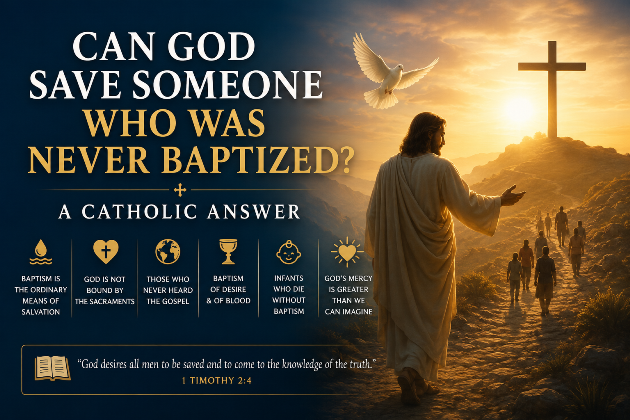
This is a very important question, and one that the Catholic Church has reflected on deeply. The Church’s teaching is both faithful to Christ’s words and full of hope in God’s mercy.
1. Baptism is the ordinary means of salvation
Jesus Himself said:
“Unless one is born of water and the Spirit, he cannot enter the kingdom of God.” (John 3:5)
Before ascending into heaven, He commanded:
“Go therefore and make disciples of all nations, baptizing them…” (Matthew 28:19)
For this reason, the Catholic Church teaches that Baptism is necessary for salvation because Christ made it the ordinary way by which we receive sanctifying grace, become children of God, and are incorporated into His Body, the Church.
2. But God is not bound by the sacraments
While we are bound to the sacraments, God is not.
The Church teaches that God can save people in extraordinary ways known only to Him. The Catechism states:
“God has bound salvation to the sacrament of Baptism, but he himself is not bound by his sacraments.”
This means that although Baptism is the normal path, God can work outside the visible sacraments if He so wills.
3. What about those who never had the opportunity to be baptized?
The Church distinguishes several situations.
Those who never heard the Gospel
If someone, through no fault of their own, never came to know Christ or His Church but sincerely sought God and tried to do His will according to the light of their conscience, the Church teaches that such a person may be saved through Christ’s grace.
This does not mean they are saved apart from Jesus. Rather, if they are saved, they are saved because of Jesus’ death and resurrection, even if they never knew Him explicitly during their earthly life.
4. Baptism of Desire
The Church also teaches about Baptism of Desire.
This includes people who desired Baptism but died before receiving it, as well as those who would have desired it had they known its necessity.
God sees the heart.
5. Baptism of Blood
Someone who dies for Christ before being baptized—for example, a catechumen martyred for the faith—is considered baptized by their martyrdom.
The early Church recognized many such martyrs.
6. What about infants who die without Baptism?
For many centuries, theologians proposed the idea of “Limbo,” but this was never official Church doctrine.
Today, the Church entrusts these children to the infinite mercy of God.
The Catechism says:
“The great mercy of God… and Jesus’ tenderness toward children… allow us to hope that there is a way of salvation for children who have died without Baptism.”
The Church therefore encourages parents to baptize infants promptly, while trusting God’s mercy for those who die before Baptism.
7. What about people who knowingly reject Christ?
This is different.
If a person comes to know that Jesus is the Son of God and that the Catholic Church was founded by Him, yet freely and knowingly rejects Him, that rejection places their salvation in serious danger.
God alone judges the heart, but deliberate rejection of known truth is a grave matter.
8. Why evangelize if God can save people without Baptism?
Because Jesus commanded us to.
We should never presume upon extraordinary means when Christ has given us the ordinary means.
Through Baptism we receive:
- Forgiveness of original and personal sin.
- Sanctifying grace.
- Adoption as children of God.
- Membership in Christ’s Body, the Church.
- The indwelling of the Holy Spirit.
Why leave someone without these immense gifts?
A Catholic summary
The Church holds these truths together:
- Baptism is the ordinary and necessary means established by Christ for salvation.
- Jesus Christ is the only Savior of humanity.
- Anyone who is saved is saved only through Christ.
- God can save those who, through no fault of their own, were never baptized or never knew Christ.
- We cannot presume that everyone is saved, nor can we declare that any particular unbaptized person is condemned.
- Therefore, we proclaim the Gospel, baptize all nations, pray for all people, and entrust every soul to the justice and mercy of God.
As Catholics, we live in the confidence expressed by St. Paul:
“God desires all men to be saved and to come to the knowledge of the truth.” (1 Timothy 2:4)
And we trust the words of Abraham:
“Shall not the Judge of all the earth do what is just?” (Genesis 18:25)
These two verses beautifully summarize the Church’s hope: God truly desires the salvation of every person, and His judgment is always perfectly just and perfectly merciful.