
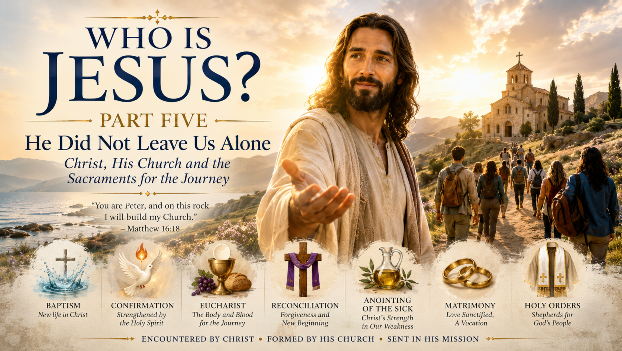
Who Is Jesus – He Did Not Leave Us Alone
Please click the PLAY button below to listen to audio
Christ, His Church and the Sacraments for the Journey
“You are Peter, and on this rock I will build my Church.” — Matthew 16:18
There is something we have not yet fully considered about the extraordinary conversation at Caesarea Philippi.
Peter has confessed:
“You are the Christ, the Son of the living God.”
Jesus has revealed something about Peter:
“You are Peter…”
And then Jesus gives Peter a mission:
“…and on this rock I will build my Church.”
Throughout this series, we have followed that movement.
Encounter.
Identity.
Mission.
But now another question arises.
What happens after Jesus sends us?
How are ordinary, fragile, sinful human beings supposed to live the life Christ has called us to live?
How do we remain faithful?
How do we keep going when we become tired?
What happens when we sin?
What happens when faith becomes difficult?
What happens when suffering comes?
What happens when we need guidance?
What happens when the voices we encountered in Part One begin offering us another Jesus—one more convenient, more fashionable, more compatible with whatever the culture currently believes?
Did Jesus simply give us a mission and then leave us to figure everything out ourselves?
No.
He did not leave us alone.
He gave us His Church.
And within His Church, He gave us extraordinary ways of continuing to encounter Him throughout the journey.
He gave us the Sacraments.
“I Will Build My Church”
We should stop for a moment over those words.
Jesus does not say:
“Peter, build me a Church.”
He says:
“I will build my Church.”
The initiative belongs to Christ.
The Church belongs to Christ.
This matters enormously because the Church is sometimes spoken about as though she were an unfortunate institution that appeared after the simple message of Jesus became complicated.
People sometimes say:
“I believe in Jesus. I just don’t believe in organized religion.”
Or:
“I don’t need the Church. Jesus is enough.”
There may be genuine wounds behind those statements.
Some people have experienced hypocrisy.
Some have encountered scandal.
Some have been hurt by clergy or other Catholics.
Some have witnessed terrible failures by members of the Church.
Those wounds must never be dismissed.
But neither can they change the words of Jesus.
Because at Caesarea Philippi, the Church is not Peter’s idea.
It is Christ’s.
The same Jesus whom Peter identifies as:
“the Christ, the Son of the living God”
says:
“I will build my Church.”
If we want to know Jesus as He truly is, rather than the Jesus we would prefer Him to be, then we must take seriously the Church that Jesus Himself says He will build.
The Church Is Not a Detour Away From Jesus
This is crucial.
The purpose of the Church is not to stand between humanity and Jesus Christ.
The Church exists to bring humanity into communion with Him.
She proclaims Him.
She teaches what He taught.
She baptizes in His name.
She celebrates His Sacraments.
She announces His forgiveness.
She gathers His people.
She feeds His flock.
She continues His mission.
And this brings us to something extraordinary.
For five parts we have been asking:
Who is Jesus?
But Catholic Christianity makes an astonishing claim.
Jesus Christ is not merely someone whose teachings the Church has preserved.
Christ continues to act in His Church.
And nowhere is this more tangible than in the Sacraments.
The Sacraments Are Not Merely Things We Do for God
Sometimes we think about Sacraments primarily from our side.
I was baptized.
I made my First Communion.
I was confirmed.
I went to Confession.
I got married in the Church.
But the more important question is:
What is Christ doing?
In Baptism,
Christ gives new life.
In Confirmation,
Christ strengthens through the Holy Spirit.
In the Eucharist,
Christ gives us Himself.
In Reconciliation,
Christ forgives and restores.
In the Anointing of the Sick,
Christ comes to strengthen, comfort and heal according to His will.
In Matrimony,
Christ sanctifies the covenant of husband and wife.
In Holy Orders,
Christ provides ordained ministers to serve and shepherd His people.
Suddenly the Sacraments cease looking like milestones on a Catholic checklist.
They become what they truly are:
encounters with the living Christ.
And when we see them that way, something beautiful happens.
Every part of this series begins coming together.
Baptism — Who Told You Who You Are?
Part Three asked a deeply personal question:
Who told you who you are?
We explored the voices that name us.
Family.
Culture.
Social media.
Our failures.
Our successes.
Our wounds.
Other people’s opinions.
But long before many Catholics were old enough to understand what was happening, something extraordinary was spoken over their lives.
They were baptized:
In the name of the Father,
and of the Son,
and of the Holy Spirit.
Baptism says something profound about identity.
You are not merely the sum of your achievements.
You are not merely your profession.
You are not merely your social status.
You are not merely your failures.
You are not merely the labels other people have placed upon you.
Through Baptism, you are joined to Christ.
You become a member of His Body.
You are incorporated into His Church.
You become an adopted child of the Father.
The question:
“Who am I?”
now becomes inseparable from another:
“Whose am I?”
I belong to Christ.
Think about how radically different life becomes if we actually believe that.
Before the world decides whether you are successful—
you belong to Christ.
Before anyone decides whether you are attractive—
you belong to Christ.
Before you accumulate money—
you belong to Christ.
Before you gain followers—
you belong to Christ.
Before anyone applauds you—
you belong to Christ.
And when the world rejects you—
you still belong to Christ.
Baptism gives us an identity the world cannot bestow and therefore cannot take away.
But Baptism Is Not a Photograph in an Album
For many Catholics, Baptism exists primarily as a memory somebody else possesses.
There may be photographs.
A white garment.
A candle.
Godparents.
A certificate somewhere in a drawer.
Perhaps we were infants and remember none of it.
But Baptism is not merely something that happened once.
It establishes a life that must now be lived.
The baptized person is called to become what Baptism has declared.
To live as someone belonging to Christ.
To reject sin.
To grow in holiness.
To participate in the life and mission of the Church.
Which means Baptism already points toward everything we discussed in Part Four.
Mission.
Confirmation — This Is Not Graduation
And here we arrive at a Sacrament that deserves much more attention than it often receives.
Confirmation.
For too many young Catholics, the journey looks something like this:
Baptism.
Confirmation.
And then—
disappearance.
Somehow we have allowed Confirmation to function culturally as a kind of graduation from Catholicism.
Finish the classes.
Make Confirmation.
Take the photographs.
Have the celebration.
And now religious formation is over.
But think about how strange that is.
The Sacrament intended to strengthen the baptized Christian through the Holy Spirit for mature Christian witness has, in many places, become the moment after which young people stop actively practising the faith.
We have somehow turned a Sacrament intended to strengthen Christians for mission into a graduation ceremony from Christianity.
Confirmation is not Jesus saying:
“Congratulations. You’re finished.”
It is much closer to:
“Now go.”
Remember Part Four?
You have met Jesus. Now what?
Mission.
Confirmation belongs right there.
The Holy Spirit who descended upon the disciples at Pentecost did not make them comfortable in the Upper Room.
He sent them out of it.
Peter, who once denied even knowing Jesus, stands publicly and proclaims Him.
Fear becomes witness.
The doors open.
The Gospel goes out.
That same Holy Spirit is not given to us so that we can place a Confirmation certificate in a drawer.
He is given so that we can live as disciples of Jesus Christ in the world.
The Eucharist — Food for the Journey
And now we come to the centre.
Because mission is difficult.
Loving enemies is difficult.
Forgiving repeatedly is difficult.
Remaining faithful is difficult.
Living chastely is difficult.
Choosing integrity when dishonesty would benefit us is difficult.
Remaining hopeful in suffering is difficult.
Being Christian on Monday morning—as we explored in Part Four—is difficult.
Jesus knows this.
And so He does not merely say:
“Go.”
He also says:
“Take and eat.”
This is where the entire Who Is Jesus? series becomes almost breathtaking.
We began by asking:
Who do people say Jesus is?
Then:
Who do YOU say Jesus is?
And now, at every celebration of the Eucharist, the Church places before us the One about whom we have been asking the question.
The priest raises the consecrated Host.
And Catholic faith makes an extraordinary proclamation.
This is not merely a reminder of Jesus.
Not merely a religious symbol pointing toward an absent Christ.
Not simply bread representing something that happened two thousand years ago.
This is Jesus Christ giving Himself to His people.
The One Peter confessed:
“You are the Christ, the Son of the living God.”
The One born at Bethlehem.
The One who touched lepers.
The One who forgave sinners.
The One who called Peter.
The One who died on Calvary.
The One who rose from the dead.
The One who will come again.
He gives Himself to us.
Body.
Blood.
Soul.
Divinity.
And suddenly the phrase “food for the journey” becomes far more than a metaphor.
Jesus does not simply give us instructions for the road.
He feeds us for the road with Himself.
Perhaps We Have Become Too Familiar With the Miracle
There is a danger for Catholics precisely because the Eucharist is so available to many of us.
Mass every Sunday.
For some, Mass every day.
Tabernacles.
Adoration chapels.
Communion lines.
We can become accustomed to the extraordinary.
We can walk forward distracted.
Thinking about lunch.
Thinking about something someone said.
Thinking about what we need to do later.
And the priest or extraordinary minister says:
“The Body of Christ.”
We answer:
“Amen.”
But do we realize what we have just said?
Amen.
Yes.
I believe.
This is Christ.
Perhaps every Communion contains, in another form, the question of Caesarea Philippi:
“But you—who do you say that I am?”
And our Amen is an answer.
Not merely with our mouths.
It must eventually become an answer with our lives.
Reconciliation — What Happens When Missionaries Fall?
But we do fall.
We sin.
We become selfish.
We compromise.
We make promises to God and break them.
Sometimes we repeat the same sins we confessed before.
And then another voice appears.
“You’re a hypocrite.”
“Look at you.”
“After everything God has done for you, you failed again.”
“Don’t bother going back.”
“God must be tired of you by now.”
Do you hear Part Three again?
Who told you who you are?
Yes, sin must be acknowledged.
Yes, conversion is necessary.
Yes, repentance is real.
Christianity does not heal us by pretending sin does not matter.
But sin does not get the final word.
Christ does.
And so He gives His Church the ministry of reconciliation.
We enter Confession carrying sin.
We name it.
We do not excuse it.
We do not rename it.
We bring it into the light.
And through the ministry Christ entrusted to His Church, we hear words that no amount of positive thinking could ever replace:
“I absolve you from your sins…”
What an extraordinary gift.
Christ does not merely tell fallen disciples:
“Try harder next time.”
He restores them.
Remember Peter.
Three denials.
And yet Jesus comes back for him.
“Simon, son of John, do you love me?”
Then:
“Feed my sheep.”
Failure.
Mercy.
Restoration.
Mission.
That pattern continues in the Church.
Anointing of the Sick — Christ Meets Us in Our Weakness
There are moments when Christian life looks very different.
Illness comes.
The body weakens.
Age advances.
A diagnosis changes everything.
Someone who once served everyone else suddenly needs others to serve them.
And perhaps a terrible question appears:
“What use am I now?”
Again:
Who told you who you are?
Human dignity does not disappear when productivity disappears.
Our value is not measured by how much we can accomplish.
And Christ does not abandon us when our bodies become weak.
In the Anointing of the Sick, the Church brings Christ’s sacramental care into suffering.
Prayer.
Anointing.
Grace.
Strength.
Peace.
Forgiveness.
And, when it accords with God’s will, healing.
The Christian journey does not cease to be holy when we become unable to run.
Sometimes holiness means allowing Christ to carry us.
Matrimony — When Love Becomes Mission
Then there is marriage.
Our culture often treats marriage primarily as a private relationship between two people who make each other happy.
Christian marriage asks for something deeper.
A baptized man and woman give themselves to one another in a covenant that Christ raises to the dignity of a Sacrament.
Their love is called to become a sign.
Faithfulness becomes witness.
Sacrifice becomes witness.
Forgiveness becomes witness.
Welcoming and forming children becomes mission.
Remaining when leaving would be easier can become witness.
Learning to love another imperfect human being while admitting one’s own imperfection becomes a school of holiness.
The family becomes what the Church has long called the domestic church.
And once again:
Encounter becomes mission.
Sometimes the place Christ sends us is not across an ocean.
Sometimes He sends us into the kitchen.
The nursery.
The difficult conversation.
The family budget.
The bedside of a sick spouse.
The ordinary daily work of loving someone faithfully.
Mission does not always look dramatic.
Sometimes it looks like keeping a promise.
Holy Orders — Christ Continues to Shepherd His People
And then there is Holy Orders.
Jesus did not establish a Church and leave every generation to reinvent its ministry.
He chose Apostles.
He sent them.
And through apostolic ministry the Church continues to be served by bishops, priests and deacons.
This is not because ordained ministers are automatically holier than everyone else.
History would quickly cure us of that illusion.
They too are sinners in need of grace.
But through Holy Orders, Christ provides ministers for His people.
Someone baptizes.
Someone preaches.
Someone absolves.
Someone anoints.
Someone shepherds.
Someone stands at the altar and speaks not his own words but Christ’s:
“This is my Body.”
The priesthood ultimately makes sense only because of Jesus Christ.
It exists to serve His people and His mission.
Seven Sacraments — One Christ
Perhaps now we can see something easily missed.
Baptism is not one religious event.
Confirmation another.
Eucharist another.
Confession another.
Marriage another.
Anointing another.
Holy Orders another.
They are distinct Sacraments with distinct graces and purposes.
But running through all seven is one reality:
Jesus Christ has not abandoned His people.
At the beginning of Christian life—
Christ is there.
As we mature—
Christ is there.
When we need nourishment—
Christ is there.
When we sin—
Christ is there.
When we discover our vocation—
Christ is there.
When the Church needs shepherds—
Christ is there.
When sickness and death approach—
Christ is there.
From the beginning of the journey to its end:
He did not leave us alone.
But Who Has the Authority to Do This?
And now, finally, we arrive at the question of authority.
Not as an institutional interruption.
Not as a Catholic power claim detached from Jesus.
But as a necessary question.
Who gave the Church authority to baptize?
Who gave the Church authority to forgive sins?
Who entrusted the Eucharist to the Apostles?
Who sent them to teach?
Who gave them responsibility for His people?
The answer keeps bringing us back to the same person.
Jesus Christ.
And once again, we return to Caesarea Philippi.
Jesus tells Peter:
“You are Peter, and on this rock I will build my Church.”
Then:
“I will give you the keys of the kingdom of heaven.”
And:
“Whatever you bind on earth shall be bound in heaven; and whatever you loose on earth shall be loosed in heaven.”
These are extraordinary words.
Jesus does not merely gather admirers.
He establishes a Church.
He gives authority.
He entrusts responsibility.
He promises that the gates of the underworld will not prevail against His Church.
And that authority exists not for domination but for service.
For truth.
For unity.
For holiness.
For mission.
Authority Is Not the Same as Power
This distinction matters enormously.
The world often understands authority as the ability to control other people.
Jesus turns that understanding upside down.
He washes feet.
He tells His disciples that greatness means service.
He gives His life for the flock.
Therefore, whenever authority in the Church becomes self-serving, abusive, arrogant or detached from Christ, it contradicts the very Lord from whom that authority comes.
Church history contains painful examples of human beings failing to exercise authority as Christ intended.
Those failures must be acknowledged.
But human failure does not erase Christ’s gift.
Peter himself proves that.
The man entrusted with extraordinary responsibility is also the man who denies Jesus three times.
That should destroy any fantasy that Christ established His Church because its human members would always be flawless.
The astonishing thing is almost the opposite.
Christ entrusted His mission to sinners whom grace could transform.
Peter’s authority rests ultimately not upon Peter’s perfection.
It rests upon Christ’s calling and promise.
Why Does the Church Need Teaching Authority?
And now something extraordinary happens.
We arrive all the way back at Part One.
Remember the question that began everything?
“Who do people say that the Son of Man is?”
Everyone had an answer.
John the Baptist.
Elijah.
Jeremiah.
One of the prophets.
The world still has answers.
Jesus the moral teacher.
Jesus the revolutionary.
Jesus the philosopher.
Jesus the social activist.
Jesus the prophet.
Jesus the spiritual guru.
Jesus the tolerant teacher who approves everything I already believe.
Jesus recreated in my political image.
Jesus recreated in my cultural image.
Jesus recreated in my image.
And here is the question we eventually have to confront:
If everybody has an opinion about Jesus, who safeguards the truth about who Jesus actually is?
Suddenly the teaching authority of the Church is not an unrelated Catholic doctrine.
It connects directly to the question with which this entire journey began.
Christ entrusted His Gospel to the Apostles.
The Apostles handed on what they had received.
And across centuries—through councils, creeds, preaching, Scripture, Tradition and the Church’s teaching office—the confession of Peter continues to ring out:
“You are the Christ, the Son of the living God.”
Cultures change.
Empires rise and fall.
Philosophies come and go.
Popular morality shifts.
Governments change.
Technology transforms society.
Human opinions about Jesus multiply.
And still the Church stands before the world proclaiming the same Christ.
The Church Does Not Own the Truth
This is another important distinction.
The Church does not possess truth as though truth were something she invented and therefore has the right to manipulate.
Jesus says:
“I am the way, and the truth, and the life.”
The Church is therefore servant of the Truth, not its creator.
She does not have authority to reinvent Jesus according to each generation’s preferences.
Her task is to guard, proclaim, explain and hand on what she has received.
That means authentic Church teaching will sometimes comfort us.
And sometimes disturb us.
Sometimes affirm us.
And sometimes correct us.
If my version of Christianity never challenges anything I believe, desire or do, there is a serious possibility that I have not surrendered to Jesus.
I may simply have created a Jesus who agrees with me.
And that takes us back once again to Part Two:
“But you—who do you say that I am?”
Do I receive Jesus as He reveals Himself?
Or only the parts of Jesus I find convenient?
What About the Failures of the Church?
We cannot speak honestly about Church authority without addressing this.
The Church is holy because Christ is holy and because He has entrusted holy things to her.
But her members are sinners.
Sometimes terribly so.
There have been scandals.
Abuses of authority.
Corruption.
Cowardice.
Hypocrisy.
Failures of leadership.
Failures to protect the vulnerable.
Actions that have wounded people profoundly.
We should never minimize these things in order to defend the Church.
Truth does not need dishonesty to protect it.
Sin within the Church must be confronted precisely because it contradicts Jesus Christ.
But here again Peter becomes strangely comforting.
Jesus knew exactly whom He was calling.
He knew Peter would misunderstand Him.
He knew Peter would argue.
He knew Peter would boast.
He knew Peter would deny Him.
And still:
“You are Peter…”
The Church’s hope has never rested upon the perfection of Christians.
Thank God.
It rests upon the faithfulness of Christ.
The Church Is a Hospital for Sinners — But Also a School for Saints
Sometimes we hear:
“The Church is not a museum for saints but a hospital for sinners.”
There is truth in that.
We come wounded.
We come sinful.
We come needing mercy.
But perhaps we should add something.
The Church is not meant merely to keep wounded people alive.
Christ intends to transform us.
The hospital must eventually become a school of holiness.
Through Scripture.
Prayer.
Community.
Teaching.
Correction.
Service.
And especially the Sacraments.
Christ takes ordinary people and begins forming saints.
Not perfect people pretending they never struggle.
Saints.
People progressively surrendered to grace.
Catherine.
Francis.
Augustine.
Carlo.
Romero.
Peter.
And perhaps—
you.
The Saints Did Not Travel Alone
This connects beautifully with Part Four.
We looked at extraordinary saints and their missions.
But none of them invented a private Christianity.
Catherine loved the Church deeply enough to challenge her when necessary.
Francis sought the Church’s approval for his way of life.
Augustine became a bishop and served Christ’s people.
Carlo’s spirituality was profoundly Eucharistic.
Romero’s entire ministry flowed from his vocation within the Church.
Their holiness was not:
Jesus OR the Church.
Their lives demonstrate something far more Catholic:
Jesus encountered within His Church, nourished by His Sacraments, and carried into the world.
That is mission.
We Need Food for the Journey
Perhaps by now we can see why Jesus gave us all of this.
Part Four sent us out.
Go.
Evangelize.
Love.
Serve.
Forgive.
Live differently.
Become who God created you to be.
But anyone who seriously tries to live the Gospel soon discovers something.
We cannot do this on our own.
We need grace.
We need truth.
We need community.
We need forgiveness.
We need strength.
We need correction.
We need encouragement.
And above everything else—
we need Jesus.
So He gives us His Church.
And His Church keeps bringing us back to Him.
To His Word.
To His mercy.
To His altar.
To His Body.
To His Blood.
Again.
And again.
And again.
Sunday After Sunday, Jesus Feeds Missionaries
Think about what happens at Mass.
We arrive from the world.
Perhaps tired.
Perhaps distracted.
Perhaps joyful.
Perhaps grieving.
Perhaps carrying sins for which we have sought forgiveness.
Perhaps wondering whether we can face another week.
We gather.
We listen to the Word.
Christ speaks.
We profess our faith.
We pray.
Bread and wine are brought forward.
And then something astonishing happens.
Christ gives Himself to His people.
We receive Him.
And then—
we are sent back out.
Do you see the rhythm?
Gather.
Listen.
Receive.
Go.
Encounter.
Identity.
Mission.
The entire movement of this series is contained within the Eucharistic life of the Church.
And then next Sunday—
we come back.
Not because the mission failed.
Because missionaries need to be fed.
He Did Not Leave Us Alone
Perhaps that is the great truth with which this series should begin drawing to a close.
Jesus did not simply walk through Galilee two thousand years ago and leave humanity with memories.
He did not merely leave us a book.
He did not merely leave us moral teachings.
He did not merely leave us an inspiring example.
He formed a people.
He established His Church.
He entrusted His Word.
He gave authority.
He gave shepherds.
He gave Sacraments.
He sent the Holy Spirit.
And He promised:
“I am with you always; yes, to the end of time.”
That promise changes everything.
And Now We Return to the Beginning
We began this journey at Caesarea Philippi.
Jesus asked:
“Who do people say that the Son of Man is?”
We listened to the voices.
Then He removed the crowd from the question:
“But you—who do you say that I am?”
The question became personal.
We moved from inherited religion toward encounter.
Then something remarkable happened.
Once Peter recognized Jesus, Jesus began revealing Peter to himself:
“You are Peter.”
And so we asked:
Who told you who you are?
We discovered that encountering Christ changes not only what we know about Jesus.
It changes how we understand ourselves.
Then Jesus continued:
“On this rock I will build my Church.”
Identity became mission.
And so we asked:
You have met Jesus. Now what?
Go.
Live.
Love.
Serve.
Witness.
Become who God created you to be.
But now we discover something else.
Jesus does not send us empty-handed.
He does not send us alone.
He gives us His Church.
He washes us in Baptism.
He strengthens us with His Spirit in Confirmation.
He feeds us with His Body and Blood in the Eucharist.
He forgives and restores us in Reconciliation.
He comes to us in sickness through Anointing.
He sanctifies married love in Matrimony.
He provides ordained ministers for His people through Holy Orders.
He teaches.
He corrects.
He nourishes.
He forgives.
He strengthens.
He sends.
And through all of it—
Jesus Christ remains with His people.
So After Five Parts, There Is Really Only One Question
Who is Jesus?
That is where we began.
And perhaps after everything we have explored, we understand why the question matters so much.
If Jesus is merely a teacher, Christianity is advice.
If Jesus is merely a philosopher, Christianity is an idea.
If Jesus is merely a moral example, Christianity is imitation.
If Jesus is merely one religious figure among many, the Church is simply another human institution.
If the Eucharist is merely bread, Catholicism is built around a symbol.
If the Sacraments are merely rituals, they are ceremonies marking important moments of life.
But if Peter is right—
if Jesus truly is:
“the Christ, the Son of the living God”
—then everything changes.
His words matter.
His Cross matters.
His Resurrection matters.
His Church matters.
His Sacraments matter.
His call matters.
And the way we live our lives matters.
The Confession Has Reached You
Peter said those words almost two thousand years ago:
“You are the Christ, the Son of the living God.”
And somehow that confession survived.
Rome could not silence it.
Persecution could not extinguish it.
Martyrs died proclaiming it.
Missionaries crossed oceans carrying it.
Parents whispered it to children.
Catechists taught it.
Saints lived it.
Priests proclaimed it.
Theologians defended it.
Ordinary Christians carried it into homes, hospitals, prisons, schools, workplaces and communities.
Generation handed it to generation.
Until eventually—
it reached you.
Think about that.
The confession spoken by a fisherman at Caesarea Philippi has crossed continents, cultures, languages and centuries.
And now you have heard it.
But Jesus will not allow Peter to answer for you.
The Church cannot answer for you.
Your parents cannot answer for you.
Your priest cannot answer for you.
This series cannot answer for you.
Eventually Jesus turns toward you.
The crowd disappears again.
And He asks:
“But you—who do you say that I am?”
Perhaps now your answer is different from what it would have been five articles ago.
Perhaps now it is no longer simply something you learned.
Perhaps it is becoming something you know.
Perhaps even Someone you know.
And if your answer is Peter’s—
“You are the Christ, the Son of the living God”
—then do not leave those words on the page.
Live them.
Let Christ tell you who you are.
Let Him forgive what needs forgiving.
Let Him change what needs changing.
Let Him call what needs calling.
Let Him feed you.
Let Him strengthen you.
Let Him send you.
Remain in Him.
Receive Him.
Follow Him.
Carry Him into the world.
And when you fall—
come back.
The journey is not over.
The Church is still here.
The Sacraments are still here.
His mercy is still here.
And above all—
He is still here.
He did not leave us alone.
He never intended to.
And He has promised that He never will.
WHO IS JESUS?
“He is the Christ, the Son of the living God.”
Now—
live as though you believe it.