
The Temple of God: From the Basilica to the Human Heart
Please press the PLAY button below to listen to the audio presentation
🕍 What Is the Feast About?
The Feast of the Dedication of the Lateran Basilica, celebrated on November 9, is not just about a building — it’s about what that building represents:
the unity of all Christians with the Bishop of Rome (the Pope), and the Church herself as the temple of God’s living presence.
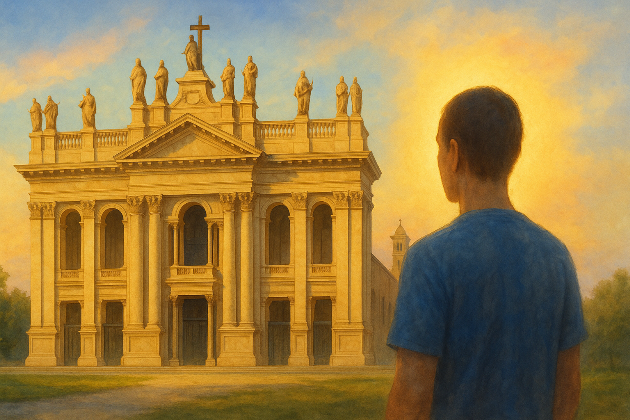
While we often think of St Peter’s Basilica as the Pope’s church, it is actually St John Lateran (its full name is The Archbasilica of the Most Holy Savior and of Saints John the Baptist and John the Evangelist at the Lateran) that holds that title.
It is the Cathedral of the Diocese of Rome, the Mother and Head of all the churches in the world (Omnium urbis et orbis ecclesiarum mater et caput).
So, today’s feast celebrates:
- The dedication of that church building to God,
- The spiritual significance of the Church as the house of God and dwelling of the Holy Spirit, and
- The unity of all local churches with Rome and, by extension, with the universal Church.
📖 Historical Background
1. The Origins
After centuries of persecution, Emperor Constantine legalized Christianity through the Edict of Milan (A.D. 313). Shortly after that, he gave the Lateran Palace (which had belonged to his wife’s family, the Laterani) to Pope Miltiades (also known as Melchiades) around A.D. 311–312.
That palace became the residence of the popes, and an adjoining church was built and dedicated around A.D. 324 by Pope Sylvester I.
This was the first public Christian church ever built in Rome — the first basilica where Christians could worship freely.
It was originally called the Basilica of the Most Holy Savior, and later rededicated to St John the Baptist and St John the Evangelist, giving us the familiar name St John Lateran.
2. The “Mother Church”
For centuries, all popes lived at the Lateran Palace.
All major councils held in Rome during the early Middle Ages took place there — including the Lateran Councils, which shaped much of Church doctrine and discipline.
Thus, the Lateran Basilica came to symbolize:
- The unity of the whole Catholic Church under its chief shepherd,
- The birth of the Church’s visible structure, and
- The freedom and triumph of Christianity after persecution.
3. The Feast Itself
The anniversary of its dedication was originally celebrated only in Rome.
But by the 11th century, the feast was extended to the entire Latin Church as a way of honoring the “Mother and Head of all churches” and affirming unity with the See of Peter.
Today, the feast reminds us that:
wherever a Christian community gathers around the altar, that place becomes the dwelling of God among His people.
It’s not just about bricks and stones — it’s about us as the living temple (1 Cor 3:16–17) where God’s Spirit dwells.
✝️ Theological Significance
- The Church as God’s Temple
The readings (Ezekiel 47; 1 Cor 3; John 2) highlight that God’s true temple is no longer limited to a physical building — but found wherever His Spirit lives, especially in the hearts of believers. - Christ as the New Temple
In the Gospel, Jesus speaks of the temple of His Body.
Through His death and resurrection, He becomes the place where heaven and earth meet — the perfect dwelling of God among us. - We Are the Living Stones
As St Paul teaches, we are “God’s building” — the Church built on Christ the cornerstone, each of us a living stone forming His temple.
So, when we celebrate this feast, we thank God for:
- The freedom to worship openly,
- The visible unity of the Church, and
- The invisible, spiritual reality that we are God’s temple, His holy dwelling.
As we honor this great basilica — the mother of all churches — we are reminded that the truest temple of God is not made of stone but of flesh and spirit. The same Holy Spirit who dwells in that sacred building desires to dwell within us. Let’s reflect, then, on the temple that is our body.
🕊️ “You Are God’s Temple”
A Reflection on the Sacredness of Our Bodies
When we celebrate the Feast of the Dedication of the Lateran Basilica, we honor the Mother Church of all churches — the visible sign of God’s dwelling among His people. But that great basilica in Rome also points to a deeper truth: each of us is a living temple of the Holy Spirit.
St. Paul reminds us:
“Do you not know that you are God’s temple, and that God’s Spirit dwells in you?
If anyone destroys God’s temple, God will destroy him.
For God’s temple is holy, and you are that temple.”
(1 Corinthians 3:16-17)
And again, in another letter, he says:
“You are not your own; you were bought with a price.
Therefore glorify God in your body.”
(1 Corinthians 6:19-20)
Those are strong, sobering words — words that call us to reverence, not fear.
They remind us that our bodies are not disposable, not meaningless, not playgrounds for impulse, but altars where the Holy Spirit desires to dwell and be adored.
1. Our Bodies, the Temples of the Holy Spirit, Should Be Properly Clothed
Every temple is adorned with dignity. We would never enter a holy sanctuary half-clothed or without reverence, because the sacred demands respect.
In the same way, our bodies — which house the very presence of God — should be clothed with modesty and honor.
This isn’t about shame or outdated rules; it’s about recognizing our worth.
To dress with dignity is to proclaim, “I know Whose I am.”
Modesty is not about hiding beauty; it’s about revealing it rightly — showing that we belong to the One who fashioned us in His image.
When we present ourselves with respect, we help others see the divine artistry of God rather than the distractions of the world.
2. Our Bodies, the Temples of the Holy Spirit, Should Be Properly Cared For
Every holy place requires upkeep — not vanity, but stewardship.
If our bodies are temples, then caring for them becomes an act of worship.
That means nourishing them, resting them, exercising them, and guarding them from anything that desecrates or dulls the life of God within.
Addictions of every kind — whether to alcohol, drugs, gluttony, or screens — damage not only the body but also the soul that inhabits it.
These are modern forms of idolatry, where we hand over control of the temple to false gods of pleasure and escape.
Instead, God calls us to sobriety of heart and mind — not rigidity, but balance and gratitude.
To care for this temple is to say, “Lord, I thank You for this body You have given me; help me to use it for Your glory.”
3. Our Bodies, the Temples of the Holy Spirit, Should Be Kept Pure and Holy
This may be the most urgent call of all.
Sexual immorality, in all its modern disguises — fornication, pornography, infidelity, the exploitation of others, and the misuse of our senses — desecrates what God designed for holiness.
St. Paul warns:
“The body is not meant for immorality, but for the Lord, and the Lord for the body.”
(1 Corinthians 6:13)
When we give in to impurity, we turn the sanctuary into a marketplace, much like the temple in Jerusalem that Jesus had to cleanse (John 2).
But when we live chastely — whether married or single — we invite God’s peace to dwell within.
Purity is not repression; it’s freedom — the freedom to love rightly, to see others as God sees them, and to live with integrity and joy.
To keep the temple pure is to allow the Holy Spirit to burn continually on the altar of our hearts.
4. The Invitation
Today, the Lord is calling each of us to rededicate the temple that is our body —
to cleanse it of what defiles,
to rebuild what has been broken,
and to let His Spirit flow once more like the river from Ezekiel’s vision — bringing life, healing, and holiness wherever it goes.
Let us remember:
- We were created in love,
- We were redeemed by blood,
- We are indwelt by the Spirit.
Therefore, let every thought, every glance, every word, every action say,
“This is the Lord’s house — holy and alive with His presence.”
🙏 Closing Prayer
Holy Spirit,
You dwell within me, the temple of Your grace.
Cleanse my heart, purify my desires,
and teach me to honor this body You have made holy.May I clothe it with dignity,
care for it with gratitude,
and guard its purity as an offering of love to You.Let Your light shine from this temple
so that others may see Your glory living in me.
Amen.