Freedom, Wisdom, and the Choice Before Us
Sixth Sunday in Ordinary Time — In the Midst of Carnival
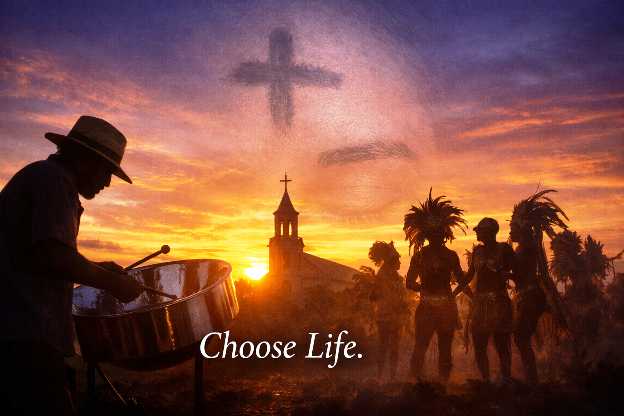
This weekend, as the Church celebrates the Sixth Sunday in Ordinary Time, the nation of Trinidad and Tobago moves into Carnival — a season vibrant with color, music, creativity, rhythm, and cultural expression. Steelpan echoes, costumes shimmer, and the world turns its eyes toward us.
Carnival, in its origin, is not evil. Its name itself comes from carne vale — “farewell to meat” — the final celebration before the penitential season of Lent. Historically, it was a moment of festivity before fasting, joy before discipline.
And yet, as we all know, something has shifted.
The question before us today is not whether culture is good. The question is: What are we choosing?
The readings today place before us a profound and sobering truth.
1. “Before Man Are Life and Death”
(Ecclesiasticus 15:16–21)
The first reading from Ecclesiasticus (Sirach) states:
“If you choose, you can keep the commandments; they will save you…
Before man are life and death, good and evil, whichever he chooses shall be given him.”
This is one of the clearest articulations of human freedom in all of Scripture.
God does not force obedience.
He does not compel virtue.
He does not remove our freedom.
He places before us life and death — and then He allows us to choose.
Carnival itself is not the issue. The issue is the choice made within it.
Do we choose modesty or excess?
Do we choose dignity or degradation?
Do we choose joy or indulgence?
Do we choose celebration or carnality?
Freedom without moral truth becomes self-destruction.
Freedom anchored in truth becomes life.
Sirach reminds us: “He has not commanded anyone to be wicked.”
If corruption exists, it is not because God willed it — it is because we chose it.
2. “Blessed Are They Who Follow the Law of the Lord”
(Psalm 119)
The Responsorial Psalm proclaims:
“Blessed are they whose way is blameless, who walk in the law of the Lord.”
Blessed — not burdened.
The world often portrays God’s commandments as restrictive. But Scripture calls them the path to blessedness.
During Carnival, the law of the Lord can feel countercultural. When everything around you seems to glorify exposure, intoxication, sensuality, and excess, fidelity can feel isolating.
But Psalm 119 reminds us:
“Open my eyes, that I may see the wonders of your law.”
God’s law is not repression.
It is revelation.
It reveals who we truly are.
A society that abandons moral truth eventually wounds itself. We see it in broken families, confused identities, objectification, addiction, and violence. What is marketed as liberation often leaves behind emptiness.
Blessedness is not loud.
It is stable.
It endures.
3. “We Speak a Wisdom Not of This Age”
(1 Corinthians 2:6–10)
St. Paul tells the Corinthians:
“We speak of a mysterious, hidden wisdom of God… not a wisdom of this age.”
This is crucial.
There is a “wisdom of this age” — and it is very loud.
It says:
- If it feels good, do it.
- Your body is for display.
- Morality is outdated.
- Modesty is repression.
- God is irrelevant to culture.
But Paul reminds us that true wisdom is hidden from the powerful of this world.
Real wisdom sees consequences.
Real wisdom understands the human person.
Real wisdom recognizes that we are not merely bodies — we are temples of the Holy Spirit.
Carnival’s artistry — the steelpan, the creativity of mas, the discipline of musicians — reflects God-given talent. But when culture disconnects from moral truth, wisdom is replaced with spectacle.
The Holy Spirit, Paul says, reveals the depths of God.
The Spirit does not condemn culture.
The Spirit purifies it.
4. The Gospel: Christ Raises the Standard
(Matthew 5:17–37)
In the Gospel, Our Lord speaks from the Sermon on the Mount. He does something radical: He deepens the law.
“You have heard that it was said… but I say to you…”
He moves morality from external behavior to interior disposition.
Not just:
- Do not kill — but do not hate.
- Do not commit adultery — but do not lust.
- Do not swear falsely — but let your yes mean yes.
Jesus is not satisfied with surface-level compliance.
He calls for conversion of the heart.
In a season where bodies are often reduced to instruments of attention, Christ reminds us that the battle begins in the heart.
Lust is not freedom.
Anger is not power.
Indulgence is not joy.
Holiness is not prudishness.
It is integrity.
Carnival and the Catholic Conscience
Let us be clear: culture is not the enemy.
The Church has always embraced what is good, beautiful, and true in culture. Steelpan, dance, costume artistry, rhythm — these can glorify God when rooted in dignity.
But when culture becomes detached from virtue, it begins to erode the very people it celebrates.
The tragedy is not celebration.
The tragedy is when celebration forgets the Creator.
In Trinidad and Tobago especially, we stand at a crossroads:
Will we allow Carnival to define us by sensuality?
Or will we reclaim what is noble within it?
The Gospel does not call us to withdraw from the world — it calls us to be salt and light within it.
A Personal Examination
This Sunday, the Word of God asks each of us:
- What am I choosing?
- Am I participating in what diminishes human dignity?
- Am I influencing others toward virtue or toward compromise?
- Does my presence elevate culture — or echo its lowest instincts?
Freedom is real.
Choice is real.
Consequences are real.
But so is grace.
A Word of Hope
Even in the midst of confusion, Christ is present.
He does not abandon His people during Carnival.
He walks among them.
He calls artists to holiness.
He calls musicians to truth.
He calls masqueraders to dignity.
He calls each of us to interior freedom.
The Church does not oppose joy.
She purifies it.
Real joy does not leave shame in its wake.
Real joy does not fracture families.
Real joy does not objectify bodies.
Real joy flows from God.
As Lent Approaches
Carnival historically precedes Ash Wednesday. The ashes remind us:
“Remember that you are dust, and to dust you shall return.”
Life is short.
Eternity is real.
Before us are life and death.
And Sirach still speaks:
“If you choose, you can keep the commandments.”
May we choose life.
May we choose wisdom.
May we choose Christ.
And may Trinidad and Tobago — and every nation — rediscover that the most beautiful culture is the one rooted in truth.
A Closing Prayer
Heavenly Father,
You are the source of all true joy,
the author of freedom,
the giver of every good and perfect gift.
You have placed before us life and death,
good and evil,
blessing and curse —
and in Your mercy, You invite us to choose life.
Lord, in this season of celebration,
in the noise and color and rhythm of our culture,
guard our hearts.
Where there is confusion, grant clarity.
Where there is excess, grant temperance.
Where there is objectification, restore dignity.
Where there is moral compromise, awaken conscience.
Holy Spirit, Spirit of Wisdom,
open our eyes to see the wonders of Your law.
Form within us a love for what is pure,
a hunger for what is true,
a courage to stand firm when the world pulls us elsewhere.
Jesus, Lord of the Sermon on the Mount,
purify not only our actions but our intentions.
Cleanse our thoughts, our desires, our hidden motives.
Teach us that holiness is not restriction —
it is freedom rightly ordered toward love.
Bless our nation of Trinidad and Tobago.
Bless our artists, musicians, designers, and leaders.
Elevate what is beautiful in our culture.
Heal what has been distorted.
Restore what has been lost.
As we approach the holy season of Lent,
prepare our hearts for repentance,
renew our commitment to Your commandments,
and draw us ever closer to You.
May our yes mean yes.
May our joy be rooted in truth.
May our freedom lead us to life.
We choose You, Lord.
Through Christ our Lord.
Amen.