
The Baptism of the Lord: Revelation, Identity, and Mission
What Jesus’ Baptism Teaches Us About Our Own
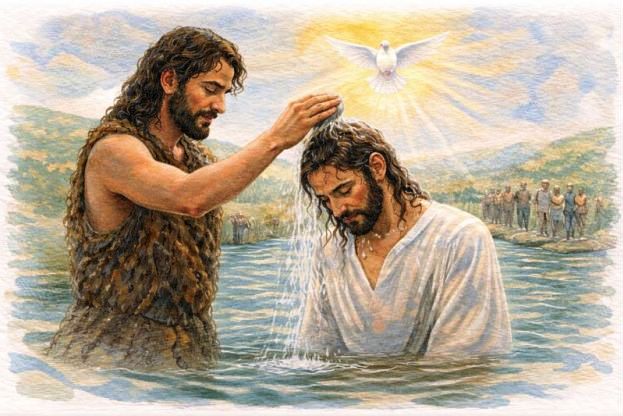
Today the Church celebrates the Baptism of the Lord, a feast that brings the Christmas season to its fulfillment and opens the door to Jesus’ public ministry. At the Jordan River, Jesus Christ steps forward to be baptized by John—an act that at first seems surprising, even puzzling.
Why would the sinless Son of God submit Himself to a baptism of repentance?
The answer reveals not only who Jesus is, but who we are called to be.
Why Jesus Was Baptized
Jesus does not enter the waters because He needs cleansing. He enters the waters because we do.
By stepping into the Jordan, Jesus fully enters into our humanity—into our weakness, our brokenness, our need for healing and restoration. He does not save us from a distance. He stands where sinners stand. He sanctifies the waters so that, one day, those same waters might sanctify us.
At His baptism:
- The heavens are opened
- The Holy Spirit descends like a dove
- The Father’s voice is heard:
“You are my beloved Son; with you I am well pleased.”
This is a moment of profound revelation. The Trinity is made visible, and Jesus’ identity is publicly declared. From this point forward, He begins His mission to proclaim the Kingdom of God.
And this moment naturally turns our hearts toward our own baptism.
Our Baptism: Not a Symbol, but a Transformation
Baptism is not a cultural ritual, a family custom, or a symbolic gesture. It is a real encounter with God, one that changes who we are at the deepest level.
Through baptism:
- Sin is washed away
- We are reborn as sons and daughters of God
- We are sealed with the Holy Spirit
- We are incorporated into the Body of Christ
- We are entrusted with a mission
In baptism, the words spoken over Jesus are mystically spoken over us:
“You are my beloved son.”
“You are my beloved daughter.”
This is our truest identity—before achievement, failure, success, or shame.
What We Can Take from the Baptism of the Lord
The Baptism of the Lord is not only something we remember; it is something we must live. From it, we draw four powerful and life-shaping truths.
1. Identity Comes Before Mission
At the Jordan, the Father declares Jesus to be His beloved Son before Jesus performs a single miracle, preaches a single sermon, or walks the road to Calvary.
This order matters.
In a world that constantly tells us we are only as valuable as what we do, baptism proclaims a different truth:
We are loved before we are useful.
Our baptism reminds us that:
- We do not earn God’s love
- We do not prove our worth
- We do not work our way into being God’s children
We begin from love, not toward it.
When identity is forgotten, faith becomes exhausting.
When identity is remembered, faith becomes joyful.
2. Humility Opens the Way for Grace
Jesus does not distance Himself from sinners. He stands among them.
By entering the waters of repentance, Jesus teaches us that grace flows where humility lives. God does not force Himself upon us; He enters where He is welcomed.
Baptism teaches us that:
- We do not save ourselves
- We do not cleanse ourselves
- We do not control grace
We surrender to it.
Water overwhelms, immerses, and washes. In the same way, baptism calls us to stop resisting God’s work and allow Him to transform us from within.
Every act of humility reopens the waters of baptism in our lives.
3. Baptism Is a Beginning, Not an Ending
The Jordan River was not Jesus’ destination—it was His starting point.
Immediately after His baptism, Jesus is led into the desert, and then into public ministry. The same is true for us. Baptism is not graduation; it is new birth.
To be baptized is to say:
“My life no longer belongs to me alone.”
We are baptized into a people, into a Church, into a mission. Every baptized person is called—not necessarily to the pulpit, but to holiness, to witness, to love that reflects Christ.
Baptism sends us out.
4. We Are Never Alone
At the Baptism of the Lord, the Holy Spirit descends and remains. That same Spirit is given to us in baptism—not temporarily, not symbolically, but truly.
The Holy Spirit:
- Strengthens us in weakness
- Prays within us when we cannot pray
- Convicts us when we stray
- Comforts us in suffering
Christian life is impossible without the Spirit—and God never asks the impossible without also giving the grace to live it.
You are never alone. Even when you feel abandoned, the Spirit remains faithful.
Why Does the Catholic Church Baptize Babies?
This question goes to the very heart of how the Church understands grace.
1. Baptism Is God’s Initiative First
The Church baptizes babies because baptism is not primarily about our choice—it is about God’s gift.
A baby does not earn love.
A baby does not choose to be born.
A baby receives life freely.
So it is with grace.
Infant baptism proclaims that God acts first—that salvation is gift, not reward. To delay baptism until a child can “decide” would suggest that grace depends on maturity or merit, rather than on God’s mercy.
2. Baptism Heals What Humanity Inherits
Baptism is not only about personal sin; it heals the wounded human condition into which we are all born. Children may not commit personal sins, but they are born into a world marked by sin and death.
Baptism restores what was lost and opens the child immediately to divine life. The Church does not withhold grace as a test—it offers grace as a remedy.
3. Faith Is First Lived in the Family
Children learn who God is the same way they learn language—by immersion.
Parents already make profound decisions for their children: food, safety, education, health. Faith is not excluded from love’s responsibility.
In baptizing a child, parents are saying:
“We will raise this child to know God, love God, and serve God.”
This is not coercion; it is care.
The Role of Parents and Godparents
Parents
Parents are the primary educators in the faith. By bringing their child for baptism, they promise:
- To live the faith authentically
- To pray with and for their child
- To teach the child who God is by word and example
Baptism plants the seed. Parents are entrusted with helping it grow.
Godparents
Godparents are not honorary figures. They are spiritual companions and witnesses. They promise to:
- Support the parents
- Pray faithfully for the child
- Encourage the child in moments of doubt or struggle
Together, parents and godparents surround the child with a living community of faith.
A Strong Call to Action: Renew Your Baptism
Today, the Church invites us not merely to remember our baptism—but to renew it.
Take time today to do the following:
- Make the sign of the cross slowly and intentionally
- Renounce anything that leads you away from God
- Reaffirm your belief in the Father, the Son, and the Holy Spirit
- Ask the Holy Spirit to rekindle the grace of your baptism
Then live it.
Choose one concrete way this week to live as a baptized disciple:
- Offer forgiveness where it is difficult
- Speak truth with love
- Pray intentionally
- Serve quietly
- Trust more deeply
Let your life proclaim what your baptism began.
A Closing Prayer
Heavenly Father,
Today we thank You for the Baptism of Your Son,
and for the gift of our own baptism.
You claimed us before we could speak,
loved us before we could choose,
and called us Your beloved sons and daughters.
Renew in us the grace of the waters that once flowed over us.
Strip away whatever dims our baptismal light.
Strengthen us with the Holy Spirit,
that we may live as true children of God.
May our lives reflect the identity we have received,
the mission we have been given,
and the love You have poured into our hearts.
We ask this through Christ our Lord. Amen.