
Secrecy at the Synod on Synodality: What we know about delegates’ confidentiality requirements
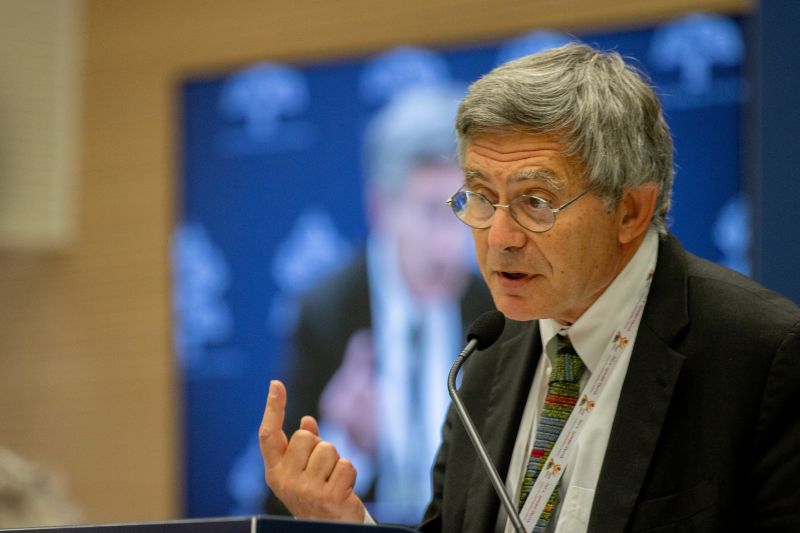 Speaking at a press briefing on Oct. 6, Vatican spokesman Paolo Ruffini said that there needs to be “a certain amount of confidentiality about who takes the floor and who doesn't in order to leave the space open … for ‘conversation in the Spirit.’” / Credit: Daniel Ibáñez/EWTN News
 Vatican City, Oct 6, 2023 / 13:24 pm (CNA).
The roughly 450 people in the room during the Synod on Synodality assembly are “bound to confidentiality and discretion” regarding what is said in Synod discussions.
Unlike at past Synod of Bishops meetings, where the “pontifical secret” only applied to sharing what was said by others in the synod hall, the Synod on Synodality’s official regulations no longer allow Synod delegates to share their personal interventions with the public.
The rules, published this week on the first day of the 16th Ordinary Assembly of the Synod of Bishops, stipulate that all Synod delegates are “bound to confidentiality and discretion regarding both their own interventions and the interventions of other participants,” a duty that it says will continue to remain in force after the Synod assembly has ended.
For the first time, the Vatican communications office is also withholding the identities of which delegates are addressing the Synod assembly each day and the members of each working group, opting instead to summarize some of the topics discussed over the course of the day’s speeches and small-group discussions.
Speaking at a press briefing on Oct. 6, Vatican spokesman Paolo Ruffini said that there needs to be “a certain amount of confidentiality about who takes the floor and who doesn’t in order to leave the space open … for ‘conversation in the Spirit.’”
“It’s not important who says what, but it is an exchange and mutual listening,” said Ruffini, who serves as the president of the information commission for the Synod and is also the head of the Vatican Dicastery for Communication.
When asked about what the potential punishments would be for breaking the confidentiality regulations, Ruffini laughed and said that the rules do not mean that “there is a policeman who is going to punish you.”
“It is an assembly of brothers and sisters who have decided to speak freely during this specific period of time and, of course, there is a personal discernment in all of this,” he said.
“We are not talking about punishments,” he added. “We are talking about this personal discernment that was asked for by the pope to the members.”
According to the Vatican, the confidentiality requirement exists “in order to guarantee the freedom of expression of each and all regarding their thoughts and to ensure the serenity of the discernment in common, which is the main task entrusted to the assembly.”
Pope Francis calls Synod to ‘fast’ from public speech
Pope Francis underlined “the priority of listening” in his opening speech of the Synod on Synodality on Oct. 4, calling for “a certain fasting from public speech” by the Synod delegates during the nearly monthlong assembly.
“Some will say — and are saying — that the bishops are afraid and that is why they don’t want the journalists talking. No. The work of journalists is very important. But we have to help them so that they can also speak of this journeying in the Spirit,” Pope Francis said.
“More than speaking, the priority is that of listening. I ask journalists to please make this known to people, that they realize that the priority is to listen.”
The pope went on to describe how past synods during his pontificate were influenced by “worldliness” and the media before they even began.
“During the Synod on the Family, public opinion, the fruit of our worldliness, [thought] that communion was going to be given to the divorced, and in that spirit we began the synod,” Francis said.
“When we had the Synod for the Amazon, public opinion, pressure, [thought] that viri probati were going to be [ordained], and we went in under that pressure. Now there is speculation about this synod: ‘What are they going to do?’ ‘Maybe ordain women?’ … Those are things they are saying out there.”
During the Synod on Synodality, communication about what takes place in the synod hall is being managed by a “Commission for Information,” which is “mandated to report on the progress of the synodal assembly.”
The Synod rules forbid participants from recording, filming, or disclosing their interventions in the Synod’s General Congregations and in the Working Groups, but note that an official audiovisual recording of the General Congregations is kept in the archives of the General Secretariat of the Synod.
During official press briefings, Ruffini, the president of the information commission, has limited himself to summarizing the structure of the assembly and to listing off “various themes” and subjects that people brought up in discussions.
Summarizing the 22 three-minute inventions given in the Synod assembly on Friday morning, Ruffini said that the topics included “the suffering of the Church in several parts of the world,” the closeness of the Church to the Ukrainian people, seminary formation, the topic of “the Eucharist as food of the synodal Church,” and how the Church can be present to young people who spend so much time on the internet.
Sheila Pires, the secretary of the Synod’s information commission, told journalists that the atmosphere inside Paul VI Hall has been “an atmosphere of joy.”
“As much as there may be some tensions here and there, above all there is really an atmosphere of joy,” she said.