

St. Francis of Assisi: A Life Transformed by Christ
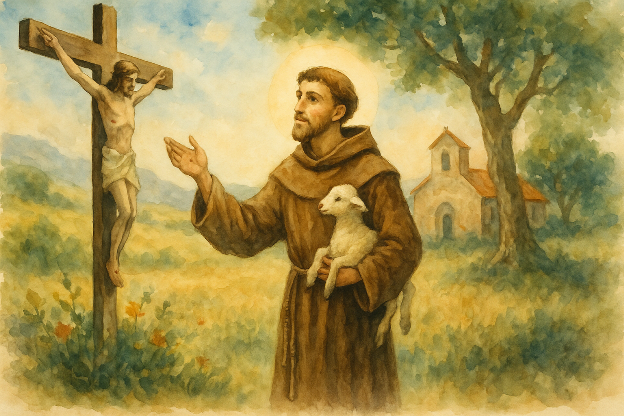
Early Life: From Privilege to Restlessness
Francis – whose feast day we celebrate today – was born in Assisi, Italy, in 1181 or 1182, the son of a wealthy cloth merchant. He grew up surrounded by comfort and privilege, dreaming of fame, chivalry, and adventure. Known for his charm and generosity, Francis was popular among his peers, yet beneath the laughter he carried an emptiness that wealth could not fill.
His youthful ambition was to be a knight. He joined a military expedition, but illness cut short his plans. In that season of weakness, Francis began to hear another call, one not from earthly glory but from God.
“For what will it profit a man if he gains the whole world and forfeits his soul?” (Matthew 16:26)
This verse could summarize Francis’s awakening: the realization that riches, power, and pleasure are fleeting, but the soul’s relationship with God is eternal.
The Turning Point: Encountering Christ in the Poor and the Cross
Francis’s conversion was gradual but marked by powerful encounters. One day, while praying before a crucifix in the dilapidated church of San Damiano, he heard Christ speak to his heart:
“Francis, go and rebuild my Church, which you see is falling into ruin.”
Taking these words literally, Francis sold some of his father’s cloth to repair the church. When confronted, he renounced his inheritance publicly, even stripping off his fine clothes to embrace a life of radical poverty.
Another decisive moment came when he met a leper. At first, Francis recoiled, but then, overcoming his fear and disgust, he embraced and kissed the man. In that act, what was bitter became sweet, and Francis discovered Christ in the poor.
“Whatever you did for one of the least of these brothers and sisters of mine, you did for me.” (Matthew 25:40)
Living the Gospel Radically
Francis committed himself fully to living the Gospel. He wore a simple tunic, begged for food, and gave everything to the poor. Soon others were drawn to his joy and authenticity, forming the beginnings of the Franciscan Order. Their life was marked by poverty, humility, preaching, and deep reverence for all of God’s creation.
Francis’s love for creation was not sentimental but theological. He saw every creature as a reflection of the Creator’s goodness. His Canticle of the Sun praises “Brother Sun” and “Sister Moon,” echoing the psalmist:
“The heavens declare the glory of God; the skies proclaim the work of his hands.” (Psalm 19:1)
Relevance for Our Time
The life of St. Francis offers a piercing challenge and an inspiring invitation for today:
- Simplicity in a materialistic world: Francis reminds us that true joy is not in possessions but in God. In an age of consumerism, he calls us back to simplicity and detachment.
- Care for the poor and marginalized: Like Francis embracing the leper, we are called to embrace those whom society rejects. This is especially urgent in light of today’s crises of poverty, migration, and inequality.
- Peace and reconciliation: Francis crossed enemy lines during the Crusades to dialogue with the Sultan, modeling peacemaking that goes beyond fear and division.
- Care for creation: In a time of environmental crisis, Francis inspires us to rediscover the sacredness of creation. Pope Francis’s encyclical Laudato Si’ draws directly on his spirit.
- Joy in God’s presence: Amidst a culture of anxiety and self-centeredness, Francis’s radiant joy points us back to the Gospel truth: “Rejoice in the Lord always. I will say it again: Rejoice!” (Philippians 4:4).
Conclusion: A Saint for Every Age
St. Francis of Assisi is not just a medieval saint but a mirror of the Gospel lived to its fullest. His life challenges us to ask:
- Where do I seek fulfillment—in possessions or in God?
- How do I treat those whom society rejects?
- Am I willing to let Christ rebuild His Church through me?
His conversion was not a one-time event but a lifelong journey of becoming more like Christ. And so it is with us.
“I have been crucified with Christ and I no longer live, but Christ lives in me.” (Galatians 2:20)
May we, like Francis, allow the Lord to strip away what is not of Him so that we may live in the freedom, joy, and love of the Gospel.