
When Forgiveness Feels Impossible: The Mercy That Sets Us Free
Please Press The Play Button Below To Listen To This Post
A reflection for the 24th Sunday in Ordinary Time — Matthew 18:21–35
There are some teachings of Jesus that are beautiful to hear until life gives us an opportunity to practise them.
Forgiveness is one of them.
It is relatively easy to speak about forgiveness when the wound is small. It is quite another thing when someone has betrayed our trust, destroyed a relationship, humiliated us, abused us, abandoned us, cheated us, been unfaithful to us, or taken the life of someone we love.
There are wounds for which the words “Just forgive” can sound almost cruel.
Jesus knows this.
And yet, forgiveness occupies such a central place in the Christian life that Jesus places it within the very prayer He teaches His disciples:
“Forgive us our trespasses, as we forgive those who trespass against us.”
We pray those words so frequently that we can easily miss their seriousness.
Every time we pray the Our Father, we acknowledge two things: I am a person who needs mercy, and I am called to become a person who gives mercy.
That brings us directly to Peter’s extraordinary conversation with Jesus in Matthew 18.
“How often must I forgive?”
Peter approaches Jesus with what sounds like a reasonable question:
“Lord, if my brother sins against me, how often must I forgive him? As many as seven times?”
Seven already sounds generous.
But Jesus responds:
“I say to you, not seven times but seventy-seven times.”
Jesus is not replacing Peter’s number with a larger number so that Christians can begin keeping score until forgiveness number 77.
The point is precisely the opposite.
Stop counting.
Peter is looking for the boundary of mercy.
When have I forgiven enough? At what point am I entitled to stop?
Jesus responds by telling him a story.
And He begins with some very important words:
“The kingdom of heaven may be likened to a king who decided to settle accounts with his servants.”
This is more than advice about conflict resolution.
Jesus is telling us something about life in the Kingdom of God.
And then He introduces a number so enormous that it changes the entire conversation.
The impossible debt: 10,000 talents
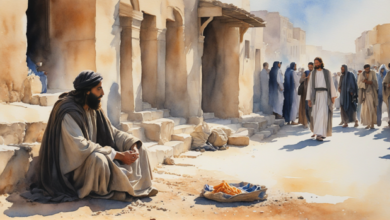
A servant is brought before the king owing 10,000 talents.
It is difficult for a modern reader to feel the impact of that number.
A talent was approximately 6,000 denarii, and a denarius represented roughly a day’s wage for an ordinary labourer.
Therefore:
10,000 talents ≈ 60,000,000 days’ wages.
Sixty million days.
Even if someone could work 300 days every year, paying every cent he earned toward the debt while spending absolutely nothing on food, clothing or shelter, it would take approximately 200,000 years to repay.
Jesus has deliberately created an impossible situation.
This is not merely a man who needs a better financial plan.
He cannot repay the debt.
And perhaps there is something even more profound here.
How did he ever accumulate a debt so enormously beyond his capacity to repay?
Jesus does not tell us.
Because perhaps the important question isn’t how.
The important fact is:
He stands before the king owing what he cannot possibly repay.
And in that servant, perhaps every one of us should recognize ourselves.
“Give me time, and I will pay you back”
The servant falls before the king:
“Be patient with me, and I will pay you back in full.”
But he won’t.
He can’t.
His promise may not necessarily be dishonest; perhaps it is simply the desperate bargaining of a terrified man.
Please! Give me another chance. Give me enough time. Somehow I will fix this.
But there isn’t enough time.
There isn’t enough work.
There isn’t enough money.
There isn’t enough life.
And here comes one of the most beautiful moments in the parable.
The servant asks for time.
The king gives him mercy.
The servant asks for an extension.
The king cancels the debt.
The servant asks for an opportunity to repay.
The king effectively says:
There is nothing left to repay.
The servant asked for much less than he actually needed.
And the king gave him infinitely more than he dared to ask.
We too stand before the King
There is a temptation to read the 10,000 talents only as representing the enormous debt created by human sin. Certainly that is part of the picture.
But perhaps the parable invites us to look still further.
Consider everything we have received from God.
Our existence.
Our breath.
Our families.
People who have loved us.
Every sunrise we have lived to see.
Every moment of beauty.
Every prayer answered.
Every prayer God answered differently because He knew what we did not.
Every second chance.
Every grace we recognized.
Every grace we never even noticed.
Baptism.
His Word.
The Eucharist.
His Holy Spirit.
And above everything else:
Jesus Christ.
God did not merely give us something.
God gave us Himself.
How do we repay that?
Scripture asks precisely this question:
“How can I repay the LORD for all the great good done for me?”
— Psalm 116:12
We cannot.
Ten thousand tongues could praise Him and still never exhaust the thanksgiving due to Him.
Even the breath with which we say “Thank You, Lord” is itself His gift.
Christianity, therefore, is not the story of human beings successfully paying God back.
It is the story of people discovering that God’s mercy is greater than anything they could ever repay.
And perhaps the proper response to mercy is not repayment.
Perhaps it is transformation.
Then he meets someone who owes him 100 denarii
The forgiven servant leaves the king’s presence.
His balance is now:
ZERO.
The impossible debt is gone.
And then he encounters another servant who owes him 100 denarii—approximately 100 days’ wages.
We must be careful here.
That is not an insignificant debt.
Jesus is not saying that the wounds inflicted upon us don’t matter.
Some wounds are devastating.
The betrayal was real.
The adultery was real.
The abuse was real.
The lie was real.
The abandonment was real.
The money really was stolen.
The reputation really was destroyed.
The child really did die.
Christian forgiveness must never become a way of pretending evil wasn’t evil.
The second servant really owes something.
But then Jesus asks us to place the two debts beside each other:
60,000,000 days’ wages.
100 days’ wages.
The first debt is approximately 600,000 times greater.
And something astonishing happens.
The second servant falls down and makes essentially the same plea:
“Be patient with me, and I will pay you back.”
The first servant should recognize those words.
He should see himself kneeling there.
He should remember his terror.
He should remember the king.
He should remember the moment when his entire future was handed back to him.
He should remember mercy.
But he doesn’t.
Instead, he refuses mercy and has the man imprisoned.
Mercy reached him—but did not pass through him
Perhaps this is the tragedy at the heart of the parable.
He received mercy without becoming merciful.
Mercy reached his account.
But apparently it never reached his heart.
The king later asks:
“Should you not have had pity on your fellow servant, as I had pity on you?”
Notice the standard.
“As I had pity on you.”
The king is saying, in effect:
Did what happened between you and me change nothing about what happens between you and others?
That is Christianity.
God’s mercy comes to me so that God’s mercy can begin flowing through me.
I cannot repay God’s mercy.
But I can become merciful.
I cannot repay His grace.
But I can become gracious.
I cannot repay His forgiveness.
But because I have been forgiven, I can learn to forgive.
Mercy was never intended to stop with me.
But what about the wounds that feel impossible to forgive?
This is where we must be pastorally careful.
There may be someone reading this whose wound is not theoretical.
Perhaps your spouse betrayed you.
Perhaps somebody abused you.
Perhaps someone destroyed your good name.
Perhaps a friend betrayed a confidence.
Perhaps a family member has not spoken to you for years.
Perhaps someone harmed your child.
Perhaps someone you loved was murdered.
And now Christianity seems to place another unbearable burden upon you:
“Forgive.”
But forgiveness does not mean pretending the evil wasn’t serious.
It does not mean saying, “It didn’t hurt.”
It does not necessarily mean trusting the person again.
It does not mean abandoning appropriate boundaries.
It does not mean remaining in an abusive or dangerous situation.
It does not eliminate the legitimate demands of justice.
And forgiveness does not always mean reconciliation. Reconciliation requires something from both parties; forgiveness can begin within one wounded heart.
Sometimes forgiveness begins with nothing more than:
“Lord, I cannot forgive this person by myself. But I want to want to forgive. Please begin in me what I cannot accomplish alone.”
That itself can be a beginning.
Forgiveness may be a journey
Sometimes we imagine forgiveness as a single emotional moment.
It isn’t always.
We may decide to forgive today and wake tomorrow feeling the wound all over again.
Then we forgive again.
The memory returns.
We surrender it again.
Anger rises.
We bring it back to Jesus again.
This may happen many times.
Perhaps seventy-seven times is not only about seventy-seven different offences.
Sometimes it may be the same wound that we must repeatedly surrender to God because it keeps returning to the heart.
Forgiveness is not necessarily the disappearance of pain.
It is the decision that the pain will no longer determine what I desire for the person who caused it.
It is gradually surrendering the right to vengeance.
It is placing judgment into God’s hands.
Sometimes that requires extraordinary grace.
Which is precisely why we must ask for it.
Look at the Cross
When forgiveness feels impossible, perhaps there is nowhere more important to look than Calvary.
Jesus is not teaching forgiveness from the safety of a classroom.
He lives it.
Betrayed.
Falsely accused.
Humiliated.
Scourged.
Mocked.
Stripped.
Nailed to a Cross.
And there He prays:
“Father, forgive them…”
The One telling Peter to forgive is the One who will show Peter what forgiveness costs.
Christian forgiveness is therefore not weakness.
Sometimes forgiveness is one of the strongest acts a human being will ever perform.
There are things we simply cannot forgive through willpower alone.
We need grace.
The Our Father suddenly becomes frighteningly beautiful
Now hear again the words we pray perhaps every day:
“Forgive us our trespasses, as we forgive those who trespass against us.”
Those words connect the two servants.
Forgive me.
Teach me to forgive.
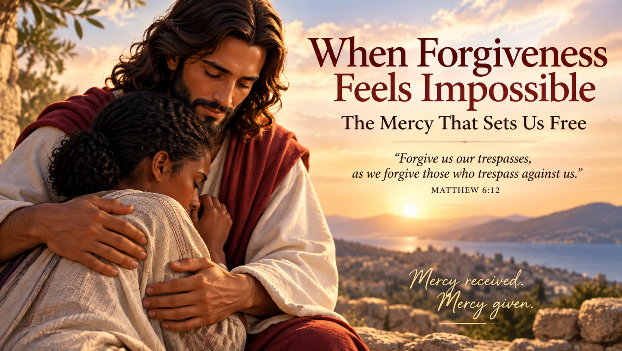
Mercy received.
Mercy given.
Vertical.
Horizontal.
God to me.
Me to my brother or sister.
And perhaps that is what life in the Kingdom looks like.
Not perfect people who have never wounded anyone.
Not people who have never been wounded.
But people who continually stand before the King, astonished that the impossible debt has been cancelled—and who then go into the world determined that the mercy they have received will not stop with them.
Peter began by counting.
Seven?
Jesus tells him to put away the ledger.
Because once we truly understand the mercy of God, the question changes.
No longer:
“How many more times do I have to forgive?”
But:
“Lord, after all the mercy You have shown me, how can I allow Your mercy to reach this person through me?”
And perhaps that is the real miracle of forgiveness.
God does not merely forgive us.
His forgiveness can gradually transform us into people capable of doing what once seemed impossible.
A Prayer for the Grace to Forgive
Lord Jesus Christ,
You know my heart.
You know every wound I carry,
even the wounds I never speak about.
You know the names, the faces, the memories,
the words that were spoken,
the promises that were broken,
the trust that was betrayed,
and the pain that still returns when I least expect it.
Lord, You know that sometimes forgiveness is hard.
Sometimes I say that I forgive,
but deep inside the wound is still bleeding.
Sometimes anger returns.
Sometimes resentment returns.
Sometimes I replay what happened
and wish that somehow I could make the person understand
just how deeply I was hurt.
Jesus, I cannot heal my own heart.
And there are some things
I cannot forgive by my own strength.
So today I ask You for grace.
Where I cannot forgive,
give me the grace to forgive.
Where I do not even want to forgive,
give me the grace to want to forgive.
Where the wound is too deep for words,
come into that place Yourself.
Lord, remind me of the ten thousand talents.
Remind me of every mercy You have shown me.
Remind me of every time I wandered
and You welcomed me home.
Remind me of every sin You have forgiven,
every second chance You have given,
every grace I did not deserve.
Remind me that I live every moment
inside an ocean of Your mercy.
And let that mercy flow through me.
I place into Your hands today
the person who wounded me.
I surrender my desire for revenge.
I surrender my demand that the past somehow be undone.
I surrender the debt into Your hands.
You are the Judge.
You are the Healer.
You are God.
Give me wisdom where boundaries are necessary.
Give me courage where justice must be sought.
Give me patience where healing will take time.
And protect me from confusing forgiveness
with allowing evil to continue.
But Lord, do not allow hatred to have my heart.
Do not allow another person’s sin
to imprison me long after the offence has passed.
Break the chains of bitterness.
Heal the memories.
Touch the places I keep hidden.
And when the wound returns tomorrow,
give me grace to surrender it again.
And again.
And again.
Seventy-seven times, Lord,
if that is what healing requires.
Jesus, when forgiveness seems impossible,
take me to Your Cross.
Let me hear You pray:
“Father, forgive them.”
Then teach me to pray those words with You.
I cannot repay You
for all the mercy You have shown me.
I cannot repay Your love.
I cannot repay Calvary.
I cannot repay the gift of Yourself.
So let my life become my thanksgiving.
As Your mercy flows to me,
may Your mercy flow through me.
Make my heart like Yours.
Make me merciful because You are merciful.
Make me forgiving because You have forgiven me.
And when at last I stand before You,
may I discover that the mercy I received from Your hands
became mercy that I freely gave away.
Jesus, I trust in Your mercy.
Jesus, heal my heart.
Jesus, teach me to forgive.
Amen.