Vanity or Eternity? A Wake-Up Call from the Word of God
Please press the PLAY button below to listen to podcast on this post
🔷 18th Sunday in Ordinary Time, Year C
Overview: Living Wisely in a World Obsessed with More
This Sunday’s readings confront us with a question we often try to avoid:
What are you building your life on — and will it last?
From the anguished cry of Ecclesiastes, to the solemn beauty of Psalm 90, to St. Paul’s stirring call in Colossians, and finally to Jesus’ sharp parable in Luke’s Gospel — this week’s message is unified and crystal clear:
Do not waste your life chasing what perishes. Live for what is eternal.
We are invited — urgently — to examine our relationship with time, wealth, ambition, and purpose. The Spirit is calling us to a radical reorientation of the heart, away from the false security of possessions and into the wisdom and freedom of a life hidden in Christ.
This isn’t just a philosophical reflection. It’s a spiritual wake-up call — and for a world drowning in materialism, consumerism, and isolation, it couldn’t be more timely.
💬 “The bread in your cupboard belongs to the hungry.”
— St. Basil the Great
🔶 Reflection on the First Reading
Ecclesiastes 1:2; 2:21–23 — “Vanity of vanities! All is vanity.”
The first words we hear in today’s liturgy strike like thunder:
“Vanity of vanities, says Qoheleth, vanity of vanities! All things are vanity!”
These are not the bitter mutterings of a man in despair. They are the sober, hard-earned wisdom of someone who has tasted everything the world has to offer — and found it wanting.
The Hebrew word translated as vanity is “hebel”, which literally means:
- breath,
- vapor,
- mist.
In other words, something fleeting, insubstantial, unable to be grasped or held. Like breath on a mirror, it vanishes the moment you reach for it.
Qoheleth (the teacher) is not saying that life is meaningless — but that when we live it disconnected from God, no matter how much we gain, it will ultimately feel empty.
He observes the futility of human toil:
A man may work wisely, skillfully, and with great effort,
yet in the end, he must leave it all to someone else.
And what does he get in return?
- Anxiety during the day,
- Restlessness at night,
- And sorrow that clings to his labor.
Is it any wonder he cries out, “Vanity!”
But this is not the final word. Ecclesiastes isn’t telling us to quit life — he’s telling us to wake up.
Because it is not our work that is the problem.
It is our worship.
If we worship money, success, legacy, or human praise, we will build our lives on mist.
But if we worship God, everything — even our work — becomes meaningful.
Qoheleth is essentially holding up a mirror and asking:
“Is this what you’re living for? Will this last? Will it satisfy your soul?”
It’s uncomfortable. It’s confronting. But it’s necessary.
🔶 Reflection on the Responsorial Psalm
Psalm 90 — “O Lord, You have been our refuge from one generation to the next.”
After the unsettling, sobering cry of “Vanity of vanities” in Ecclesiastes, the Responsorial Psalm gently draws our gaze upward — toward the eternal refuge of God.
Where Qoheleth laments the futility of life lived under the sun, the psalmist reminds us:
There is a refuge. There is One who does not change. There is a God whose eternity gives meaning to our passing days.
This psalm — the only one attributed to Moses — is a prayer of profound humility and wisdom. It sets up a stark contrast between the eternity of God and the frailty of man:
“Before the mountains were born… from everlasting to everlasting, you are God.”
And then:
“You turn men back to dust… A thousand years in your sight are like yesterday, come and gone.”
This is not poetic despair — it is a sacred reminder. We are dust. Our days are numbered. Even the strongest among us may only reach seventy or eighty years — and much of it is filled with toil and struggle.
But the psalm does not end in sadness. It leads us to petition, to wisdom, to grace:
“Make us know the shortness of our life, that we may gain wisdom of heart.”
This is one of the most important prayers we can ever make.
When we become aware of life’s brevity, we stop wasting it on trivial pursuits.
We stop chasing vapors and start building on things that endure: love, mercy, service, justice, holiness.
The psalmist continues:
“In the morning, fill us with your love.”
This is the antidote to vanity — to be filled, daily, with the love of God.
That love becomes our anchor, our purpose, our joy — not the accumulation of wealth, not prestige, not security that can be taken away.
Psalm 90 teaches us how to live well in a passing world:
- Live wisely.
- Live humbly.
- Live rooted in the eternal love of God.
And from that foundation, we cry:
“O Lord, You have been our refuge from one generation to the next.”
He is not just our shelter, but our purpose and our goal.
🔶 Reflection on the Second Reading
Colossians 3:1–5, 9–11 — “There is only Christ: He is everything and He is in everything.”
After hearing that everything on earth is fleeting (Ecclesiastes) and that our lives are like passing shadows (Psalm 90), St. Paul now turns our eyes to what truly lasts — to Christ, who is our life.
“Since you have been brought back to true life with Christ, seek the things that are above, where Christ is, seated at the right hand of God.”
This is the voice of someone speaking not just to the mind, but to the newly resurrected heart.
Paul is addressing baptized Christians — those who have died to the world and risen with Christ through the waters of baptism. And he is urging them to live like it.
His words challenge us to rethink our entire orientation:
- Not just what we do,
- But what we desire.
- What we pursue.
- What we treasure.
“Let your thoughts be on heavenly things, not on the things that are on the earth.”
Why? Because “you have died”, Paul says — meaning, the old self ruled by fear, ego, and earthly security is dead.
And your life now is hidden with Christ in God.
This is one of the most beautiful truths in the New Testament:
Your true identity is not in your possessions, your past, your status, or your achievements.
Your true life is hidden in Christ — secure, beloved, eternal.
Paul then calls for a deep internal transformation:
“You must kill everything in you that belongs only to earthly life…”
And he names them clearly:
- Fornication
- Impurity
- Greed (which he bluntly calls idolatry)
- Lies
- Anger
- Division
These are the signs of someone still clinging to the old world. They are the behaviors of someone who is still storing up treasure “for self,” rather than being “rich in what matters to God.”
But Paul does not stop at what we must strip off. He points us to what we must put on:
“You have put on a new self, which will progress towards true knowledge the more it is renewed in the image of its Creator.”
This is an ongoing journey of transformation — becoming more and more like Christ.
And finally, in a world obsessed with categories, status, and exclusion, Paul says something radical:
“There is no room for distinction between Greek and Jew, slave and free… there is only Christ, and He is everything.”
This is liberating and leveling.
Christ becomes the measure of all things.
He becomes the goal. The way. The meaning.
In light of Ecclesiastes and Psalm 90, Paul gives us the answer:
- If all earthly things are fleeting, then seek what is eternal.
- If human life is short, then live it anchored in the One who conquered death.
- If the world divides, then root yourself in Christ, who makes us one.
“There is only Christ: He is everything, and He is in everything.”
🔶 Reflection on the Gospel Reading
Luke 12:13–21 — “You fool! This very night your soul will be demanded of you.”
Today’s Gospel is not a gentle one. It is not comforting.
It is a spiritual alarm bell — a direct confrontation from Jesus to every soul that seeks meaning in material things.
The parable begins with a request:
“Master, tell my brother to give me a share of our inheritance.”
Jesus refuses to get involved in the squabble, not because justice is unimportant, but because He sees something deeper — a heart consumed by greed, a life revolving around possession.
He then speaks a parable to the crowd. A man, already rich, experiences an abundant harvest. And what does he do?
“I will tear down my barns and build bigger ones… and I will say to my soul, ‘Eat, drink, and be merry.’”
No prayer. No thanksgiving.
No thought of the poor.
No thought of God.
Just self-talk, self-planning, and self-indulgence.
And then the voice of God breaks in — not tenderly, but sharply:
“You fool!”
🔹 Why Does Jesus (through God in the parable) Use the Word Fool?
Isn’t this the same Jesus who said in Matthew 5:22:
“Whoever calls his brother ‘fool’ is liable to judgment”?
Yes — and that’s precisely why this moment is so serious.
In Scripture, the word “fool” (aphrōn in Greek) is not an insult, but a divine diagnosis — a judgment from God on a soul who lives as if God does not exist.
Just like in Psalm 14:1:
“The fool says in his heart: ‘There is no God.’”
The man in the parable is a fool not because he is rich, but because:
- He made his wealth his security.
- He lived as if time belonged to him.
- He saw his life as his own, not a gift from God.
He forgot the most essential truth:
“This very night, your soul will be demanded of you.”
He planned for many years, but didn’t realize he only had hours left.
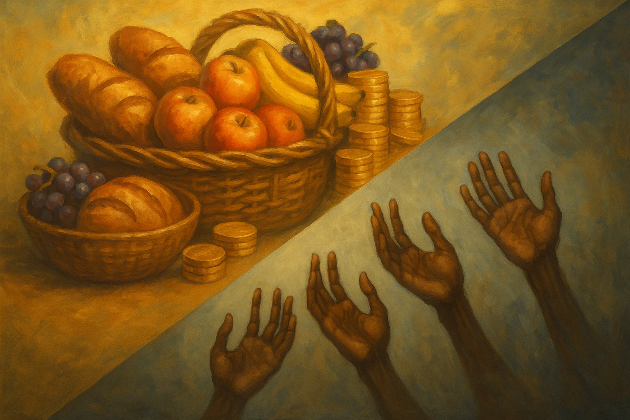
🔹 The Tragedy of Hoarding vs. the Grace of Sharing
This parable is not just about one man — it is a mirror held up to the world.
And the image we see is heartbreaking.
In our modern times:
- Tons of food are destroyed or discarded every day in wealthy nations.
- Sometimes this is done deliberately — to preserve market value, keep prices high, or because of arbitrary regulations.
- Meanwhile, in large parts of the developing world, people starve.
Children go to bed with nothing. Whole communities suffer malnutrition.
This is not just a logistical issue. It is a spiritual crisis.
As St. Basil the Great boldly said:
💬 “The bread in your cupboard belongs to the hungry.
The coat hanging unused in your closet belongs to the one who needs it.
The shoes rotting in your closet belong to the one with no shoes.
The money you hoard belongs to the poor.”
The rich man in the parable could have been a Joseph, like in Genesis:
- Joseph also stored grain.
- But he did so at God’s command, to feed the nations, not enrich himself.
- His barns were storehouses of mercy, not monuments to pride.
The Gospel reveals that what makes a man wise or foolish is not what he possesses — but what he does with what he possesses.
🔹 The Final Line: “So it is with the one who stores up treasure for himself but is not rich in what matters to God.”
This is the spiritual punchline.
God is not condemning wealth — He is condemning self-centeredness, the refusal to love, to share, to remember eternity.
To be rich in what matters to God is to be:
- Generous,
- Humble,
- Aware of others’ needs,
- A steward, not an owner,
- Anchored in eternal life, not earthly success.
This parable is not about guilt — it is about truth.
And the truth is this:
One day, all our barns will be left behind.
Only what we gave away in love will remain.
🔶 Tying It All Together
What Is God Saying to Us Today?
These readings are not isolated. They are not random.
They are like four voices singing in harmony — each one exposing a lie we’ve believed, and inviting us back to truth.
Let’s summarize the voices:
- Ecclesiastes cries out: “All is vanity!”
Don’t spend your life toiling for what you cannot keep. Life under the sun, without God, is ultimately meaningless. - Psalm 90 responds: “Teach us the shortness of our life, that we may gain wisdom of heart.”
Don’t waste your days. Live with an awareness of eternity. - St. Paul in Colossians teaches: “You have died. Your life is hidden with Christ in God.”
You belong to heaven now. Let your desires, your ambitions, your whole orientation be eternal. - Jesus in Luke’s Gospel warns: “You fool! This night your soul will be demanded of you.”
Do not store up treasures for yourself while your soul remains poor. True riches are the things that matter to God.
And in unison, these voices proclaim a single, urgent message:
Don’t build your life on what passes away. Build it on what lasts.
Don’t live as though this world is your home. Live as citizens of the Kingdom.
Don’t hoard what was meant to be shared. Become a channel of God’s mercy.
🔹 What Makes This So Urgent Now?
We live in a world where:
- Greed is normalized.
Success is often defined by how much we can accumulate, not by how much we give. - Inequality is staggering.
A small portion of the world drowns in abundance while others die from hunger. - Waste is epidemic.
Millions of tons of food are discarded while millions of people go to bed hungry. - God is forgotten.
Even among believers, it’s easy to plan, save, build, and work without ever consulting the One who gave us life in the first place.
And yet… God is speaking. Through His Word, He is shaking us awake:
“This very night, your soul may be demanded of you.
What will you leave behind?
What did you live for?”
🔹 The Fool or the Faithful?
Jesus’ parable forces a decision.
We can be like:
- The man who built bigger barns for himself, or
- Joseph, who stored grain to feed the world.
We can be:
- A people who hoard, or
- A people who steward.
We can chase vapor, or we can anchor ourselves in eternity.
It all depends on who we’re living for.
🔹 The Call Is Clear:
- Return to God.
- Reevaluate your attachments.
- Use your blessings to bless others.
- Make space for eternity in your plans.
- And above all, live as though Christ is your life — because He is.
💬 “There is only Christ: He is everything, and He is in everything.” (Colossians 3:11)
🔶 Call to Action
“Be Rich in What Matters to God”
God is not asking us to feel guilty for having wealth or blessings.
He is asking us to wake up and use what we have for eternal purposes.
Today, we are being summoned — not softly invited, but summoned — to live differently. To live as people who believe that:
- Life is short,
- Time is precious,
- And souls are at stake.
If we are serious about being followers of Christ, then we must:
✅ 1. Examine Your Attachments
- What are you clinging to that will not last?
- Are you living for status, wealth, possessions, or comfort — or are you living for Christ?
Be honest. Ask the Holy Spirit to reveal where your treasure truly lies.
✅ 2. Live With the End in Mind
- Remember: “This very night, your soul may be demanded of you.”
- Are your current goals, plans, and habits preparing you for that moment — or distracting you from it?
Ask yourself: If today were my last day, would I be ready?
✅ 3. Give Generously and Intentionally
- Who in your life, in your community, or in the world is hungry, hurting, or forgotten?
- What do you have that they need?
As St. Basil reminds us:
💬 “The bread in your cupboard belongs to the hungry.”
Whether it’s your money, your time, your skills, or your listening ear — don’t build bigger barns. Build longer tables.
✅ 4. Anchor Your Life in Christ
- Begin and end each day with God.
- Root your identity not in what you have, but in Whose you are.
- Nourish your soul with prayer, Scripture, and the sacraments.
Your life is hidden with Christ in God — seek the things that are above.
✅ 5. Speak Against Waste and Injustice
- If you are in a position to influence policies or systems — do it.
- Advocate for more just use of resources.
- Support organizations that feed the hungry, care for the poor, and fight inequality.
Let your discipleship include your voice, your wallet, and your choices.
⚠️ This is Not Optional
Jesus didn’t tell this parable to entertain.
He told it to save.
To pull us back from a cliff we may not realize we’re standing on.
“So it is with the one who stores up treasure for himself but is not rich in what matters to God.”
Let us not be found foolish.
Let us be found faithful.
🔶 Closing Prayer
A Prayer for Conversion of Heart
Lord God, Eternal Father,
Refuge of every generation,
We come before You today with hearts that tremble —
Because Your Word has exposed the truth about us.
You have shown us how often we build our lives on sand,
Clinging to things that fade,
Grasping for security in what cannot save.
You have revealed the vanity of our toil,
The emptiness of self-centered plans,
The foolishness of storing up treasure
while neglecting what matters most.
Lord, we confess:
We are the rich fool.
We are the ones who say,
“This is mine,”
“This will last,”
“This is for me.”
And yet, all of it —
our breath,
our bodies,
our homes,
our talents,
our wealth,
even the next beat of our hearts —
all of it is a gift from You.
Forgive us, Lord.
Not just for what we have done,
But for what we have refused to do.
For the hungry we ignored,
The mercy we withheld,
The Gospel we failed to live.
We ask not for You to change others,
But for You to change us.
Change our hearts, O God.
Take from us the fear that clutches and controls.
Take from us the greed that hoards and forgets.
Take from us the blindness that looks at wealth and calls it blessing,
While turning away from the cross.
Give us new hearts, Lord —
Hearts that are generous,
Hearts that are free,
Hearts that see You in the poor, the hungry, and the forgotten.
Teach us to live with eternity in mind.
To build not bigger barns,
But deeper trust.
To be rich not in possessions,
But in what matters to You.
And when our time comes —
When our soul is required of us —
May we be found not foolish,
But faithful.
We ask this through Jesus Christ,
Our life, our treasure, and our hope.
Amen.