
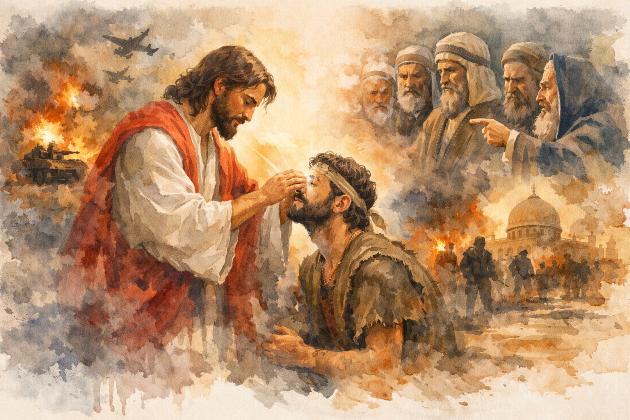
Reflection on John 9:1–41
The Gospel today presents one of the most powerful encounters in the ministry of Jesus: the healing of the man born blind.
At first glance, the miracle itself seems to be the center of the story. But as the narrative unfolds, it becomes clear that the true miracle is not simply the restoration of sight to a blind man. The deeper miracle is the revelation of who is truly blind.
In fact, by the end of the Gospel, the one who had been blind from birth can see clearly—both physically and spiritually—while the religious leaders, who believed themselves to be enlightened, remain trapped in darkness.
This Gospel invites us to examine a question that is as urgent today as it was then:
Are we truly seeing the world through the light of Christ, or are we living in blindness without realizing it?
The Blind Man Who Came to See
Jesus encounters a man who had never seen the light of day.
A man who had lived his entire life in darkness.
Through an act both simple and profound, Jesus heals him. He places mud on his eyes and sends him to wash in the Pool of Siloam. The man obeys, and suddenly the world bursts into light.
But the miracle does not end there.
As the story unfolds, the man begins to see in another way.
At first he calls Jesus simply “the man called Jesus.”
Later he recognizes Him as a prophet.
Finally, when Jesus reveals Himself, the man responds with the most powerful words of faith:
“Lord, I believe.”
And he falls down and worships Him.
The man who had been blind from birth becomes the one who sees most clearly.
The Leaders Who Refused the Light
While the blind man begins to see, the religious leaders move in the opposite direction.
They investigate the miracle.
They question the man.
They interrogate his parents.
And when the evidence becomes impossible to deny, they still refuse to believe.
Why?
Because the miracle does not fit their expectations.
Instead of rejoicing that a man who had lived his entire life in darkness now sees the light, they focus on one detail: the healing took place on the Sabbath.
Their rigid certainty blinds them.
In the end they drive the healed man out of the synagogue.
The very people who believed themselves to be guardians of truth reveal that they cannot recognize truth standing right in front of them.
And Jesus responds with words that echo through every generation:
“I came into this world so that those who do not see might see,
and those who see might become blind.”
A World That Is Struggling to See
When we look at our world today, it is difficult not to feel that we are living in a time of profound blindness.
We see it in the conflicts and wars that continue to erupt across our planet.
The war that began with Russia’s invasion of Ukraine continues to devastate lives and communities.
Tensions in the Middle East have escalated into new and dangerous confrontations involving Israel, Iran, and the United States.
In many parts of the world, violence is escalating while dialogue grows quieter.
Nations defend their positions.
Leaders justify their actions.
Each side claims to see clearly.
Yet the human cost grows larger with each passing day.
And one cannot help but ask:
Are we truly seeing one another as brothers and sisters, or have we become blind to the dignity of human life?
The Most Dangerous Blindness
The most dangerous blindness is not physical.
It is the blindness of the heart.
It is the blindness that prevents us from recognizing the humanity of the other.
It is the blindness that allows hatred, resentment, and fear to grow unchecked.
It is the blindness that convinces us that we are right and everyone else is wrong.
The Pharisees in the Gospel suffered from this very blindness.
They were convinced that they already understood everything about God.
And because they believed they already saw clearly, they could not recognize the light standing in front of them.
The Courage to Admit We Cannot See
The blind man in the Gospel teaches us something extraordinary.
When questioned by the religious leaders, he does not pretend to know everything.
He simply says:
“One thing I do know: I was blind and now I see.”
That humility becomes the doorway through which faith enters his life.
The tragedy of the Pharisees is that they refuse to acknowledge their blindness.
And Jesus says something both simple and devastating:
“If you were blind, you would have no sin.
But now that you say, ‘We see,’ your sin remains.”
The Light the World Still Needs
Our world today desperately needs the light of Christ.
Not simply religious language.
Not political solutions alone.
But a transformation of the human heart.
Only the light of Christ can teach us to see differently.
To see beyond national borders.
Beyond ideological divisions.
Beyond the walls that separate us.
To see one another as children of the same Father.
The healing of the blind man reminds us that Christ is still doing the same work today.
He is still opening eyes.
He is still calling hearts out of darkness.
And He is still inviting every one of us to step into His light.
A Final Question
The Gospel leaves us with a question that each of us must answer personally.
Are we willing to allow Christ to open our eyes?
Or will we remain like those who insist that they already see?
Because the truth is this:
The greatest miracle is not the healing of a blind man two thousand years ago.
The greatest miracle is when Christ opens the eyes of the human heart.
And when that happens, the world itself begins to change.
Closing Prayer
Lord Jesus Christ,
You are the Light of the world.
In a world so often darkened by division, hatred, and war, we ask You to open our eyes. Remove the blindness from our hearts that prevents us from seeing one another as brothers and sisters. Heal the pride that convinces us that we already see clearly when we are walking in darkness.
Lord, just as You opened the eyes of the man who was born blind, open our eyes to Your truth. Help us to see the dignity of every human life. Help us to see beyond anger, beyond prejudice, beyond fear.
Bring Your light into the places of conflict in our world. Into every nation wounded by war. Into every heart hardened by bitterness. Into every community longing for peace.
Teach us to walk as children of the light, so that our words, our actions, and our lives may reflect Your love.
Lord, when we are tempted to judge, help us to see with compassion.
When we are tempted to despair, help us to see with hope.
When we are tempted to close our hearts, help us to see with mercy.
Open our eyes, Lord, so that we may recognize Your presence in the world and follow You more faithfully each day.
And like the man in the Gospel, may we always be able to say with faith and gratitude:
“Lord, I believe.”
Amen.