
Meet the ‘Lone Survivor’ priest and ‘Grunt Padre’ author who’s now the head chaplain of the Coast Guard
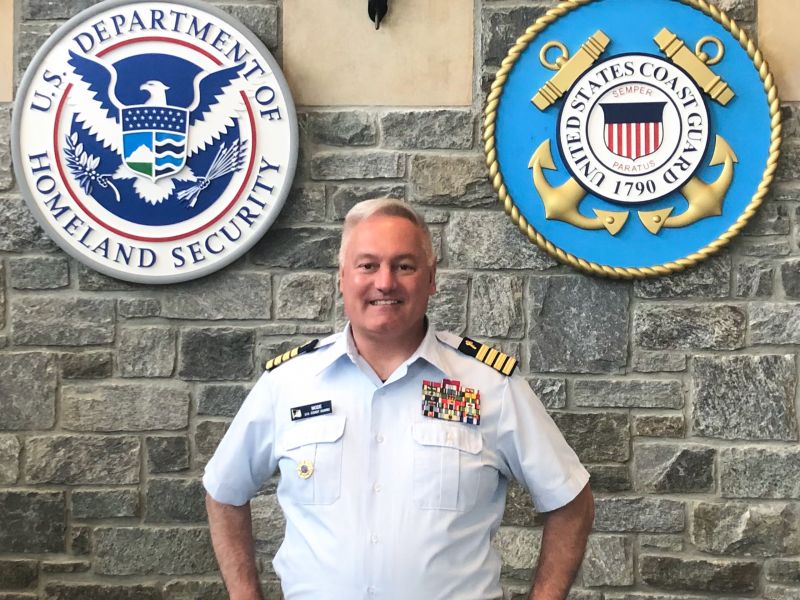 Father Daniel L. Mode, chaplain of the Coast Guard, stands in the large atrium of the Coast Guard headquarters in Washington, D.C., in front of a massive wall of flags and insignia of the Department of Homeland Security and the U.S. Coast Guard. / Credit: Leslie Miller/Arlington Catholic Herald
 Washington, D.C. Newsroom, Feb 5, 2023 / 04:00 am (CNA).
Father Daniel Mode was the chaplain for the “Lone Survivor” SEAL team in Afghanistan and has authored a book about the famed “Grunt Padre,” Father Vincent Capodanno.
Now there’s a new distinction on Mode’s impressive service record: leading the chaplaincy efforts of the U.S. Coast Guard, the first Catholic priest to hold that important role in 12 years.
Yet Mode, 57, says his greatest mission is bringing the peace of Jesus Christ to the service members and civilians to whom he ministers.
“Peace is kind of my mantra,” Mode told CNA.
Mode grew up in a Navy family and moved around frequently, attending Bishop Denis J. O’Connell High School in Arlington, Virginia, as a teen. He was ordained in 1992 in the Diocese of Arlington, where he served for 13 years, pastoring Queen of the Apostles Parish in Alexandria from 2001 to 2005.
Mode was deployed as a chaplain to Afghanistan in 2005, and within the first 24 hours of being in theater he came face-to-face with the realities of war.
“I had my first death,” he said. “The soldier died in my arms in a field hospital in Kandahar.”
After ministering to service members in Afghanistan for 22 months, Mode said he realized the “amazing need for chaplains” and felt a “call within a call” to continue serving those who serve.
Since receiving his bishop’s permission to become a full-time, active military chaplain in 2007, Mode has worked to share God’s peace in his ministry all over the world. He has spent nine years overseas, seven of those years on ships and aircraft carriers.
“I’ve served in very remote places and very overseas places, and it’s just reinforced … that service members need their shepherds, they need their chaplains,” Mode said.
How has he sustained such incredible challenges as a priest and a military chaplain?
Mode, now a Navy captain, explained that “God is preeminent in my life. My savior Jesus gives me hope for the future. I believe in grace, and I believe that God gives us the grace to continue.”
A SEAL team’s grief
In June 2005, Mode was serving as a Navy chaplain, moving from one Forward Operating Base (FOB) to another every few days.
One day Mode received word that SEAL Team 10 was in dire need of a chaplain after an elite group of SEALs had been ambushed and killed by Taliban warriors, leaving only a lone survivor, Marcus Luttrell.
“When that happened, the Navy SEALs specifically requested a Navy chaplain,” Mode explained. “There were very few of us in the country at the time … So, I was sent in there for those weeks to care for them.”
“It was indeed tragic and very historic, especially for the Navy SEALs, and actually the largest loss of life, to that time, of American service members in Afghanistan,” Mode said.
Luttrell went on to write a book about his horrific experiences, titled “Lone Survivor” (Back Bay Books, 2008), which was later turned into a major motion picture starring Catholic actor Mark Wahlberg.
Yet very few know that when disaster struck SEAL Team 10, the man who responded to the call for help was a Catholic priest.
Mode described his time serving the tragedy-stricken unit as “several weeks of intense ministry.” Besides ministering to those left behind, he accompanied the fallen service members back home and participated in their “ramp ceremonies,” where their sacrifices were honored at their home base.
“It underlines the reality that there’s a lot of difficulties like that, a lot of tragedies that happen in conflict and war, and chaplains are always there on the front lines,” Mode said of those experiences. “The key with any difficulty that you enter into is just to give them (the soldiers) space and time to be able to talk.”
Inspired by the ‘Grunt Padre’
When Mode, who has advanced degrees in theology and Church history, went to Navy chaplain school in Newport, Rhode Island, he realized that a nearby-anchored ship, a nearby street, and even the school itself were all named after Medal of Honor recipient Father Vincent Capodanno, a Navy chaplain during the Vietnam War.
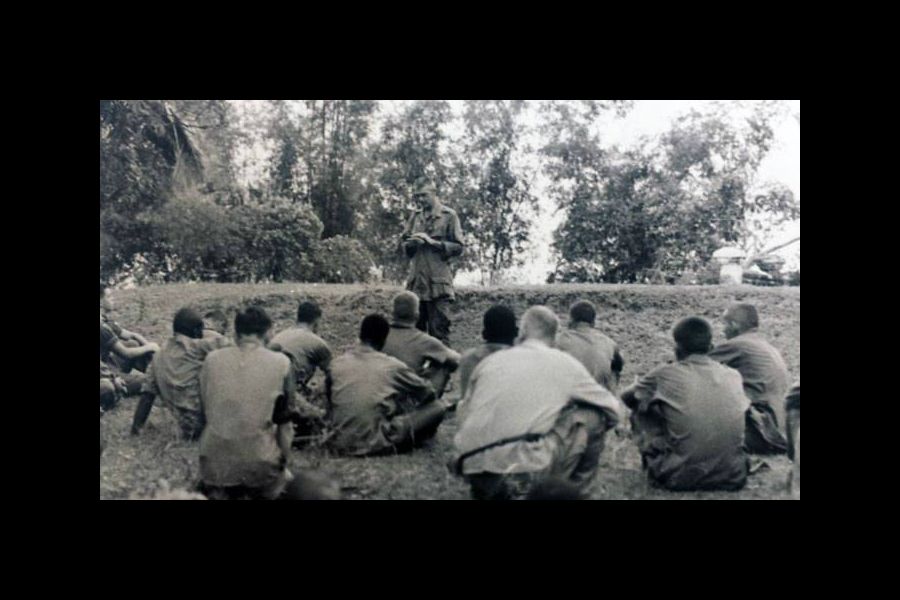
Capodanno dedicated himself wholeheartedly to the Marines in his care, giving special care to the lowest-ranking service members, called the “grunts.” Capodanno became a beloved companion and father of the soldiers, living, eating, and sleeping in the harshest conditions alongside them. His dedication earned him the nickname the Grunt Padre.
On Capodanno’s second tour in Vietnam in 1967, his unit got pinned down by a North Vietnamese ambush. Already seriously wounded himself, Capodanno rushed to the aid of a wounded man and was gunned down by enemy fire.
“That inspired me. I was still in the seminary at the time, and I decided to write my master’s thesis on him. So, I spent the next two and a half years researching and writing about his life,” Mode explained.
Mode’s thesis ultimately became a book, “The Grunt Padre: Father Vincent Robert Capodanno, Vietnam, 1966-1967” (CMJ Marian Publishers, 2000).
Mode told CNA that Capodanno’s cause for canonization has cleared the diocesan level and is now underway in the Vatican. With one miracle already attributed to the intercession of Capodanno, his cause is now being considered for the next level, “venerable.”
As an expert on Capodanno’s life and service, Mode continues to be called in by the Church hierarchy to advise on his canonization process.
As a Navy chaplain himself, Mode says the Grunt Padre has had an incredible impact on his ministry.
“His life, his witness, his spiritual care has affected me,” Mode said. “In Afghanistan, I often would say, ‘What would Father Capodanno do in this situation?’ Whether with the Navy SEALs, whether with all the other units I was with, whether with this death or this person who’s coming for a difficult counseling situation, what would Father Capodanno do?”
New role, same mission
In April 2022, Mode was appointed head chaplain for the U.S. Coast Guard, a role based in Washington, D.C., in which he oversees 157 other chaplains of different faiths.
Wherever he goes, Mode said, “the biggest thing I hear from everyone is, ‘We would like another chaplain,’ and it goes back to what we said: People want their shepherds.”
Even in this new role, Mode continues to hear the same clear call from God to share Christ’s peace.
In the military, there is a tradition of commanders giving out memento coins as symbols of honor.
“When I became the chaplain of the Coast Guard,” Mode said, “I got to design that coin. And at the bottom of that coin, I had the word ‘PAX’ — ‘peace’ in Latin.”