
Exiles describe Nicaragua regime’s ‘unholy war against the Catholic Church’ at congressional hearing
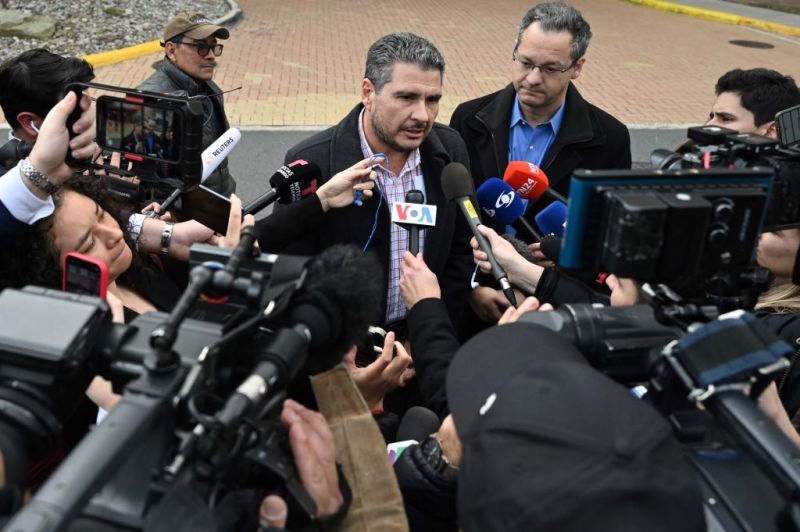 Nicaraguan political prisoner Juan Sebastian Chamorro speaks to the press ouside a hotel in Herndon, Virginia, on Feb. 9, 2023, after he was released by the Nicaraguan government. / Photo by ANDREW CABALLERO-REYNOLDS/AFP via Getty Images
 Washington D.C., Mar 23, 2023 / 17:14 pm (CNA).
Recently released political prisoners and human rights activists testified before members of Congress Wednesday about the ongoing persecution in Nicaragua, which one witness called an “unholy war against the Catholic Church.”
In recent years, the Nicaraguan government under Daniel Ortega has detained, imprisoned, and likely tortured numerous Catholic leaders, targeting at least one bishop and several priests.
In addition, the Ortega regime has repressed Catholic radio and television stations and driven Catholic religious orders, including the Missionaries of Charity, from the country.
Among those to testify March 22 was Juan Sebastian Chamorro, a former presidential candidate opposed to the Ortega regime who detailed his arrest and imprisonment.
“I was kidnapped by the police from my house the night of June 8, 2021. I was captured in front of my wife and my daughter … My family did not know anything about me until I was able to see my sister … almost three months after my arrest,” he said.
“Today, as the result of this authoritarian project in Nicaragua, there is no law, there is no media, and there are no civil rights.”
Other witnesses included Bianca Jagger, a Nicaraguan human rights activist and former actress, and Felix Maradiaga, a Nicaraguan scholar and activist who is another recently freed political prisoner. It was Jagger who called the repression an “unholy war against the Catholic Church and civil society in Nicaragua.”
Dozens of other Nicaraguan exiles attended the hearing, held at the Rayburn Office Building on Capitol Hill before members of two House subcommittees: the Subcommittee on Western Hemisphere and the Subcommittee on Global Health, Human Rights, and International Organizations. The latter body is chaired by Rep. Chris Smith, R-New Jersey.
“Under President Ortega, Nicaragua has become a pariah dictatorship, in league with other human rights abusers like Cuba. Russia, Iran, North Korea, and the People’s Republic of China,” Smith said in his opening statements.
According to Chamorro, “the repression against the Catholic Church in Nicaragua is unprecedented in the history of Latin America … After putting all opposition in jail, repressing all forms of protest, the dictator had to deal with the last standing voice defending freedom, defending peace, and defending human dignity.”
“Ortega had to silence the voice of the Church in order to impose his own voice of hate and violence,” Chamorro added.
On Feb. 10, the Ortega regime struck at the heart of Nicaraguan Catholicism by sentencing one of the country’s foremost leaders, Bishop Rolando Álvarez Lagos, to 26 years and four months in prison for being a “traitor to the homeland.”
Pope Francis condemned Alvarez’s arrest, likening Ortega’s regime to Nazi Germany.
Last week the Vatican’s diplomatic headquarters in Nicaragua was forced to close and its last remaining diplomat, the chargé d’affaires (ambassador), left the country, officially cutting diplomatic ties with the Church in what is a deeply Catholic country. A little more than a year ago, Ortega expelled the Vatican’s apostolic nuncio, Archbishop Waldemar Stanislaw Sommertag.
“Alvarez is in prison because he was the only voice left free to preach an undeniable truth, that all men are created equal, that they are endowed by their creator with certain unalienable rights, that among these are life, liberty, and the pursuit of happiness,” Maradiaga said during his Wednesday testimony.
Members of Congress, including Smith; Rep. Maria Salazar, R-Florida; and Rep. French Hill, R-Arkansas, followed the testimony by focusing their questions to witnesses on the reasons beyond Ortega’s repression and how the U.S. can best respond to the Ortega regime’s oppression.
Salazar asked why Ortega has targeted the Catholic Church in particular.
“This guy is a tyrant. This guy is willing to bet anything to do anything to push his plan … and he knows that the Catholic Church is the only institution in his way,” Maradiaga answered.
“The message of the leaders of the Catholic Church was very powerful,” Chamorro said. “They defended with a strong voice and Ortega didn’t appreciate that; he doesn’t like criticism.”
Smith told CNA after the hearing that he “learned a lot” from the testimony, and he criticized what he called a lack of response from the Biden administration.
“Not enough is being done. I wish somebody would ask Biden … ‘You say what a great Catholic you are, what about Bishop Alvarez?’” Smith said.
“Why aren’t we doing something with the [U.N.] Human Rights Council? Bring an action against Nicaragua right now, do it,” he continued. “Charles Taylor, the president of Liberia, has got 50 years for his crimes against humanity. It can be done. It takes a commitment and purpose, and it’s lacking.”