New poll: Florida could become first state to defeat abortion amendment
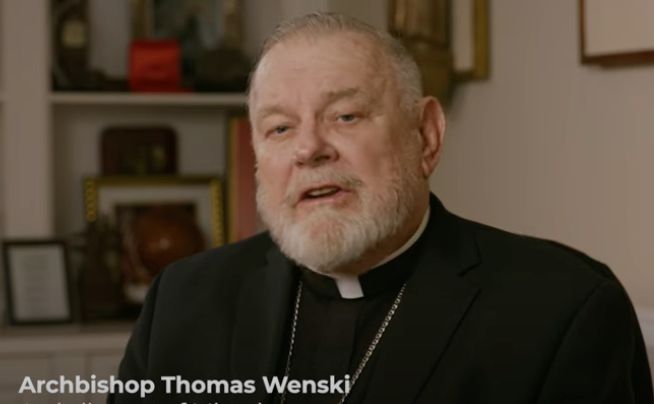
 Miami Archbishop Thomas Wenski is leading a campaign that will highlight various reasons to vote against the amendment, including that it allows third-trimester abortions and eliminates a law requiring parental consent for minors obtaining abortions. / Credit: Courtesy of the Archdiocese of Miami/Screenshot
 CNA Newsroom, Aug 22, 2024 / 06:30 am (CNA).
Several pro-life leaders have told CNA that defeating the Florida abortion amendment could reverse the momentum in the national abortion fight. A new poll by Mainstreet Research and Florida Atlantic University (FUA) now suggests they could succeed.
Since the overturn of Roe v. Wade, abortion amendments like the one on the Florida ballot have passed by wide margins in California, Ohio, Michigan, and Vermont.
Nonetheless, pro-life Floridians, including Florida Right to Life and the Florida Conference of Catholic Bishops are determined to put up a fight, in an effort to make Florida the first state to defeat an abortion amendment.
What is the Florida abortion amendment?
Titled the “Amendment to Limit Government Interference with Abortion” or simply “Amendment 4,” the measure would invalidate both Florida’s six-week and fifteen-week pro-life protections for the unborn.
The amendment would also allow abortion past the point of viability through all nine months of pregnancy if determined by a healthcare provider to be necessary for the health of the mother.
Poll findings
According to the Mainstreet/FUA poll, which was released on Aug. 14, it could be a close contest.
The poll found that most Floridians – 56% – support the amendment. Though that’s a majority, it still remains just shy of the 60% threshold required for passage.
The possibility that the amendment will pass, however, is still substantial. The poll found that while nearly a quarter — 23% — of Florida voters are undecided on the measure, that number is higher than those who are solidly opposed, who comprise only 21%.
While an FUA analysis of the poll shows that Democrats are largely united with 80% in support of the amendment, there is a significant contingent of Republicans — 35% — who support the measure as well. Meanwhile, 59% of independents, 62% of voters ages 18-49, and 59% of women polled registered support for the amendment.
The 56% in favor of the amendment marks a significant increase from another poll taken by Mainstreet/FUA in April that found 49% of voters in support of the amendment’s abortion expansions. However, 56% is well below the level of support suggested by earlier polls such as one by the University of North Florida’s Public Opinion Research Lab which found 69% of voters supporting the amendment, and another by the Florida Chamber of Commerce which found 61% in support.
The ‘end of the pro-life movement’ in Florida
Among the most outspoken opponents of the amendment is Governor Ron DeSantis, who has said that it would radically alter the abortion landscape in Florida.
Speaking at a fundraiser in opposition to the amendment last week at Jesuit High School in Tampa, DeSantis said that the amendment’s passage would mean the “end of the pro-life movement” in Florida, the Tampa Bay Times reported.
At last week’s fundraiser, DeSantis emphasized the need to reach abortion moderates and undecided voters to communicate what he has called the radical nature of the amendment.
“If you look at the state of Florida, we do not have a pro-life majority,” said DeSantis. “We’ve got a big chunk, but we don’t have a majority. If only people that are pro-life oppose it, it very well might pass.”
As of Aug. 21, the Tampa Bay Times reported that DeSantis had raised $ 2.5 million to defeat both the abortion amendment and another amendment legalizing marijuana. This is significantly less than the tens of millions raised by amendment proponents pushing for its passage.
Additional opposition
DeSantis is not the only Florida official working in opposition to the amendment. In July the Florida Financial Impact Estimating Conference approved a “financial impact statement” to be placed alongside the amendment on the ballot. The statement warns that the abortion measure could have a depressive effect on the state’s economy.
Although members of the campaign to pass the abortion amendment sued to keep the impact statement from being on the ballot, the Florida Supreme Court ruled on Aug. 21 that it could remain.
Florida bishops weigh in
Miami Archbishop Thomas Wenski told CNA that while he was “heartened” by the Mainstreet/FUA poll he knows there is a lot of work still to be done.
Wenski shared that the Florida Catholic bishops are planning to invest over $ 1 million in efforts to stop the abortion amendment.
“If anybody wants to know a good reason to oppose Amendment 4, I tell them that last year in Florida there were 80,000 abortions and so that’s 80,000 reasons why we should oppose Amendment 4,” he said.
The Archdiocese of Miami has just launched a campaign to raise awareness about the dangers of the amendment and to mobilize voters against it. The campaign will run from now until election day and will include voter education workshops, educational outreach, and a social media blitz with the theme “#VoteNoOn4.”
The archdiocese’s campaign will highlight various reasons to vote against the amendment, including that it puts women at risk, allows third-trimester abortions, and eliminates a law requiring parental consent for minors obtaining abortions.
As part of the campaign, the archdiocese produced a video highlighting “what they don’t tell you about Florida’s Amendment 4.”
Responding to criticisms that the Church should not be involved in political matters, Wenski said that “abortion is not a religious issue, it’s a human rights issue.”
“We are people of faith but we bring our faith to our exercise of our citizenship,” he added. “I suspect that as we get closer to November it’ll be more intense and more intensified on both sides. But we’ll stay the course and continue to advocate as we should.”
Winning Florida could turn the tide
Pro-life leaders understand the importance Florida plays on the national stage and are aware of what winning or losing in the Sunshine State could mean for the entire pro-life movement.
After the amendment was officially added to the ballot in April, Kelsey Pritchard, director of state public affairs for Susan B. Anthony Pro-Life America, told CNA that “if we win Florida, I think it can really turn the tide on these ballot measure fights.”
Lynda Bell, co-chair of Do No Harm Florida, a coalition of groups dedicated to defeating the abortion amendment, told CNA that the danger of the measure passing comes from voters – Catholics included – not understanding how far the amendment will expand abortion in Florida.
Members of Bell’s coalition have been crisscrossing the state, handing out informational materials and giving talks to schools, churches, and community groups.
“If we can get in front of as many people as possible, they will vote no,” she said.