Christ The King: The King Who Came Not To Be Served But To Serve
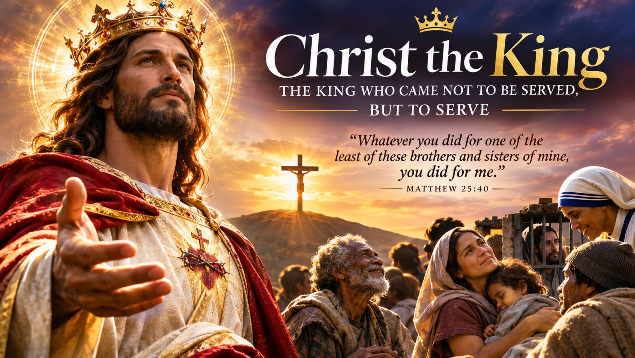
Solemnity of Our Lord Jesus Christ, King of the Universe — November 22, 2026
Scripture: Ezekiel 34:11–12, 15–17; Psalm 23; 1 Corinthians 15:20–26, 28; Matthew 25:31–46
Whose kingdom are we trusting? Whose voice are we following? And who truly reigns over our lives?
These are questions worth asking as we celebrate the Solemnity of Our Lord Jesus Christ, King of the Universe.
We live in a world fascinated by power. Nations compete for dominance. Political leaders promise security, prosperity and peace. Governments rise and fall. Empires are built, only to crumble. And too often, those entrusted with authority seem more concerned with preserving their power than protecting the people they were called to serve.
Yet today, the Church places before us a King unlike any other.
A King who wears a crown of thorns rather than a crown of gold. A King whose throne is the Cross. A King who does not demand that His subjects die for Him, but who willingly lays down His life for them.
His name is Jesus Christ. And His Kingdom shall have no end.
A solemnity born out of a troubled world
In 1925, Pope Pius XI instituted the Feast of Christ the King through his encyclical Quas Primas.
The world was still recovering from the devastation of the First World War. Political upheaval, growing secularism, hostility towards Christianity, and the increasing tendency of governments and societies to exclude God from public life deeply troubled the Holy Father.
Pope Pius XI recognised a dangerous development: humanity was increasingly placing its confidence in political power, human ideologies and worldly institutions, while pushing aside the authority of God.
His response was not to establish another political movement or earthly kingdom.
It was to remind the world of a truth it was in danger of forgetting:
Jesus Christ is King. Not merely of Catholics. Not merely of Christians. But of all creation, of every nation, of every generation, and of all eternity.
Originally celebrated on the last Sunday of October, the feast was moved to the final Sunday of the liturgical year following the reforms of the Second Vatican Council.
And how fitting that is!
As the Church concludes another liturgical year, she reminds us that history does not ultimately belong to presidents, prime ministers, monarchs, governments or empires.
History belongs to Jesus Christ.
One hundred and one years after Pope Pius XI established this feast, we might well wonder what he would say about the world in which we live today.
We have achieved extraordinary advances in science, medicine, technology and communication. Yet we continue to witness devastating wars, political divisions, economic injustice, widespread poverty, violence and the displacement of millions of people.
We have become remarkably powerful, but have we become more compassionate?
We have developed extraordinary means of communication, but have we learned to listen to one another?
We have accumulated enormous wealth, but have we learned to share it?
Perhaps the message of Christ the King is even more urgently needed today than it was in 1925.
“I myself will look after my sheep”
Our first reading from the prophet Ezekiel contains one of the most beautiful and reassuring declarations in Sacred Scripture.
God announces that He Himself will search for His sheep, gather those who have been scattered, rescue those who are lost, care for the injured, and strengthen the weak.
But to appreciate the full power of these words, we must understand their context.
Earlier in Ezekiel chapter 34, God delivers a devastating rebuke to the shepherds of Israel.
Those entrusted with caring for His people had failed miserably.
Instead of feeding the flock, they had fed themselves. Instead of strengthening the weak, they had neglected them. Instead of healing the sick and seeking the lost, they had allowed the sheep to wander and become scattered.
The shepherds had forgotten that the flock did not belong to them.
And so God intervenes.
“I myself will look after my sheep.”
What an extraordinary declaration!
It is as though God is saying: Those whom I entrusted with the care of my people have failed them. But I will not abandon my people. I will come to them myself.
And is this not precisely what we celebrate in Jesus Christ?
In Jesus, the promise of Ezekiel becomes a living reality.
God does not merely send another messenger. He comes Himself in the person of His Son.
The Good Shepherd enters the world, searches for the lost, touches the untouchable, welcomes the rejected, heals the brokenhearted, and ultimately lays down His life for His sheep.
Here we discover the first great difference between worldly power and divine kingship.
The worldly ruler may regard the people as existing for the benefit of the ruler. The Good Shepherd understands that His authority is exercised for the good of the flock.
And this is a powerful challenge to every person entrusted with authority — whether in government, in the Church, in the workplace, or within the family.
Authority is not a licence for domination.
It is a responsibility to serve.
The Lord is my Shepherd
How beautifully today’s responsorial Psalm continues this message!
“The Lord is my shepherd; there is nothing I shall want.”
Psalm 23 presents us with a King who leads His people to green pastures, restores their strength, guides them along the right path, and accompanies them even through the darkest valleys.
Notice the intimacy of this relationship.
The psalmist does not say that the Lord is merely a distant ruler, issuing commands from an inaccessible throne.
He is my Shepherd.
He knows me. He guides me. He protects me. He walks with me.
And perhaps this is precisely what so many people need to hear today.
When the world seems uncertain, when political leadership disappoints, when institutions fail, when violence and injustice appear overwhelming, we are reminded that our ultimate security does not rest in the hands of earthly rulers.
Our ultimate security rests in the hands of the Good Shepherd.
This does not mean that we abandon our responsibility to work for justice, peace and the common good. Quite the opposite!
It means that our commitment to these things must be rooted in something greater than political allegiance or human ambition.
It must be rooted in Jesus Christ.
A King whose greatest victory was won through sacrifice
In today’s second reading, St Paul takes us beyond the political struggles and uncertainties of our present world and directs our attention towards eternity.
Christ has been raised from the dead, the firstfruits of those who have fallen asleep.
Through Adam came death, but through Christ comes resurrection and life.
Paul then speaks of the ultimate triumph of Christ, when every hostile power will be brought to nothing and the final enemy, death itself, will be destroyed.
What earthly king can make such a promise?
What president, prime minister, monarch or military leader can defeat death?
Human governments may improve our circumstances. They may establish laws, build institutions, protect freedoms and promote prosperity. These are important and necessary responsibilities.
But no earthly government can offer eternal life.
No political ideology can conquer the grave.
No human ruler can redeem humanity from sin.
Only Jesus Christ can do that.
And how did He accomplish this extraordinary victory?
Not through military conquest.
Not through political manipulation.
Not through intimidation or coercion.
He accomplished it through the Cross.
The One who possessed all authority willingly humbled Himself, became obedient unto death, and offered His life for the salvation of the world.
Here lies the great paradox of Christianity:
The greatest King who ever lived achieved His greatest victory by giving Himself completely away.
And when His saving work reaches its fulfilment, St Paul tells us that the Son will hand over the Kingdom to God the Father, so that God may be all in all.
What a glorious destiny awaits those who belong to Christ!
“Whatever you did for one of the least of these…”
And then we come to today’s Gospel.
Matthew 25:31–46 presents one of the most challenging and revealing teachings of Jesus.
The Son of Man comes in His glory, accompanied by the angels. All the nations are gathered before Him, and He separates the sheep from the goats.
Here, at last, we encounter the King seated upon His glorious throne.
But what does He use as the measure of our lives?
Does He ask how wealthy we became?
How influential we were?
How many people admired us?
How much power we accumulated?
No.
Instead, He speaks of the hungry who were fed, the thirsty who were given something to drink, the stranger who was welcomed, the naked who were clothed, the sick who were visited, and those in prison who were not forgotten.
And then comes that astonishing revelation:
“Whatever you did for one of the least of these brothers of mine, you did for me.”
Think about what Jesus is telling us.
The King of the Universe, the Lord of heaven and earth, identifies Himself with those whom the world so often overlooks.
The hungry child.
The elderly person who has been forgotten.
The sick person lying alone in a hospital bed.
The prisoner who longs for a visit.
The stranger seeking refuge.
The poor person whose suffering has become invisible to society.
Jesus identifies Himself with the vulnerable.
And this means that our relationship with Christ cannot be separated from our treatment of one another.
We cannot sincerely proclaim that Jesus is our King while deliberately turning our backs on those whom He loves.
We cannot worship Christ at the altar and then refuse to recognise His presence in the suffering person outside the church doors.
We cannot speak passionately about the Kingdom of God while remaining indifferent to injustice, cruelty, exploitation and human suffering.
The authenticity of our allegiance to Christ the King is revealed not merely by what we profess with our lips, but by how we love with our lives.
And notice something else.
Both groups in the Gospel are surprised.
Those who cared for the needy did not realise that they were serving Christ Himself. Those who neglected them did not realise that they were neglecting Him.
The difference was not simply what they knew.
It was how they lived.
The Gospel is therefore not merely an invitation to occasional acts of charity. It is a summons to allow the love of Christ to transform the very way we see and treat every human being.
Whose kingdom are we building?
Today, we are surrounded by competing claims upon our loyalty.
Political parties ask for our allegiance. Governments demand our obedience. Advertisements promise happiness through possessions. Social media encourages us to measure our worth by popularity, recognition and influence.
And in the midst of all these competing voices, Jesus quietly asks:
Will you allow Me to be King of your life?
Not merely King of your Sunday worship.
Not merely King of your prayers.
Not merely King of your religious traditions.
But King of your decisions, your relationships, your ambitions, your finances, your priorities, and the way you treat others.
Because acknowledging Christ as King is far more than making a religious declaration.
It is choosing to live according to the values of His Kingdom.
Where the world glorifies domination, we choose service.
Where the world encourages revenge, we choose forgiveness.
Where the world promotes selfish ambition, we choose generosity.
Where the world divides people into the powerful and the powerless, the important and the insignificant, we recognise the dignity of every human being.
Where the world teaches us to seek greatness by climbing above others, Jesus teaches us to discover greatness by kneeling to wash their feet.
And where the world offers power that is temporary, Jesus offers a Kingdom that is eternal.
The King who will never abandon His people
Perhaps the most reassuring truth of this solemnity is that the kingship of Jesus Christ does not depend upon the approval of the world.
Governments may reject Him.
Societies may ignore Him.
Individuals may turn away from Him.
But none of these things can diminish His authority.
His Kingdom does not rise or fall with elections.
His promises do not expire when political administrations change.
His love is not subject to economic conditions.
His mercy is not restricted by national borders.
And His victory over sin and death can never be overturned.
Jesus Christ is King yesterday, today and forever.
And yet, this all-powerful King does not force His way into our hearts.
He invites us.
He calls us to trust Him, to follow Him, to surrender ourselves to His love, and to become living witnesses of His Kingdom.
And so, as we celebrate this great solemnity, perhaps the most important question is not whether Jesus Christ is King.
He is.
The question is whether we have truly allowed Him to reign in our lives.
For when Christ reigns in our hearts, His mercy begins to shape our actions, His truth guides our decisions, His peace sustains us through life’s storms, and His love reaches others through us.
And perhaps that is the greatest witness we can offer to a troubled world.
Not simply to proclaim that Christ is King, but to live in such a way that others encounter His kingship through our compassion, our integrity, our humility, our forgiveness and our love.
Let the rulers of this world seek their thrones. Let the powerful pursue their glory. Let earthly kingdoms rise and fall.
We place our trust in Jesus Christ — the King who became a servant, the Shepherd who became the Lamb, the Lord who gave His life for His people, and the Saviour whose Kingdom shall never end.
Long live Christ the King!
Closing Prayer
Lord Jesus Christ, King of the Universe,
You are the Good Shepherd who searches for the lost, heals the wounded, strengthens the weak and never abandons His flock.
In a world so often troubled by violence, injustice, division and the misuse of power, teach us to place our trust not in the passing kingdoms of this world, but in Your eternal Kingdom.
Reign in our hearts, Lord Jesus.
Reign over our thoughts, our words, our decisions and our actions.
Free us from selfish ambition, pride and the desire to dominate others. Teach us instead to exercise whatever authority we have been given with humility, compassion, justice and love.
Open our eyes to recognise Your presence in the hungry, the poor, the sick, the lonely, the imprisoned and all those who suffer.
May we never turn away from You when You come to us in the needs of our brothers and sisters.
And when our earthly journey is complete, may we hear Your gracious invitation to enter the Kingdom prepared for those who have loved and served You.
For Yours is the Kingdom, the power and the glory, now and forever.
Amen.
Christus Vincit! Christus Regnat! Christus Imperat!
Christ conquers! Christ reigns! Christ commands!