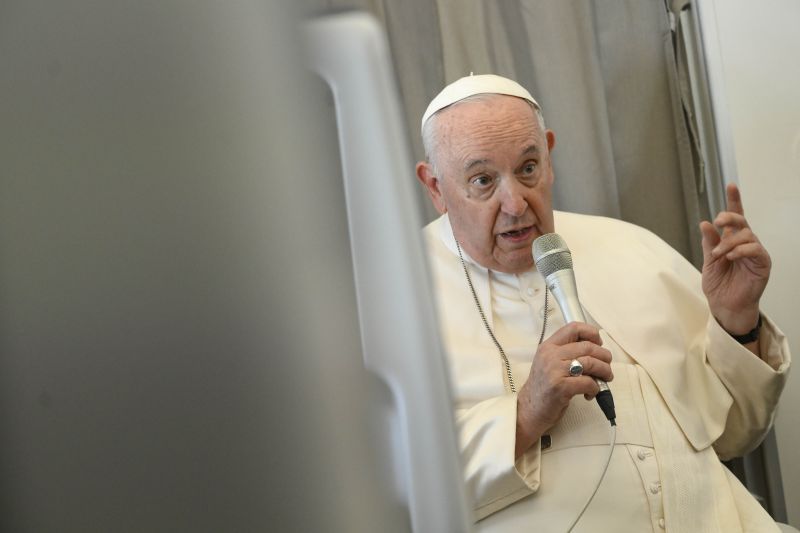

Apostolic Journey of His Holiness Pope Leo XIV to Uruguay, Argentina and Peru (6 – 17 November 2026) – Meeting with the Bishops of Peru in the Chapel of the Archbishop’s Residence in Lima
Meeting with the Bishops of Peru in the Chapel of the Archbishop’s Residence in Lima
At 9.00 (15.00 in Rome), the Holy Father, after celebrating Mass in private at the Apostolic Nunciature, travelled by car and Popemobile to the Archbishop’s residence in Lima for the meeting with the bishops of Peru, stopping along the way at the Sanctuario de Las Nazarenas and the Palacio Municipal for the presentation of the keys to the city.
Upon arrival at the entrance to the residence, the Pope was welcomed by the President of the Episcopal Conference, Bishop Carlos Enrique García Camader, who accompanied him to the Chapel, where they took their places for the meeting.
After the words of welcome from the President of the Episcopal Conference, the Holy Father delivered his address, followed by the exchange of gifts and the group photograph with the Bishops.
At the conclusion of the meeting, the Pontiff transferred on foot to the Basilica Cathedral of Saint John the Apostle and Evangelist for the celebration of the Midday Prayer with the bishops, priests, consecrated men and women, seminarians, Synodal Teams and Pastoral Councils.
The following is the address delivered by the Holy Father to those present at the meeting with the Bishops of Peru:
Address of the Holy Father
Your Eminences,
Your Excellencies,
Monsignors,
Dear brothers!
I am grateful for the words addressed to me on your behalf by the Most Reverend Carlos Enrique García Camader, Bishop of Lurín and President of the Episcopal Conference, together with prayers for my recovery. Some of you know that there were those “Thomases” who said, “He will not come;” “He won’t be able to.” But God is great, and his grace is greater than all of us. I am truly very happy to be here with you.
I thank God that on this occasion he is allowing us to continue this dialogue as brother bishops. Not many months ago, you were in Rome for the ad limina visit; now we are here together. I am also looking forward to the meetings I will have over the next few days in Peru. Thank you for all the work you have done to organize my visit.
Dear brother bishops, the roads that crisscross a country’s landscape also run through the soul of its people. We can observe this truth in Peru. Its mountains, valleys, coastline, Amazon region and ancient trails preserve the memory of peoples who learned to come together and share their gifts.
Among these paths there is one that is very familiar to you: the Great Inca Road, that vast network which united territories, communities and cultures throughout this land. Drawing on this image, I would like to invite you to reflect on our episcopal mission, for the Church is like a path leading us to a communion and hope that crosses the mountains of indifference, the deserts of individualism and the distances that separate people. Furthermore, the motto of this visit — “Let us open our hearts!” — invites us to conversion, to communion and to mission.
But what does “opening one’s heart” mean for a bishop? It means knowing the path to God so that he may walk alongside the faithful, as well as allowing God and the faithful to challenge his priorities. It is an eminently missionary journey, much like the Inca Trail, which was not built so that travelers might linger to admire its magnificent landscapes, but to reach the whole of Tawantinsuyu . Like the chasquis , who traveled the length and breadth of the empire carrying urgent messages and vital provisions, the bishop is the messenger who bears the Good News of the Gospel, safeguards the treasure of the word of God and administers the sacraments as those indispensable gifts which are necessary to sustain the Christian life.
We may also consider that, just as this Trail is the heir to the ancient paths used by pre-Incan cultures, the bishop is a servant in his Diocese of the history of salvation that began before him and will continue after him. For this reason, “opening one’s heart” for the bishop means recognizing the path that God is already traveling with his people, the journey that still lies ahead and the direction in which we must go to continue building a future of hope for all.
Dear brothers, for the bishop, opening one’s heart also means getting to know his Diocese by entering people’s homes, accompanying the sick, meeting young people and reaching out to communities which, due to their geographical remoteness or social vulnerability, are rarely able to make their voices heard. Indeed, the shepherd is called to go out and meet everyone.
In this regard, the figure of Saint Turibius of Mogrovejo stands out in a unique way. He understood that his mission required him to be with the communities in order to focus first and foremost on Christian formation and to ensure that the Gospel could also be proclaimed in the languages of the indigenous peoples. The Catechism that was developed in communion with the bishops gathered at the Third Provincial Council of Lima, written in Aymara, Quechua and Spanish, bears witness to his missionary zeal.
We know that the Inca Trail is no easy path, for its steep ascents and narrow passes test the traveler’s endurance, though their efforts find solace in contemplating the majesty of creation. Similarly, the episcopal mission does not always follow clear paths. We encounter pastoral difficulties, social divisions, misunderstandings and decisions that can prove to be painful. Here, Saint Turibius enlightens us once more, helping us to understand that pastoral charity does not consist in avoiding problems but in remaining faithful to Christ and seeking the greatest possible good for people. Just as the hardships of the journey wind through the mountains, so too does the Cross of Jesus weigh upon our ministry. Yet that very Cross reminds us that no toil offered out of love is in vain when it is united with the self-offering of Jesus Christ (cf. Mt 16:24-25).
It is important to remember that this trail is not to be walked alone. Being in the region that was home to Peru’s first seminary, I think of the bishop, who transforms the journey itself into a traveling Yachay wasi , a “house of knowledge.” As a traveling companion to his priests, he does not merely show them the way, but also shares in their struggles and aspirations, recognizes God’s footprint in their lives and ensures that no one is left behind. Yet beyond the realm of imagination, the truth is that walking together fosters communion, a gift for which we must always pray: communion with the Successor of Peter, with the other bishops, with men and women religious and with the whole People of God. This is essential for faithfully traveling the Way which is Christ.
In light of this, I am heartened by the synodal process that has been undertaken in the Peruvian Church. In partnership with the People of God, I ask you to continue working steadfastly, making it increasingly possible to build a Church in which we all recognize ourselves as co-responsible and missionary disciples of the Lord. A Church in which each person lives according to their own vocation, in mutual trust, so that authority is not exercised autocratically nor is obedience mere servility.
I would now like to speak of those who have walked these lands before us. In addition to Saint Turibius of Mogrovejo, let us think of Saint Rose of Lima. Her prayer and her dedication to those in need remind us that apostolic fruitfulness depends on our union with the Lord and, consequently, on the care we take of our own spiritual life in the episcopal ministry.
From Saint Francis Solano we learn to cross borders to proclaim the Gospel. His joyful missionary spirit reminds us that the Church exists to proclaim Jesus Christ, especially to those living on the human and geographical peripheries.
Through their humility, Saint Martin de Porres and Saint Juan Macías teach us to recognize Christ in the least among us. From these saints we also learn that charity begins with a simple gesture, a listening ear. They also remind us that no person can be judged by their rank, their origins or their social status. In this regard, allow me to mention a reality that has caused us so much pain: the abuses perpetrated by members of the clergy or within the context of the Church. We must respond as Jesus would, with truth, justice, forgiveness, making amends and an ever more resolute commitment to fostering a culture of prevention and protection for the weakest in light of such crimes.
The lives of the saints — each distinct yet united by a single faith: bishops, priests and laity; Spaniards, Creoles and Mulattos — represent the unity of the Church in Peru and form a school of holiness. They continue to walk with us, here and now, along the many paths of the one Way, teaching us to be in Illo uno unum .
Dear brother bishops, in 2018 I was seated there in the back among you in this very place, and we received from our beloved Pope Francis a passionate exhortation to work for unity. I recall that he told us: “Do not remain prisoners of divisions that create cliques and hamper our vocation to be a sacrament of communion… That was — and is and always will be — the best way to evangelize” ( Meeting with the Peruvian Bishops , Lima, 21 January 2018). Indeed, communion among you, among us, is the foundation of the credibility of the Gospel you proclaim.
Our mission as bishops calls us to be bridge-builders, to foster dialogue, to educate others in having fruitful encounters and to help heal the wounds that divide Peruvian society. In order to be effective in this way, it is helpful to open our hearts to our brother bishops so as to cultivate trust, share our difficulties and strengthen episcopal fraternity. No bishop should feel alone on this journey. No particular Church should carry out its mission as if it were separate from that of the others. In and through communion, the bishop will be an instrument in preventing social or political polarization from weakening his prophetic and evangelizing mission.
Finally, dear brothers, the bishop must open his heart to the Peru of today. An ancient path retains its value when it continues to enable people to reach their destination. We must ask ourselves which paths truly lead to Christ, and we should denounce false paths. Today, Peru needs shepherds capable of listening to the questions of our time and illuminating them with the clarity of the Gospel. In this way, you will be able to accompany families, support young people, defend the life and dignity of every person, promote justice and commit to the care of creation, helping in a particular way those who suffer from poverty, exclusion, corruption, violence and a lack of opportunities.
This mission requires us to combine doctrinal fidelity with pastoral closeness; the celebration of the sacraments with a commitment to our neighbor; and the formation of consciences with a concrete witness of charity.
The Eucharist is the source and summit of our Christian life. Before the tabernacle, we regain the correct perspective on our ministry. The Church does not belong to us; it belongs to Christ. We are messengers who will one day complete our journey. Only God remains!
May we never lack the time to be with the Lord and to accompany those who need to experience the bishop’s spiritual fatherhood. For the bishop, united to Christ, even amidst his limitations, is an instrument of comfort, unity and hope.
I would like to conclude with three suggestions:
First: do not cease to walk with the people.
Second: let us never cease to walk together, in episcopal communion, as witnesses to the unity we proclaim.
Third: let us never tire of opening our hearts to God, so that he may renew our vocation; to our brothers and sisters, so that divisions may be healed; and to his people, so that they may find in you the “father bishop” who is close at hand, courageous and merciful.
May the Blessed Virgin Mary, Mother of the Church, grant us this, so that all the children of this beautiful land — in the Andean highlands, in the valleys, in the Amazon, on the coast and on the islands — may find in the Church a home where they are welcomed, listened to, loved and led to Jesus Christ. Thank you very much.
\n\n
Source: Holy See — Read the original report