
Loreto: The Holy House of Mary and the Story Behind the Litany of Loreto
Knowing Mary: The Meaning Behind Her Titles
When we pray the Litany of Loreto, invoking the Blessed Virgin Mary as Mother of Divine Grace, Refuge of Sinners, Help of Christians, Queen of Peace, and under so many other beautiful titles, we may never stop to ask: Where is Loreto, and why is this prayer named after it?
The answer takes us to a small town in Italy, to an extraordinary tradition surrounding the home of the Blessed Virgin Mary, and to centuries of devotion that continue to enrich the Catholic Church.
Where Is Loreto?
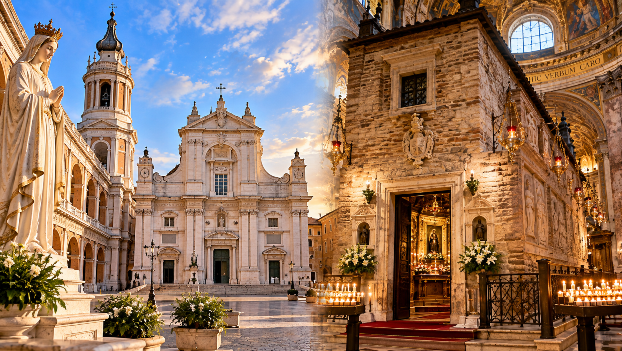
Loreto is a town in the Marche region of central Italy, not far from the Adriatic Sea. It is home to one of the world’s most important Marian shrines, the Basilica of the Holy House, known in Italian as the Basilica della Santa Casa.
Within this magnificent basilica stands a small, simple structure consisting of three ancient walls. According to a centuries-old Catholic tradition, these walls once formed part of the house in Nazareth where the Blessed Virgin Mary lived and received the announcement from the angel Gabriel that she would become the Mother of Jesus.
Imagine the significance of that possibility! The very place associated with Mary’s extraordinary response to God’s invitation: “Behold, I am the handmaid of the Lord. May it be done to me according to your word” (Luke 1:38).
How Did Mary’s House Come to Loreto?
According to an ancient tradition, the Holy House was miraculously transported by angels from Nazareth, first to the region of present-day Croatia in 1291, and eventually to Loreto, Italy, in 1294.
Another historical explanation suggests that Christians rescued the stones of the house from the Holy Land during a period of conflict and transported them to Europe.
Archaeological investigations have identified building materials and features consistent with ancient Palestinian construction. However, the precise circumstances of the house’s arrival remain a matter of historical investigation and religious tradition. The miraculous transportation by angels is a cherished tradition, not a doctrine Catholics are required to believe.
What is certain is that Loreto became a major centre of Marian pilgrimage, attracting generations of believers seeking to deepen their relationship with Jesus through the example and intercession of His Mother.
The Litany of Loreto: A Prayer Born of Devotion
Over the centuries, pilgrims visiting the shrine developed and popularised a beautiful series of invocations honouring the Blessed Virgin Mary. This prayer became known as the Litany of Loreto, or the Litany of the Blessed Virgin Mary.
Although its precise origins are not fully documented, the litany took shape through the Church’s developing Marian devotion and became closely associated with the sanctuary. In 1587, Pope Sixtus V formally approved it, helping to spread its use throughout the Catholic world.
The litany begins by invoking God’s mercy and calling upon the Holy Trinity. It then turns to Mary under a succession of beautiful titles, each revealing something about her relationship with God, her virtues, or her maternal care for the Church.
We call her Mother of Divine Grace because she gave birth to Jesus Christ, the source of all grace. We invoke her as Refuge of Sinners because she intercedes for those seeking God’s mercy. We honour her as Help of Christians because of her maternal concern for the followers of her Son. And we call her Queen of Peace because she is the Mother of Jesus, the Prince of Peace.
After each invocation, we respond, “Pray for us.”
These simple words express something central to Catholic devotion. We do not worship Mary. Worship belongs to God alone. Rather, we honour her as the Mother of our Saviour and ask her to intercede for us, just as we ask fellow Christians to pray for us.
Over time, additional titles have been incorporated into the litany, including Mother of Mercy, Mother of Hope, and Solace of Migrants, reflecting the Church’s continuing reflection on Mary’s maternal care.
What Does Loreto Teach Us Today?
Perhaps the most beautiful lesson of Loreto is found not in the grandeur of its basilica, but in the simplicity of the little house at its centre.
God chose to enter human history through the humble home of a young woman in Nazareth. It was there that Mary welcomed His word, surrendered herself to His will, and became the Mother of the Saviour.
Loreto reminds us that holiness is not confined to great churches, monasteries, or extraordinary religious experiences. It can flourish within the ordinary circumstances of family life: in our homes, our relationships, our daily responsibilities, and our willingness to say yes to God.
And the Litany of Loreto reminds us that Mary’s life has so much to teach us. Every title is an invitation to reflect more deeply on her faith, her humility, her courage, and her relationship with Jesus.
The titles of Mary are not simply beautiful names to recite. They are windows through which we can discover more about the Mother of Jesus and, through her, draw closer to her Son.
Let Us Pray
Blessed Virgin Mary, Mother of God, you who welcomed Jesus into your humble home at Nazareth, help us to welcome Him into our own homes and hearts. As we honour you through the beautiful titles of the Litany of Loreto, teach us to imitate your faith, humility, compassion, and obedience to God’s will.
May every invocation of “Pray for us” deepen our trust in your maternal intercession and lead us into a closer relationship with Jesus Christ, your Son and our Saviour. Amen.
Our Lady of Loreto, pray for us.
Fully Catholic — Sharing the Joy of the Faith