
The Dawn from on High: A Catholic Bible Study on Luke 1:67–79 (The Benedictus of Zechariah)
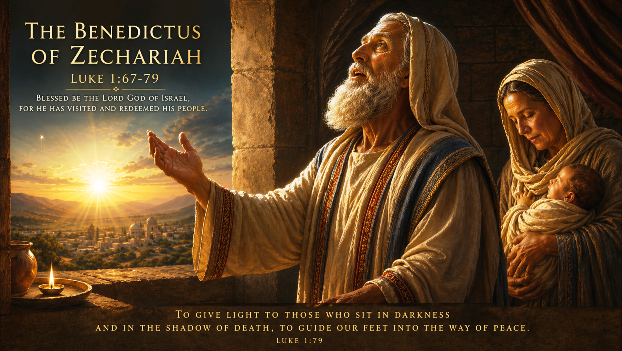
Luke 1:67–79 is one of the great canticles of the New Testament. In the Latin tradition of the Church, it is known as the Benedictus, from its opening word, “Blessed.” It is the prophetic hymn of Zechariah, the father of John the Baptist, spoken after his tongue is loosed at the birth and naming of his son. The Church has treasured these words for centuries, praying them daily in Morning Prayer because they proclaim the fulfillment of God’s promises, the coming of the Messiah, and the mission of John as the forerunner of the Lord.
This passage stands at the threshold of the Gospel. It looks backward to the covenants, promises, prophets, and hopes of Israel, and at the same time it looks forward to Christ, whose coming brings redemption, forgiveness, light, and peace. It is deeply Jewish in form and imagery, yet unmistakably Christian in fulfillment. The old covenant is not discarded here; it is brought to completion in Jesus Christ.
What follows is a detailed Catholic study of each verse, explaining the theological depth, biblical background, and spiritual meaning of this sacred hymn.
Setting the Scene
Before we begin verse by verse, it is important to understand the context.
Zechariah had doubted the angel Gabriel’s message that he and Elizabeth would have a son in their old age. Because of his unbelief, he was rendered mute until the child’s birth. When the child is named John, in obedience to the angelic instruction, Zechariah’s mouth is opened. His first use of restored speech is not casual conversation. He erupts in praise and prophecy.
That detail alone is spiritually rich. When grace restores a man, his first true speech ought to be praise of God.
Luke tells us that Zechariah was “filled with the Holy Spirit” when he spoke these words. This means the Benedictus is not merely a father’s emotional response to the birth of a son. It is inspired prophecy. Zechariah is speaking under divine illumination, and what he says goes far beyond his own household joy. He is interpreting salvation history.
Luke 1:67
“And his father Zechariah was filled with the Holy Spirit, and prophesied, saying…”
This verse establishes the character of everything that follows. Zechariah does not merely compose a beautiful poem; he prophesies. In Scripture, prophecy is not only prediction of future events. It is the Spirit-enabled proclamation of God’s truth, revealing the meaning of God’s actions in history.
To be filled with the Holy Spirit means Zechariah is being moved, enlightened, and empowered by God Himself. Throughout Luke’s infancy narratives, the Holy Spirit is especially active: John is filled with the Spirit from the womb, Elizabeth speaks under divine influence, Simeon will later be guided by the Spirit, and now Zechariah becomes a mouthpiece of divine revelation. Luke wants us to understand that what is happening in these opening chapters is not ordinary history. God is acting decisively.
There is also a beautiful irony here. The man who had been silent because of unbelief now speaks because of faith, and his restored speech becomes a vessel of prophecy. God’s mercy is evident even in His discipline. Zechariah’s silence was not mere punishment; it was purification. When his voice returns, it is sanctified.
This verse invites us to examine how we use speech. Do our words bless, proclaim, and interpret God’s work? Or are they wasted on complaint, vanity, or distrust? Zechariah teaches us that speech reaches its true purpose when it becomes praise.
Luke 1:68
“Blessed be the Lord God of Israel, for he has visited and redeemed his people,”
Zechariah begins with blessing: “Blessed be the Lord God of Israel.” This is the language of covenant worship. God is identified not abstractly, but relationally—as the God of Israel, the God who revealed Himself to Abraham, Isaac, Jacob, Moses, and David. Christianity is not detached from Israel’s story. Jesus comes as the fulfillment of God’s covenant dealings with His chosen people.
The phrase “he has visited” is profoundly important. In biblical language, when God “visits” His people, He does not merely drop by. Divine visitation means God has come in power to act, either in judgment or in mercy. Here it is clearly mercy. God has not forgotten His people. He has drawn near to intervene in their plight.
Then Zechariah says God has “redeemed his people.” Redemption means liberation through a costly act. In the Old Testament, it evokes the Exodus, when God delivered Israel from bondage in Egypt. Zechariah is recognizing that a new and greater Exodus is now beginning. Yet the remarkable thing is that Jesus has not yet been born, and already Zechariah speaks in the past tense: “has visited,” “has redeemed.” This is the language of prophetic certainty. What God has begun is as good as accomplished.
This verse reveals the unity of salvation history. The God who redeemed Israel from Egypt is now redeeming humanity from sin. The old deliverance was political and historical; the new deliverance is spiritual, universal, and eternal. The first Exodus freed from Pharaoh; the new Exodus frees from sin, death, and Satan.
It is also worth noting that redemption is initiated by God. Humanity does not climb its way to heaven. God visits. God redeems. Grace comes first.
Luke 1:69
“and has raised up a horn of salvation for us in the house of his servant David,”
The expression “horn of salvation” is drawn from Old Testament imagery. In biblical symbolism, the horn represents strength, power, victory, and kingly might. It evokes the strength of an ox or a conquering ruler. A “horn of salvation” is therefore a mighty Savior—one who is able to rescue effectively and decisively.
This Savior is raised up “in the house of his servant David.” Here Luke emphasizes the Davidic identity of the Messiah. Jesus is not merely a teacher or prophet appearing out of nowhere. He is the promised son of David, heir to the royal covenant. God had promised David that his throne would endure forever. Zechariah now sees that promise moving toward fulfillment.
The phrase “his servant David” is also important. David, the great king, is remembered above all as God’s servant. This reminds us that biblical kingship is never absolute autonomy; true kingship is obedience under God. Jesus, the perfect son of David, will reign not by domination but through obedient self-gift.
Catholically understood, this verse proclaims Christ’s kingship. Jesus is the mighty Savior, but His salvation is not merely military or nationalistic. Many in Israel longed for a Messiah who would overthrow Roman occupation. Zechariah’s words can sound political at first, but as the Gospel unfolds it becomes clear that the true enemy is deeper than Rome. The horn of salvation defeats sin and death through the Cross and Resurrection.
This verse invites us to ask whether we have reduced salvation to worldly categories. Christ does indeed save, but not always in the way fallen humanity expects. His power is real, but it is divine power expressed through humility, sacrifice, and resurrection glory.
Luke 1:70
“as he spoke by the mouth of his holy prophets from of old,”
Zechariah immediately roots the coming of Christ in the prophetic tradition. Nothing that is happening is a divine improvisation. God is faithful to what He had spoken “from of old.”
This is one of Luke’s major concerns: the Gospel is the fulfillment of Scripture. Christianity is not a break from God’s previous revelation, but its flowering. The prophets had spoken of a coming deliverance, a righteous king, a renewed covenant, forgiveness, the outpouring of the Spirit, and the gathering of God’s people. In Jesus, these hopes converge.
The expression “holy prophets” reminds us that the prophetic word is sacred because it comes from God. The prophets were not religious commentators offering opinions. They were consecrated instruments of divine revelation.
This verse is a reminder that Sacred Scripture possesses profound unity. The Old Testament is not obsolete reading material. It is the inspired preparation for Christ. The Church has always insisted that the two Testaments illuminate one another. One cannot fully understand Jesus without the prophets, and one cannot fully understand the prophets without Jesus.
Spiritually, this verse also reassures us of God’s reliability. What He promises, He fulfills. Often the fulfillment takes longer than human beings expect. Centuries may pass. Empires rise and fall. People may think God has forgotten. But this verse declares that divine delay is never divine abandonment. God keeps His word.
Luke 1:71
“that we should be saved from our enemies, and from the hand of all who hate us;”
At first glance, this verse may sound entirely political or national. Israel had long known oppression from enemies—Assyrians, Babylonians, Greeks, Romans, and others. Naturally, the language of salvation from enemies arises from that history.
Yet in the full light of the Gospel, we see that these words are deeper than political liberation. The ultimate enemies of God’s people are not flesh and blood alone. The real enemies are sin, Satan, death, and all the powers of darkness that hold humanity captive. Christ’s mission addresses the roots of bondage, not just its external symptoms.
This does not mean the historical meaning is erased. Israel’s longing for deliverance was real. But the salvation Jesus brings transcends national expectation. He saves not one ethnic people from one imperial power, but all who believe from the dominion of evil.
In Catholic thought, Scripture often works on multiple levels. A passage may refer first to visible enemies, while also pointing beyond them to spiritual realities. This verse is one such example. Every human being needs rescue from “the hand” of that which hates the life of God in us.
We can apply this personally. Our enemies include not only outward evils but inward ones: pride, lust, bitterness, despair, cynicism, addiction, envy, hardness of heart. These are not minor moral inconveniences. They are enslaving powers. Christ comes to save us from them.
This verse therefore is not a charter for hostility against other people. It is a proclamation that God acts to liberate His people from whatever opposes His saving plan.
Luke 1:72
“to perform the mercy promised to our fathers, and to remember his holy covenant,”
This verse reveals the heart of salvation: mercy. God acts not because Israel has earned His intervention, but because He is merciful and faithful.
The phrase “promised to our fathers” points to the patriarchs—to Abraham, Isaac, Jacob—and beyond them to the whole ancestral story of God’s covenant people. The coming of Christ is the performance, the carrying out, of what God had long promised.
Then Zechariah says God has come “to remember his holy covenant.” In biblical language, when God “remembers,” it does not mean He had forgotten and suddenly recalls something. Divine remembrance means God acts in fidelity to His covenant commitment. To say God remembers is to say He now brings His promise into effect.
The covenant is called holy because it comes from the Holy One and sets apart a people for Himself. Covenant is not merely a contract. It is a sacred bond initiated by God, shaping the relationship between God and His people.
Catholically, this verse is central. Christianity is covenantal through and through. Jesus does not abolish covenant; He fulfills and renews it in His own Blood. At the Last Supper, He will speak of the new covenant. The Eucharist is the sacramental participation in that covenantal mystery. Thus the mercy Zechariah celebrates here reaches its sacramental expression in the life of the Church.
Spiritually, this verse is deeply consoling. God’s relationship with His people rests not on His mood, but on His fidelity. Human memory fails; divine covenant mercy does not.
Luke 1:73
“the oath which he swore to our father Abraham,”
Now Zechariah becomes even more specific. The covenant he has in mind is particularly the oath sworn to Abraham. This takes us to the foundational promises in Genesis: that Abraham would become a great nation, that his descendants would be blessed, and that through him all nations of the earth would be blessed.
This is crucial, because it shows that the coming of Christ is not merely about Israel in isolation. The Abrahamic promise always had universal scope. In Abraham, God was already aiming at the blessing of the nations. Jesus, the descendant of Abraham, brings that blessing to fulfillment.
The fact that Zechariah speaks of an oath emphasizes the solemnity and certainty of God’s promise. God freely bound Himself by His word. The initiative is entirely divine.
This verse shows that salvation history is unified from Genesis to the Gospel. The same God who called Abraham is now acting in the womb of Mary. What began in promise is moving toward fulfillment in Christ. The Church, composed of Jews and Gentiles united in Christ, becomes the extended family of Abraham by faith and grace.
Spiritually, Abraham is also the model of faith. God’s oath invites a human response of trust. Zechariah, who once doubted, is now proclaiming the faithfulness of the God who never lies. There is a beautiful conversion in that.
Luke 1:74
“to grant us that we, being delivered from the hand of our enemies, might serve him without fear,”
Here we reach one of the great purposes of redemption: service to God without fear.
Redemption is not an end in itself. God does not merely free His people from something; He frees them for something. Israel was delivered from Egypt so as to worship the Lord. Likewise, Christians are redeemed from sin so as to serve God.
The word serve here carries a liturgical and covenantal resonance. It means worshipful service, reverent devotion, a life ordered toward God. Salvation is not mere inner comfort. It is reorientation of the whole person toward divine worship and obedience.
The phrase “without fear” deserves careful thought. It does not mean without reverence for God. Scripture praises holy fear—the fear of the Lord, which is awe-filled reverence. Rather, Zechariah means freedom from the terror that comes from bondage, condemnation, and hostile oppression. In Christ, we are not meant to live as cowering slaves, but as children reconciled to the Father.
Catholic theology beautifully holds together reverence and confidence. In Christ we approach God with deep awe, yet not with servile dread. Through grace, the fearful distance created by sin is overcome. We may now stand before God in filial trust.
This has great spiritual importance. Many people relate to God primarily through fear of punishment, shame over their past, or anxiety about their worthiness. While repentance is essential, the ultimate goal of redemption is not perpetual terror but loving service. Christ does not merely spare us; He restores us to worship.
Luke 1:75
“in holiness and righteousness before him all the days of our life.”
This verse describes the manner of the redeemed life. To serve God “without fear” is not a vague spirituality. It takes concrete form in holiness and righteousness.
Holiness refers to consecration to God, a life set apart for Him. It speaks of our relationship to God—belonging to Him, reflecting His purity, and living in communion with Him.
Righteousness refers more to uprightness, justice, moral integrity, and conformity to God’s will. It concerns not only worship, but also conduct. In biblical thought, holiness and righteousness belong together. One cannot claim closeness to God while living unjustly.
The phrase “before him” is especially significant. The Christian life is lived coram Deo—before the face of God. We do not merely maintain appearances before others. True holiness and righteousness are offered in God’s sight.
Then comes the searching phrase: “all the days of our life.” This is not a temporary religious moment. Salvation is not an isolated spiritual experience disconnected from daily life. It is a lifelong vocation. God’s purpose is that the whole span of our days be consecrated to Him.
Catholically, this verse strongly supports the Church’s teaching that grace transforms life morally and spiritually. Salvation is not merely legal acquittal; it is renewal unto holiness. God’s mercy does not leave us unchanged. Justification and sanctification are intimately related in the Catholic understanding. The redeemed are called to become holy in truth, not merely to be regarded as holy while remaining inwardly untouched.
This verse also challenges modern fragmentation. Many today divide life into “religious” moments and “ordinary” life. But Zechariah’s vision is total: all our days, all our life, before God.
Luke 1:76
“And you, child, will be called the prophet of the Most High; for you will go before the Lord to prepare his ways,”
At this point the hymn turns directly toward the infant John. Zechariah now speaks not only of the Messiah, but of his own son’s role in God’s plan.
John will be “the prophet of the Most High.” This is extraordinary. For centuries, Israel had not known a prophet in the full biblical sense. Now prophetic speech returns, and John will stand at the hinge of the ages—the last and greatest of the prophets, because he will not merely foretell the Messiah from afar but directly point Him out.
To call God “the Most High” emphasizes divine transcendence and sovereignty. John’s dignity comes entirely from the greatness of the One he serves.
Then Zechariah says John will “go before the Lord to prepare his ways.” This clearly echoes prophetic texts such as Malachi and Isaiah about the forerunner who prepares the way of the Lord. The astonishing implication is that the One whose way John prepares is none other than the Lord Himself. In Christian reading, this is a profound witness to the identity of Jesus. John prepares the way for Jesus; the prophecy speaks of preparing the way of the Lord. Therefore Jesus shares in the divine identity.
John’s mission is preparatory. He is not the light, but the witness to the light. He is not the bridegroom, but the friend of the bridegroom. He is great precisely because he points away from himself toward Christ.
This verse offers a powerful model for Christian vocation. Every authentic calling in the Church is preparatory and referential: it exists to lead others to Jesus. The priest, catechist, parent, scholar, evangelist, and friend all imitate John when they prepare the way of the Lord in souls.
Luke 1:77
“to give knowledge of salvation to his people in the forgiveness of their sins,”
This verse is one of the clearest indications of the true nature of the salvation being announced. John’s role is not to organize a political uprising or merely stir patriotic hope. He is to give knowledge of salvation—and this salvation consists fundamentally in the forgiveness of sins.
That is decisive. The deepest human problem is sin. Sin ruptures communion with God, disorders the soul, wounds human relationships, and leads to death. Therefore the deepest salvation must address sin at its root.
To give “knowledge” of salvation means more than conveying information. In biblical thought, knowledge is relational and transformative. John will awaken the people to the reality of their need and to the mercy God is offering. He will call them to repentance so that they may recognize the Lamb of God when He comes.
The phrase “in the forgiveness of their sins” should be treasured. Salvation is not abstract self-improvement. It begins with mercy. The burden of guilt, alienation, and spiritual uncleanness is lifted because God forgives.
Catholic theology finds here a beautiful foundation for the sacramental life, especially Reconciliation. The forgiveness of sins is not an optional side benefit of the Gospel; it is central to salvation. Christ comes to forgive. The Church, as His Body, continues this ministry through the sacraments.
Spiritually, this verse calls us to honesty. Many people desire peace, purpose, and hope, but do not wish to confront sin. Yet without repentance, salvation remains vague and sentimental. John’s mission reminds us that true preparation for Christ requires conversion of heart.
Luke 1:78
“through the tender mercy of our God, when the day shall dawn upon us from on high”
This is one of the most beautiful verses in the whole Gospel of Luke.
Everything that has been said about redemption, covenant, forgiveness, and salvation comes “through the tender mercy of our God.” The Greek expression here carries the sense of deep compassion, almost visceral mercy—mercy arising from the very depths of God’s loving heart. Salvation is not cold administration. It springs from divine tenderness.
Then Zechariah introduces the luminous image: “the day shall dawn upon us from on high.” Some translations render this as the “sunrise” or “dayspring.” The image is of heavenly light breaking into darkness. The world sits in night, and God causes the dawn to rise over it.
This image is rich with biblical resonance. Light symbolizes revelation, salvation, holiness, life, and the presence of God. Darkness symbolizes ignorance, sin, suffering, and death. Christ is thus presented as the dawn from above—the heavenly light entering the human condition.
Notice also the phrase “from on high.” This light is not generated from below by human progress, philosophy, or moral effort. It comes from heaven. Salvation is transcendent in origin. Grace descends.
Catholically, this verse beautifully expresses the Incarnation. In Jesus, divine light enters history. God’s mercy becomes visible, tangible, and personal. The eternal Son comes among us not simply to instruct, but to illumine and save.
This verse is especially beloved in the liturgical tradition because it speaks to every form of darkness. The Church prays it at dawn because it interprets the rising sun as a sacramental sign of Christ, the true Light.
Spiritually, this verse is balm for the weary soul. Some people live in very real darkness—grief, confusion, sin, depression, fear, spiritual dryness. Zechariah announces that God’s answer is not merely advice shouted into the darkness, but light entering it.
Luke 1:79
“to give light to those who sit in darkness and in the shadow of death, to guide our feet into the way of peace.”
This final verse gathers the whole hymn into a grand conclusion.
Christ comes “to give light to those who sit in darkness and in the shadow of death.” The image is not of people merely passing through dimness, but sitting in it—as though trapped, settled, unable to escape. This is humanity apart from grace: overshadowed by mortality, ignorance, sin, and hopelessness.
The phrase “shadow of death” recalls Psalm 23 and many Old Testament images of mortal peril and spiritual gloom. Human beings are not merely morally confused; they are under the reign of death. Into that condition Christ comes as light.
But the verse does not stop there. The light has a purpose: “to guide our feet into the way of peace.” Peace in the biblical sense, shalom, is far more than absence of conflict. It is wholeness, reconciliation, right relationship with God, and the harmony that flows from salvation.
Notice the progression: light, guidance, peace. Christ illuminates, directs, and leads. He is not just a comforting presence; He is a guide into a path. Salvation is dynamic. We are led from darkness to peace.
Catholically, peace is inseparable from communion with God. There can be no lasting peace without truth, forgiveness, and right order in the soul. Jesus is therefore the true bringer of peace because He reconciles humanity to the Father through His paschal mystery.
This final line is deeply practical as well. God guides our feet—our concrete steps, choices, and daily walk. The Gospel is not merely for contemplation but for movement. We must walk in the way of peace.
Theological Themes in the Benedictus
Having examined the verses individually, it is helpful to gather the major themes of the passage.
1. God is faithful to His promises
Zechariah sees the birth of John and the coming of Jesus as the fulfillment of ancient promises to Abraham, David, and the prophets. God never abandons His word.
2. Salvation is rooted in mercy
Again and again the hymn points to divine mercy, covenant love, and tender compassion. Salvation originates in the heart of God, not in human deserving.
3. Christ is the promised Messiah and Davidic King
He is the “horn of salvation,” the mighty Savior in the house of David, the Lord whose coming fulfills prophecy.
4. John the Baptist is the forerunner
His mission is to prepare hearts through repentance and to give knowledge of salvation in the forgiveness of sins.
5. The true enemy is deeper than political oppression
The Gospel reveals salvation from sin, darkness, death, and the powers opposed to God.
6. Redemption leads to worship and holiness
We are delivered so that we may serve God without fear, in holiness and righteousness all our days.
7. Christ is the dawn from on high
The imagery of light is central. Jesus comes as heavenly dawn, illuminating those who sit in darkness and guiding them into peace.
Catholic Spiritual Reflection
This hymn is not only a theological proclamation; it is also a school of prayer.
Zechariah begins with praise before he speaks of himself, his son, or his circumstances. That is a lesson for all of us. The soul becomes rightly ordered when it starts with God.
The Benedictus also teaches us how to interpret life. Zechariah does not see John’s birth as an isolated family event. He reads it within salvation history. Likewise, Catholics are called to read their lives sacramentally and historically—to see personal events within God’s larger covenant story.
This passage also reveals the proper response to Christ: repentance, forgiveness, service, holiness, and peace. The Gospel is not merely comforting poetry. It calls for conversion.
And finally, the Benedictus is a hymn of hope. It is for those who feel they are in darkness, under the shadow of death, surrounded by confusion or spiritual weariness. The Church places this canticle on our lips at the start of each day because every dawn is a reminder that Christ still comes as light.
Concluding Exhortation
Luke 1:67–79 is one of the most majestic proclamations in all of Scripture. In it, the whole history of Israel gathers into one inspired song and opens into the coming of Christ. Zechariah, once silenced by doubt, becomes the herald of hope. His hymn teaches us that God has visited His people, remembered His covenant, raised up a Savior, sent a prophet to prepare the way, and caused the dawn of redemption to break upon a darkened world.
For the Catholic reader, this passage is not only something to admire; it is something to pray, to enter, and to live. We are the people visited by God. We are the ones called out of darkness. We are the ones invited to serve Him without fear. And we are the ones whose feet must now walk in the way of peace.